
Dylan Cease, Wicked Sliders...and Sword. ⚔️

Blue Jays can help Dylan Cease regain his elite status in 2026
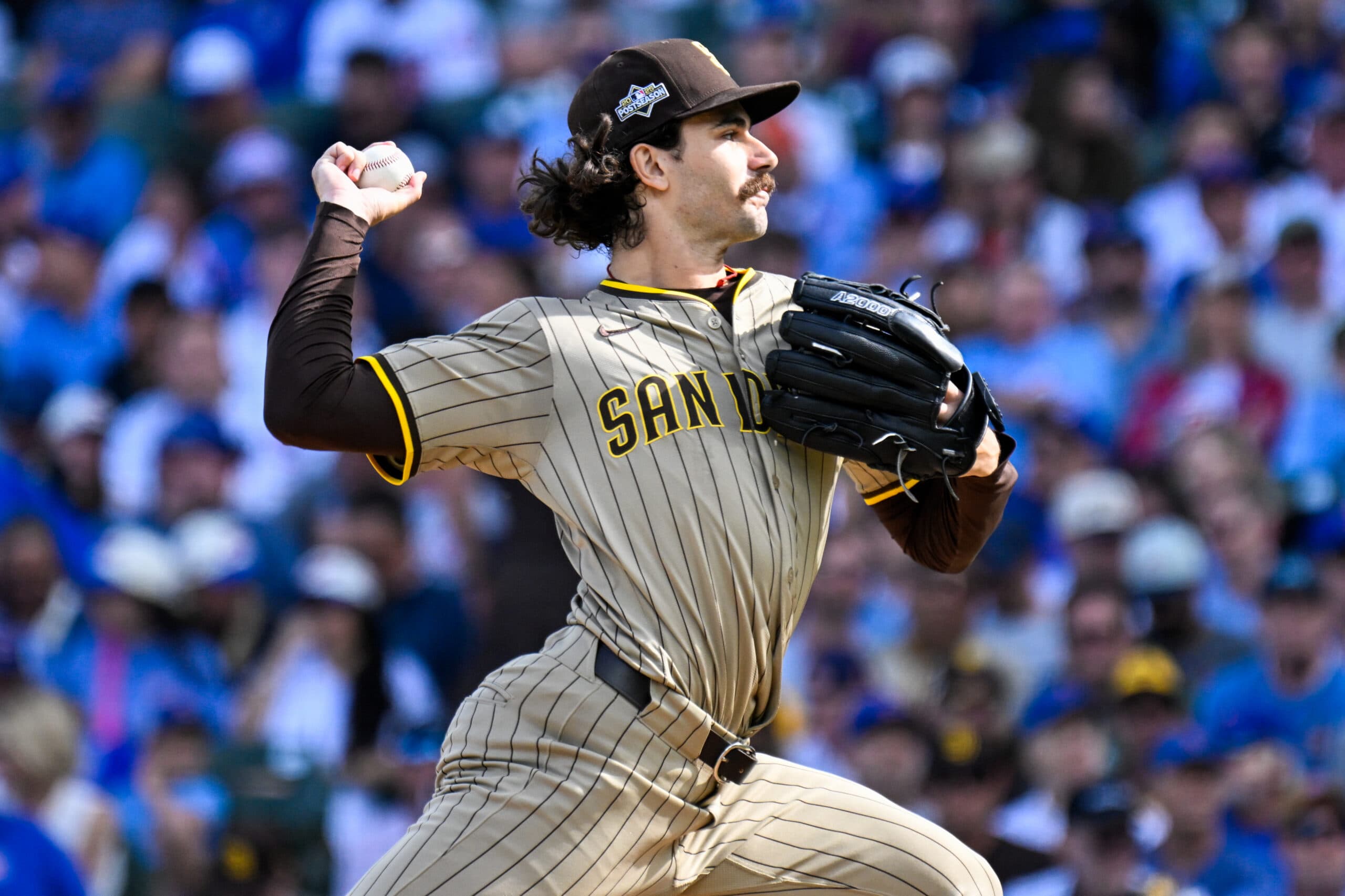
Photo credit: Matt Marton-Imagn Images

By Thomas Hall
Dec 2, 2025, 16:30 ESTUpdated: Dec 2, 2025, 16:36 EST
After becoming the second-richest player in franchise history, behind only Vladimir Guerrero Jr. (14 years, $500 million), the Toronto Blue Jays need to help take free-agent starter Dylan Cease to the next level in the first season of his seven-year, $210 million contract.
The goal needs to be ensuring that Cease becomes a consistent front-of-the-rotation starter throughout his tenure north of the border. Granted, the 29-year-old has shown flashes of that potential over the years — he’s finished top five in Cy Young voting twice, including a second-place finish in 2022 — but has yet to be able to cobble together that dominance over multiple seasons.
That narrative needs to change starting in 2026, and the Blue Jays are now the ones tasked with that challenge.
They are, however, beginning with a strong foundation as they attempt to mould Cease into a formidable ace that can lead their staff moving forward, especially with Kevin Gausman and Shane Bieber both becoming free agents next off-season.
Cease already provides immense durability — leading the majors in games started (162) since 2021 — which, of course, is a trait highly valued by Toronto’s front office. But he’s also one of the game’s premier strikeout pitchers, punching out at least 200 batters in each of the previous five campaigns, racking up an MLB-high 1,106 in that span.
The newest Blue Jays hurler also features elite stuff via his six-pitch arsenal, headlined by his fastball-slider combination. If memory serves correctly, this organization successfully transformed another starter who thrived with that same one-two punch back in 2021 — left-hander and AL Cy Young winner Robbie Ray.
The seven-year MLB professional — whose seven-year contract, the richest signed by a free agent in franchise history, was made official on Tuesday — is said to be extremely motivated to unlock his full potential with Toronto this upcoming season. How both sides plan to accomplish that feat remains to be seen, though.
They’re keeping those details close to the vest, as you can imagine. But, according to reports, transforming Cease into a reliable front-line starter was a crucial element of this franchise’s pitch during free-agent negotiations. So, with that in mind, here’s a four-step guide on how they can help him achieve that goal.
Step 1: Make Cease’s Slider Elite Again
There’s probably no better place to start than right here. Let’s dive in.
In 2022, Cease’s slider was arguably the best pitch in baseball, leading the sport with its plus-35 run value. And it repeated that feat two years later, this time with a plus-25 run value. Where did it rank last season? Not first. Not second. Not even amongst the top 100 pitches in the majors. Instead, with a measly plus-four run value, it finished tied for 32nd among qualified big-league sliders.
That pitch remained Cease’s best weapon in ’25, as he utilized it 41 per cent of the time and induced impressive strikeout (37.5 per cent) and whiff rates (42.8 per cent). Having said that, it was nowhere close to being as effective as before, with opponents registering a .228 AVG and .374 SLG (.117 points higher from ’24) against it.
Part of that diminished effectiveness revolved around luck, or a lack thereof, given the identical hard-hit rates posted against Cease’s slider over the past two seasons — 34.5 and 35.3 per cent, respectively. But there’s more to this development than just batted ball misfortune. Pitch quality needs to be put under the microscope, too.
Case in point, Cease’s slider earned well-above-average Stuff+ ratings during his Cy Young-calibre performances in 2022 and ’24 at 125 and 121, respectively. Each of the following seasons, though, those figures fell to 115 — both representing his career low.
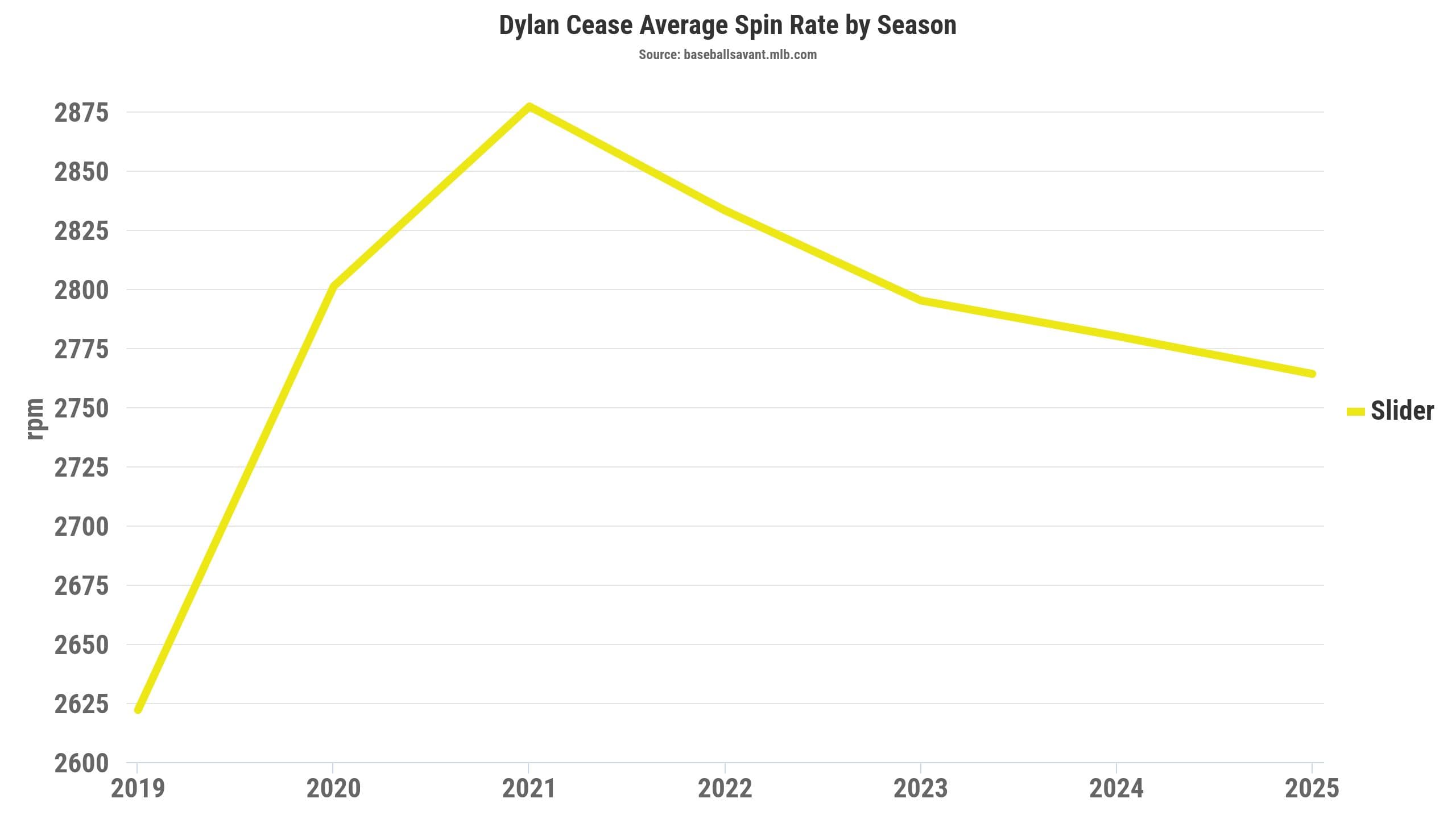
Another concerning development is that his slider produced its lowest average spin rate (2,764 RPMs) since his 2019 rookie campaign. As such, it’s gone from ranking second among qualified major-league sliders (min. 1,000 pitches thrown) to 12th in a span of just four seasons.
Source: Baseball Savant
The effectiveness of Cease’s slider is entirely tied to his ability to maximize how much spin it generates on each pitch. While it doesn’t rely on elite pitch movements, it certainly hasn’t helped that both its induced horizontal and vertical readings have gradually declined over the past few seasons, with each recording career lows in ’25 — 1.3 and 3.3 inches, respectively.
So, you can see why a metric like Stuff+ would be down on Cease’s slider heading into ’26. Considerable declines in spin rate, as well as pitch movements, all transpiring in the same season, will do that to any pitch — even an offering as elite as his primary breaking ball. But a few tweaks to its pitch velocity may offer a tangible solution to correcting these woes.
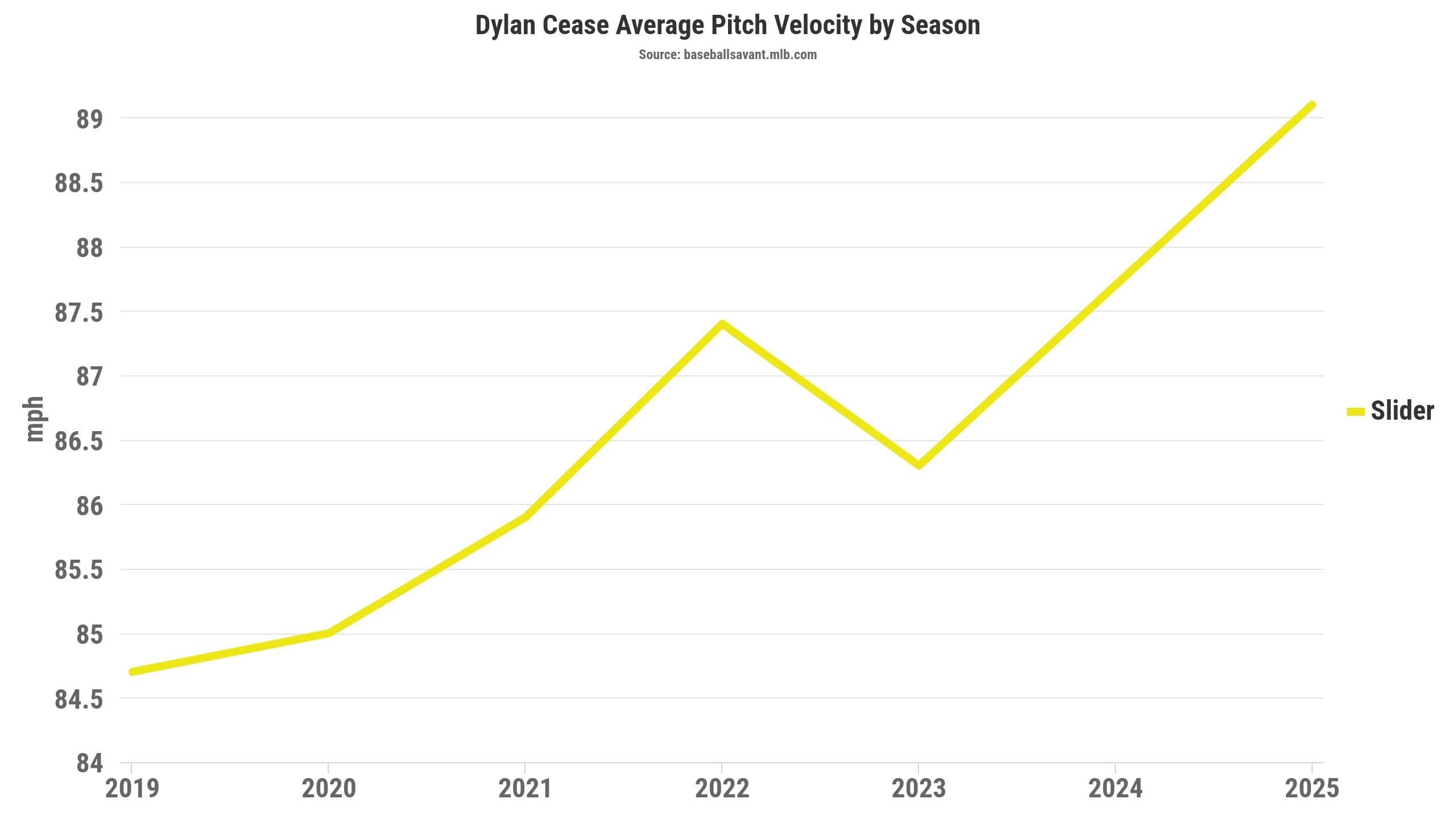
Despite the other red flags surrounding the right-hander’s slider, Cease still threw it harder than he ever has before, with it averaging a career-high 89.1 m.p.h. — placing it amongst the sport’s top 25 hardest sliders. Normally, that’d be a positive for most hurlers, but perhaps not for Cease.
Source: Baseball Savant
Cease will primarily operate as a two-pitch starter. He’ll also mix in his curveball and sinker, occasionally his sweeper and changeup, too — which is another issue in itself, but we’ll address that further down. For the most part, hitters will either face his fastball or slider, particularly in two-strike counts.
Because of that usage, more attention has to be paid to disguising Cease’s top two offerings. In past years, he’s had anywhere from 9 to 11 m.p.h. of velocity separation between those pitches, reducing the chances of them overlapping. Last season, however, the gap shrank to only 8 m.p.h. and often saw both draw even closer to each other’s velo.
Judging by previous seasons, Cease’s slider is at its best when it’s ranging between 86-87 m.p.h. rather than 88-89. If he can rediscover that happy place again, it should provide his premier swing-and-miss weapon additional time to complete its necessary revolutions and pitch movements, maximizing its position to succeed.
Step 2: Pair Cease With Alejandro Kirk
No disrespect to any of the catchers to come before Kirk in Chicago and San Diego, but Cease is surely in for a treat by having one of baseball’s top all-around catchers as his batterymate in ’26.
Only San Francisco’s Patrick Bailey (+79) has earned a higher fielding run value than Kirk (+61) since the start of ’22, with both topping the sport’s best defenders (regardless of position) in that span. So, that in itself presents as a major upgrade for Cease heading into next season.
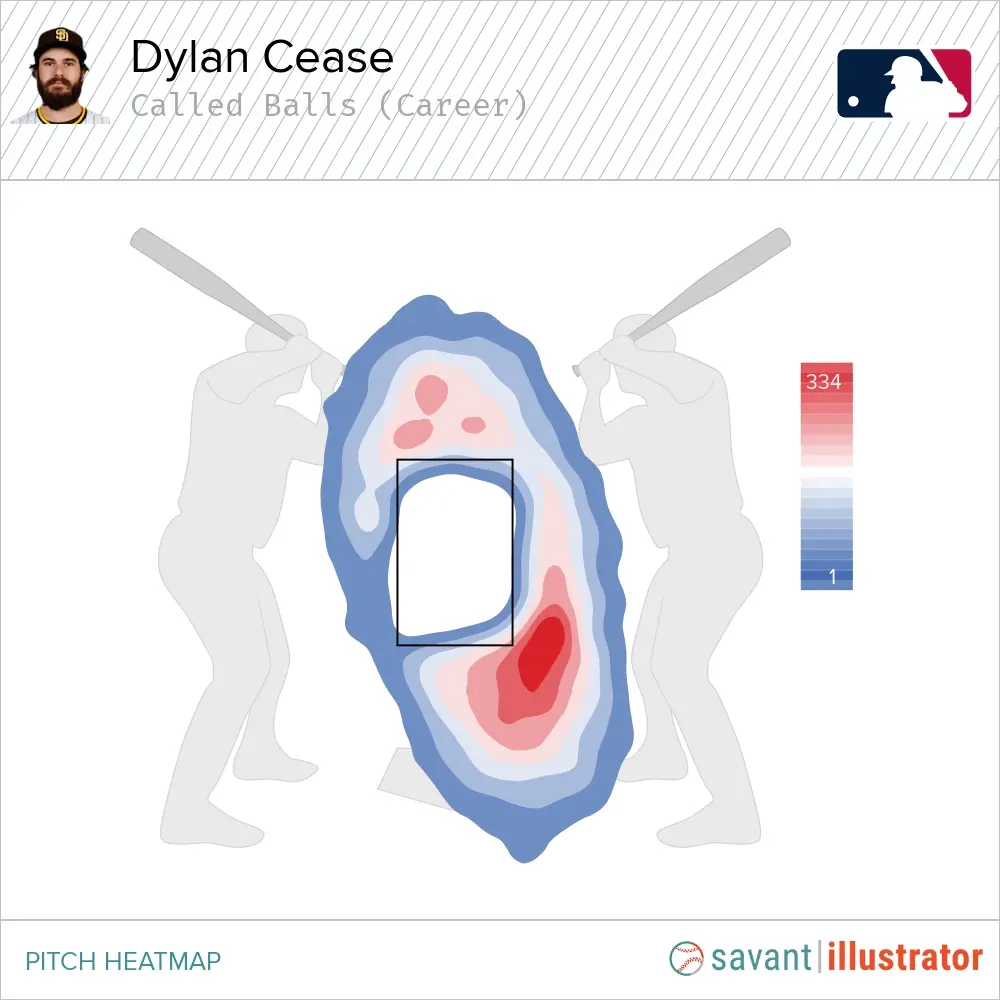
And where Kirk’s presence figures to have the biggest impact lies with pitch framing. Why is that? Well, just look at the image below. It illustrates where most of the balls have been called against Cease in his career. Notice how the majority of them are below the strike zone, often missing down and away to righties, and down and in to lefties — highlighted by that bright red cylinder-looking blob.
Source: Baseball Savant
With the automatic ball-strike challenge system (ABS) being introduced at the major-league level next season, it should help clean up plenty of the borderline calls that have previously impacted Cease’s command issues (25th percentile or worse walk rate in five of seven MLB seasons).
You could also argue that its arrival will greatly reduce the value of pitching framing. While that may eventually be true, most ABS challenges — with each club expected to receive two per game, as well as the ability to retain those challenges with successful outcomes — should be utilized to correct egregious calls and to question ones during pivotal counts.
Thus, that should allow elite pitch framers such as Kirk to continue to steal strikes moving forward. Considering he’s the best in the business at doing just that at the bottom of the strike zone — as he leads all big-league catchers in framing runs (29) in that quadrant since ’22 — there’s the potential for that ability to have a major impact on Cease’s frequency of creating count leverage.
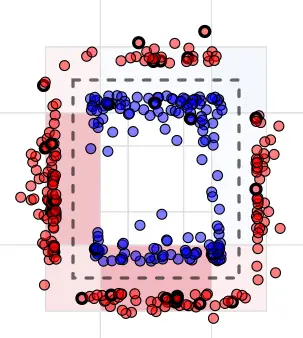
*catcher’s perspective* (red = called strike, blue = called ball)
In comparison, the Padres’ catching tandem of Martín Maldonado, Elias Díaz and Freddy Fermin were among the worst at stealing strikes at the bottom of the zone last season. As a team, they finished tied with the Washington Nationals for dead last in framing runs (-9) in that regard. Toronto’s catchers, meanwhile, placed second (+12) behind only the New York Yankees (+16).
But it isn’t just Kirk’s defence that Cease stands to benefit from next season. He’ll also receive impeccable defensive support from the eight players behind him, which was essentially nonexistent in San Diego in ’25, as his defence registered minus-seven outs above average — tied for eighth-worst among qualified big-league pitchers.
As a fly-ball pitcher, Cease, who’s induced more fly balls than ground balls in each of the previous five seasons, will be in much safer hands with a healthy Daulton Varsho roaming centre field next season.
Step 3: Increase Sweeper Usage Versus RHBs
Remember earlier when we put a pin in Cease’s secondary pitch usage? Now it’s time to unpack it.
The 6-foot-2 righty’s fastball-slider tag team has proved lethal in right-on-right matchups over the years. But, as most pitchers will admit, there’s always room to improve. In this case, it’s about developing a third weapon.
Overall, Cease has been punished by the third-time-through-the-order penalty, sporting a 5.33 ERA and 3.57 FIP in his career when facing a lineup for a third time. That’s the main reason he only lasted six innings or more in 11 of his 32 regular-season starts a season ago, and why he hasn’t pitched beyond the fourth inning in any of his five career post-season starts.
Cease needs to prove he can be trusted late in games, and versus right-handed batters, the solution to this dilemma may revolve around his underrated mid-80s sweeper. That pitch became a larger part of his repertoire in ’24, albeit marginally, with a similar trend unfolding in the first half of ’25. Then, suddenly, its usage rose above 10 per cent in the second half versus righties — who went 2-for-21 (.095) against it on the year, swinging and missing nearly 27 per cent of the time.
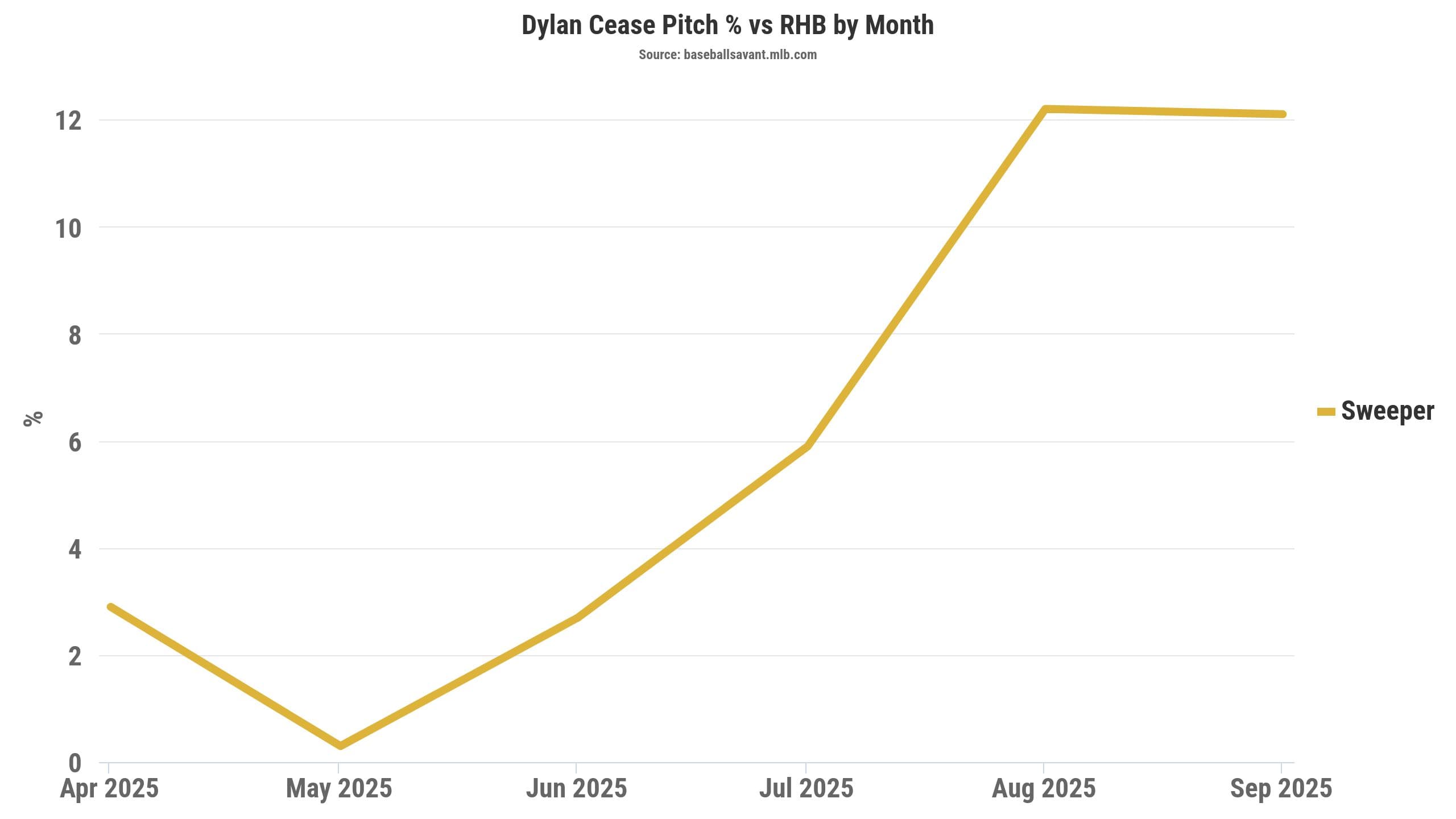
Source: Baseball Savant
Not only did Cease’s sweeper impress in limited performance results, but it also stood out from a pitch quality standpoint — producing the 13th-highest average spin rate (2,912 RMPs) among qualified big-league sweepers and nine more inches of induced vertical break than league average ones at comparable velocity.
Despite those encouraging pitch characteristics, he ended up throwing seven more sinkers — which opponents hit .440 against with a .680 SLG — than sweepers in these situations last season. Still, if his second-half adjustments carry over into next season, chances are it’ll continue on its trajectory to becoming his third-most-used pitch against righties.
Step 4: Develop More Dependable Third Weapon Versus LHBs
To further reduce the third-time-through-the-order risk against Cease, the Blue Jays will also need to help him make similar adjustments with his arsenal versus left-handed batters. While he appears to possess a hidden gem when the platoon advantage is in his favour, the same can’t be said when it favours the opposition.
Lefties improved from a .166 AVG and .276 SLG versus Cease’s slider in ’24 to a .244 AVG and .403 SLG last season, greatly emphasizing the need for a reliable third pitch in these matchups. Historically, that responsibility has fallen to his curveball, which did generate a 39.7 per cent whiff rate in ’25, but surrendered a .321 AVG and .536 SLG — and has allowed a combined .497 xSLG over the last three seasons due to poor command.
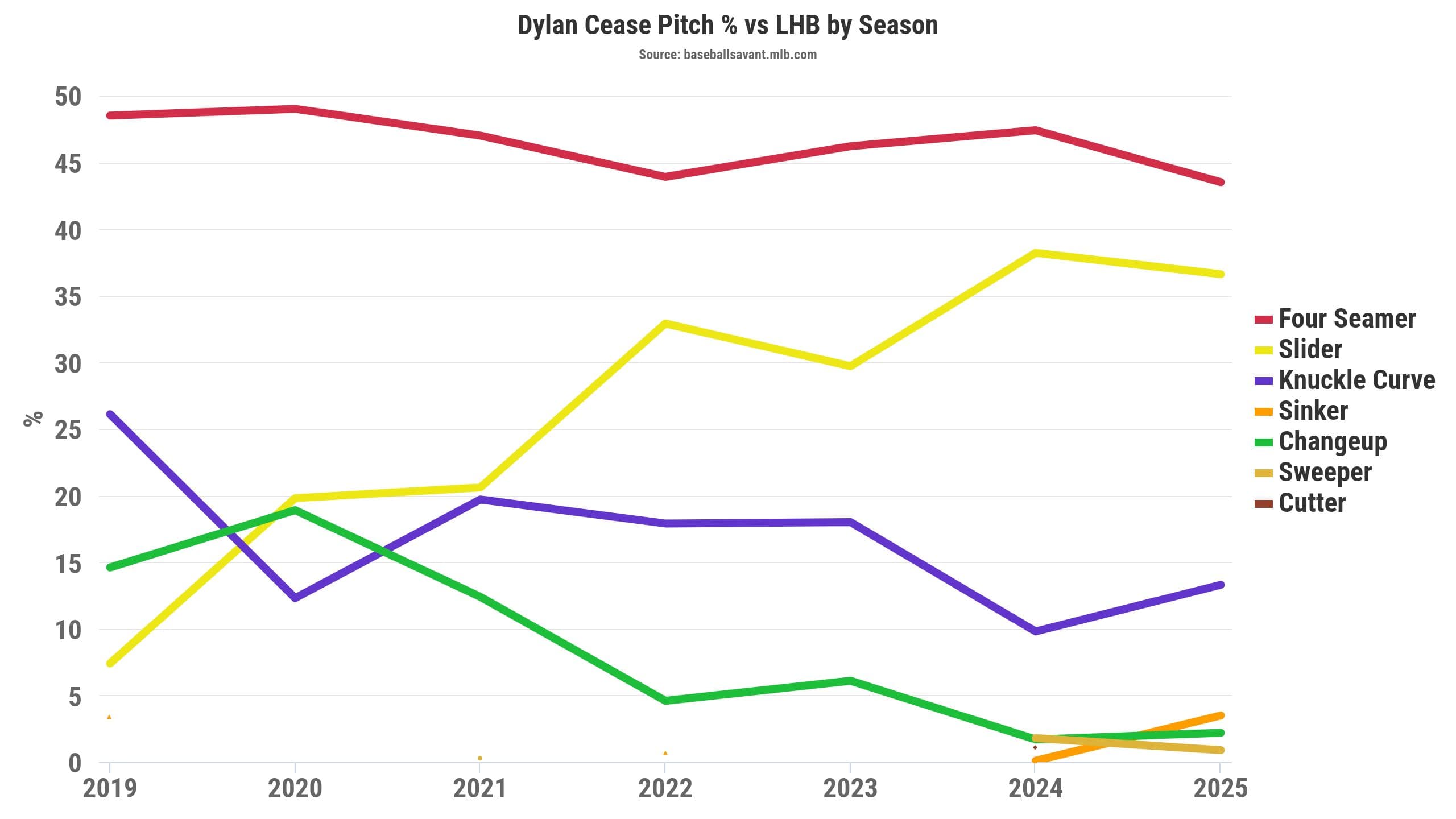
Source: Baseball Savant
The simplest way forward would be for Cease to better control his curveball, keeping it away from the heart of the plate more consistently. However, as his recent results and pitch heat maps prove, achieving that feat will likely be easier said than done next season.
While it’s conceivable that more sweepers may also help here, too, overhauling his current changeup or developing a splitter would allow him to attack the low-and-away quadrant of the strike zone more effectively against left-handed batters. And there are already a handful of pitchers on this roster who could help him learn a split (Kevin Gausman, Jeff Hoffman, Trey Yesavage).
As far as spring training storylines go, almost all the focus will centre around Cease’s arrival — barring any other headline-stunning acquisitions, of course — and whether he’ll showcase any new tricks from his toolbox, particularly versus lefties.
Recent articles from Thomas Hall
Breaking News
- Brett Bateman discusses his first big-league hit ‘just trying to get the barrel on the ball’
- Blue Jays sign three prospects in international free agency
- Jake Bloss tosses two scoreless frames in Arizona Fall League debut
- Blue Jays 2026 end of season Prospect Countdown: No. 15 Daniel Guerra
- Blue Jays’ Kazuma Okamoto named to Baseball America’s 2026 MLB All-Rookie Team