
Addison Barger: > 112.5mph double in Game 1... > 93.2mph avg exit velo this season (leads team) > 74mph avg bat speed (2nd on team) I'd like to see more of him.

Four Blue Jays hitters who must trust process over results amid offence’s struggles
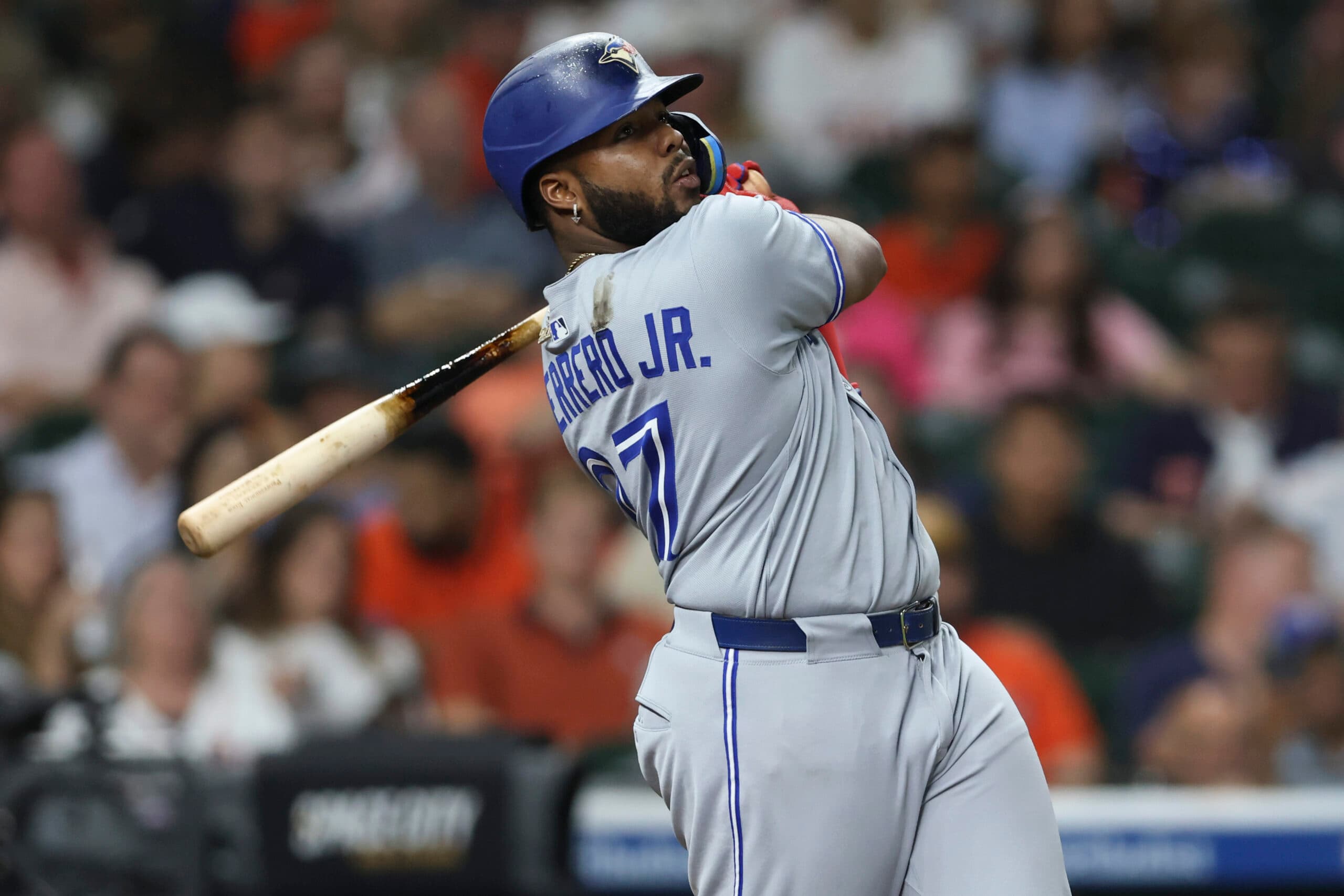
Photo credit: Troy Taormina-Imagn Images

By Thomas Hall
Apr 29, 2025, 15:00 EDTUpdated: Apr 29, 2025, 16:56 EDT
As you’ve probably heard, the Toronto Blue Jays have struggled to score runs this season, particularly lately.
Entering Tuesday’s series opener versus the Boston Red Sox, this offence sits tied with the Chicago White Sox for 26th in runs scored per game (3.39) — a concerning reality for any playoff hopeful — after only mustering nine total runs during their most recent six-game road trip through Houston and the Bronx.
Toronto’s power outage isn’t a secret at this point, as the lineup has produced the second-fewest home runs (15) in baseball, ahead of only the Kansas City Royals (13). Still, this is an offence that featured a 106 wRC+ over its first 22 games of the 2025 season, placing it six per cent above league average. The last six, however, have been so poor that they’re now seven per cent below league average with a score of 93.
For context, the only teams with a worse wRC+ include the Houston Astros (91), Texas Rangers (85), Los Angeles Angels (83), Pittsburgh Pirates (79), White Sox (77), Royals (72) and Colorado Rockies (65).
Amidst the Blue Jays’ current 2-7 skid over their last nine games, everyone is searching for any reason for optimism as pressure appears to be starting to mount for a struggling offence that has scored three runs or less in eight of the club’s previous 10 contests.
Nothing, of course, will be more reassuring than a dramatic uptick in offensive production. But your guess is probably as good as any in regards to when that might occur. When it does, though, the four hitters below could have a major impact on that surge — as long as they continue to trust their encouraging processes at the plate while waiting for the results to arrive.
Vladimir Guerrero Jr.
Guerrero Jr. has only homered twice in 28 games this season, slashing .272/.372/.388 with a respectable 125 wRC+ (100 league average). It’s an early-season stat line that most major league hitters would take in a heartbeat. For Vladdy, though, they’re below his elite-level standards.
But, then again, we have lived through this story before.
The 26-year-old superstar endured a relatively slow start last season, only hitting three home runs with a .229/.331/.347 slash line and 100 wRC+ across the first month of 2024. But then the calendar flipped to May, a month that kickstarted his eventual MVP-calibre performance with a .357/.447/.469 slash line and 168 wRC+ over a 25-game span.
The hope is that Guerrero can flip that switch for a second consecutive year in ’25. While that’ll likely be easier said than done, there are a handful of positives that we can draw from to suggest a return-to-form stretch may not be too far off in the distance.
For starters, balls have continued to explode off the four-time All-Star’s bat, as he’s generated a hard-hit ball (an exit velocity of at least 95 m.p.h.) on over half of his balls in play, with his 53-per-cent clip positioned in the 90th percentile of the sport. That’s to go along with his 94th percentile average bat speed of 75.7 m.p.h.
On top of his quality-of-contact metrics, Guerrero has been producing line drives at a higher clip than he ever has previously, resulting in a career-high 25.3 per cent rate. But he’s also been a tad unlucky on many of those liners, losing eight of his 25 total line drives to outs — seven of which were hard hit.
Because of examples like that, there’s a gap of nearly 100 points between Guerrero’s actual SLG (.388) and his expected SLG (.482). Granted, he’s historically been someone who’s underperformed his expected metrics due to the high amount of hard contact he generates. Still, such a sizeable difference like this one certainly appears abnormal and should normalize over a larger sample size — at least to some degree.
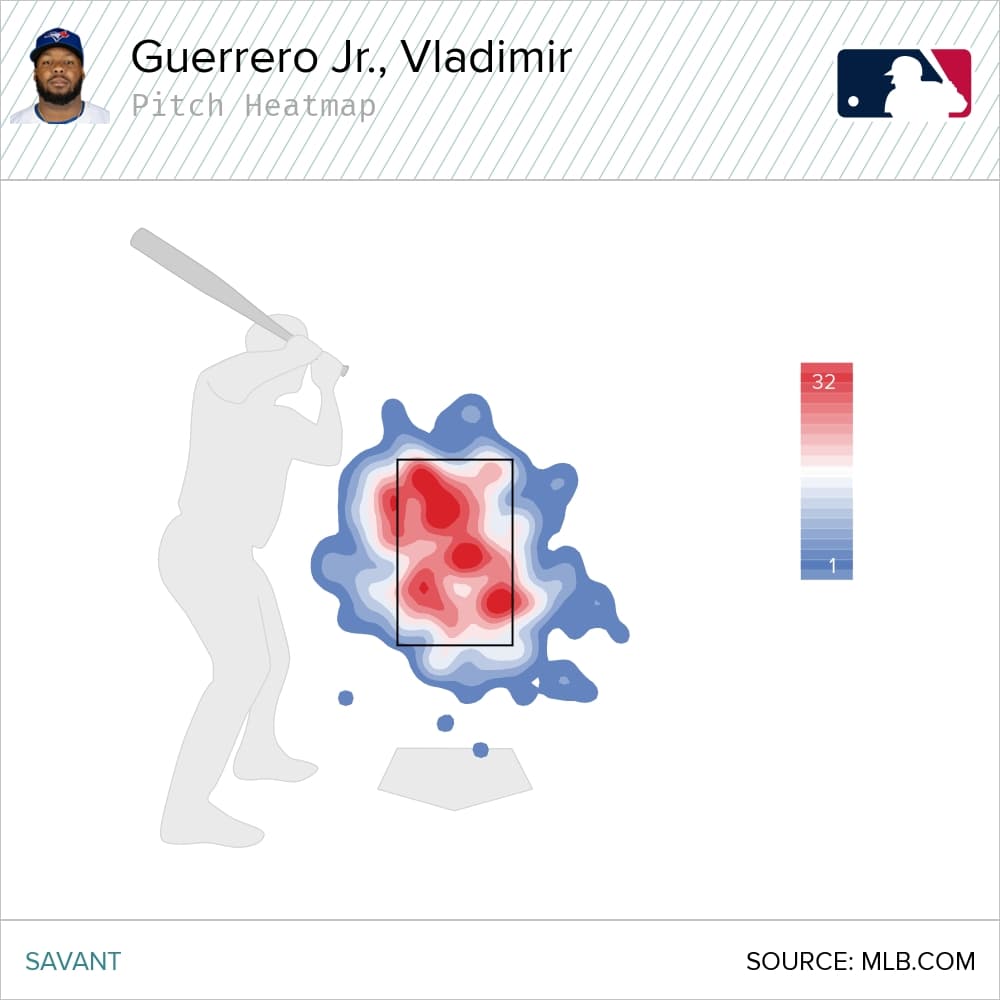
One way he could help speed up that process is by becoming a bit more aggressive in the batter’s box, given he’s been offering at pitches at a career-low swing rate of 42.7 per cent. That doesn’t mean expanding the strike zone like we’ve seen him do as of late, but rather looking to ambush pitchers a bit more, especially early in counts.
Needless to say, we haven’t seen enough of that type of game plan from Guerrero to this point, a sentiment further depicted by his ’25 swing heat map.
Source: Baseball Savant
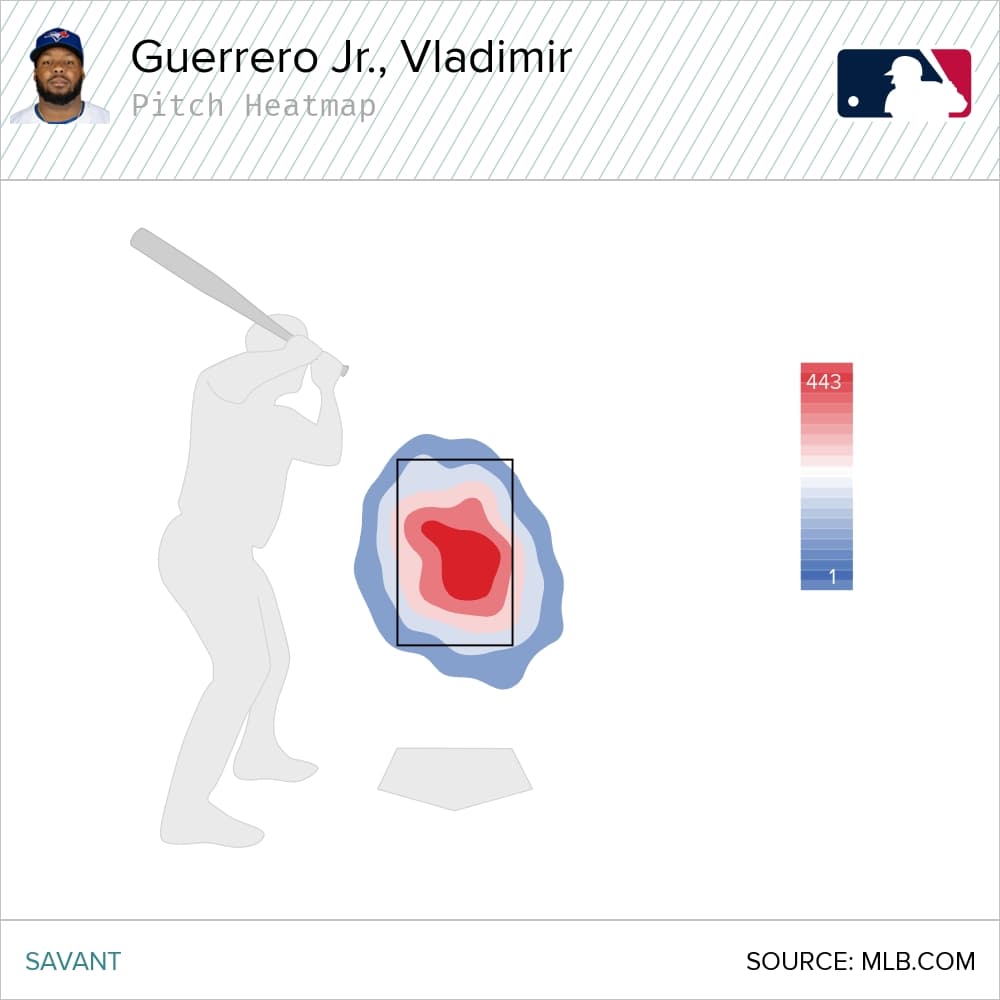
When you compare it to Guerrero’s heat maps from 2021 and ’24, it’s clear where he needs to target his sights more consistently moving forward — over the heart of the plate.
Source: Baseball Savant
Most of Guerrero’s positive regression will come through more favourable batted-ball fortune during the weeks/months ahead. That part is largely out of his control. But it’s proof that he needs to continue trusting his overall approach at the plate.
What he can control, though, is making a conscious effort to improve his swing decisions and pitch selection, which should further help get him back to the dangerous threat he was for most of last season.
Bo Bichette
Many believed Bichette’s remarkable showing in spring training would translate into a red-hot start to the regular season for Toronto’s cornerstone shortstop. But things haven’t played out that way early on, obviously, at least in the power department.
Of the 15 home runs this offence owns, zero have come from Bichette, who hasn’t homered since May 27, 2024 — a drought of 59 games. Despite the lack of thump, the 27-year-old has hit for a high average this season, posting a .292 clip thus far, which sat above .300 prior to the club’s recent road trip that included a 4-for-20 skid without an extra-base hit.
Results-wise, though, that’s where most of the positivity ends.
Bichette has never been someone with a high or even slightly modest walk output. But he’s taken that approach to a new level in ’25, as evidenced by his career-low 3.9 per cent walk rate (ninth percentile). The good news, however, is that his strikeout rate has also fallen to a career-low mark of 14.8 per cent (86th percentile).
Overall, there’s still his troubling 98 wRC+, placing him two per cent below league average. For the Blue Jays’ offence to ignite, they need him to get back to the 25-per-cent-above-league-average hitter he was from 2020-23. But like his close friend, Guerrero, he also features plenty of encouraging underlying metrics.
The most promising among them include his hard-hit (47.1 per cent) and line-drive rates (31.4 per cent, career-high). But he’s also been successful at maximizing his launch angle during each swing, producing a 45.1 per cent sweet-spot rate (a batted-ball event with a LA between eight and 32 degrees), ranking in the 97th percentile.
Though Bichette does his best work when he’s driving balls down the right-field foul line, he possesses a pulled air rate (any ball hit in the air) of 15.7 per cent this season — the second-highest of his career, excluding ’20.
If you combine all those elements, it should result in a ton of extra-base hits. And yet, Bichette’s SLG is currently at .358, 155 points below his .513 xSLG — the eighth-largest gap among qualified major league hitters.
That perfectly illustrates the type of unluckiness that has followed the two-time All-Star through the first month of the season. It also hasn’t helped that just over half of his 30 hard-hit fly balls and line drives have been recorded as outs rather than falling for hits.
For someone as motivated as Bichette — a pending free agent — to enjoy a bounce-back performance, there’s no evidence to suggest he won’t eventually shake off these early woes and begin to produce close to the level that saw him lead the American League in hits from 2021-22.
Alejandro Kirk
When it comes to lengthening Toronto’s lineup, look no further than Kirk.
The 26-year-old backstop entered this season as someone this team was counting on to provide depth contributions beyond the top three of Bichette, Guerrero Jr. and Anthony Santander. Like many, though, he’s still waiting for the results to show up.
It’s been a struggle for Kirk over his first 21 games, hitting one home run while slashing .241/.274/.316 with a measly 70 wRC+. Even more concerning is that he’s earned just three walks and struck out 11 times. If he were at his best, like he’s been in years past while controlling the strike zone and laying off borderline pitches, those numbers would likely be flipped.
Despite those woes, Kirk has still managed to create lots of hard contact, registering the second-highest hard-hit rate (46.4 per cent) of his career, excluding his brief big-league appearance during the shortened ’20 campaign.
Most of the increase he’s displayed has occurred against fastballs, with his hard-hit rate rising from 40.2 per cent in ’24 to 53.3 this season. That hasn’t translated into much power quite yet, though, as he’s slugged just .294 versus heaters — a gap of nearly .90 points from his .380 xSLG. Granted, the difference between those two would be even higher if half of his 30 batted-ball events weren’t in the form of ground balls.
Nevertheless, it still serves as a bit of optimism that Kirk is due to receive an uptick in production against four-seamers, sinkers and cutters over a larger sample size.
To take a significant leap forward, however, Kirk — whose 80.3 per cent contact rate is the lowest of his career — has to put more balls in play and cut down the whiffs (22.4 per cent, career-high) and chases (31.7 per cent, career-high).
Addison Barger
For a lineup searching for power, Barger’s hard-hitting skill set is precisely what this ailing Blue Jays offence needs, even if the results have yet to materialize for the 25-year-old slugger.
That was certainly the case out of the gate, as he went 1-for-17 during his first seven games after being recalled from triple-A Buffalo on Apr. 15. But the left-handed-hitting outfielder only struck out four times over that span, cutting down the swing-and-miss that plagued him for much of his big-league stint last season.
Barger’s quality-of-contact metrics were another encouraging sign, with six of his 13 balls in play coming off his bat at 95 m.p.h. or harder. And that underlying success finally paid off over the weekend versus the Yankees, resulting in a pair of multi-hit performances, including a 112.5-m.p.h. double.
For reference, no other Blue Jays hitter outside of Guerrero — whose 120.4-m.p.h. groundout stands as the hardest-hit ball in the majors in ’25 — has hit a ball harder than Barger this season. It’s also worth noting that his 75.1 m.p.h. average bat speed ranks second on the team, trailing, well, none other than Guerrero.
It’s all about finding sufficient playing time for Barger, which will largely have to come at third base rather than in a crowded outfield following Daulton Varsho’s return from the IL.
Recent articles from Thomas Hall
Breaking News
- 5 Blue Jays named 2026 American League Gold Glove finalists
- Blue Jays: Yohendrick Piñango and three others set to play in Venezuelan Winter League
- Blue Jays free agent target: Randy Arozarena
- Vladimir Guerrero’s struggles were emblematic of the Blue Jays’ 2026 season
- Blue Jays’ Yariel Rodríguez set for take part in Puerto Rico Winter League