
Jake Bloss' early-season woes continued this afternoon with AAA Buffalo. 2.2 IP, 5 H, 7 R, 3 BB, 4 K & 65 pitches (39 strikes) It was smooth sailing until Syracuse's 7-run 3rd inning, which included back-to-back HRs off Bloss. #BlueJays

Jake Bloss unable to snap early-season woes in latest start, increasing concerns surrounding Blue Jays’ lack of MLB-ready arms

Photo credit: Nathan Ray Seebeck-Imagn Images

By Thomas Hall
Apr 16, 2025, 13:00 EDTUpdated: Apr 16, 2025, 13:26 EDT
It’s been a rough start to the 2025 season for right-hander Jake Bloss, who, through three starts, now carries a troubling 10.32 ERA to begin the year.
Poor weather conditions caused by a late spring haven’t made things easy for the struggling 23-year-old hurler. Nor have the Buffalo Bisons’ early-season defensive woes, which led to half of the 12 runs against him over his first two starts being unearned. Still, surrendering six earned runs across a pair of outings — neither of which spanned at least five innings — isn’t ideal, either.
So, heading into Tuesday’s matchup against the Syracuse Mets — New York’s triple-A affiliate — Bloss was aiming for a return-to-form performance. Despite an encouraging start to the contest, the Toronto Blue Jays’ No. 6 prospect per MLB Pipeline endured his shortest start of the young season, departing after only 2.2 innings of work.
Bloss got rolling early, retiring five consecutive hitters — three via strikeout — after allowing a leadoff single in the bottom of the first, with catcher Ali Sánchez neutralizing that baserunner on a stealing attempt later in the inning. Through two scoreless frames, it seemed this would be the bounce-back outing the young righty needed following a pair of clunkers.
But all that optimism came apart amidst a seven-run third for the triple-A Mets — with all seven charged to Bloss.
It quickly became a loud-sounding hitting display for Syracuse’s lineup, as they began the inning with three straight hits — all producing an exit velocity over 100 m.p.h. — including back-to-back home runs. Unfortunately, the damage didn’t stop there for Bloss, who loaded the bases with two outs through a pair of walks and another hard-hit single before walking in a run on his third free pass of the contest, signalling the end of his afternoon.
The former Houston Astros prospect — acquired by Toronto as part of the return from last summer’s Yusei Kikuchi trade — was lifted after throwing his 65th pitch, leaving the bases loaded as Paxton Schultz entered from the bullpen. But he allowed three more runs to cross before the inning mercifully concluded.
Once the dust settled, Bloss’ third start consisted of seven runs (all earned) on five hits and three walks while striking out four over 2.2 innings. Of the eight balls put in play against him, six came off the Mets’ bats at 99 m.p.h. or higher, with five occurring in the third inning.
Among the most concerning signs thus far has been Bloss’ command, given that he’s issued nine walks — two-thirds of them have been against his four-seamer — and surrendered a trio of home runs over 11.1 innings pitched, inflating his FIP to 8.14 through three starts.
The right-hander’s ineffective primary fastball is largely to blame for those woes, as opponents have slashed .400/.538/.600 against it this season, including Tuesday’s 4-for-9 showing. But he also hasn’t enjoyed much success with his slider, which has allowed a .444/.450/.889 opposing slash line and a hard-hit rate against north of 50 per cent.
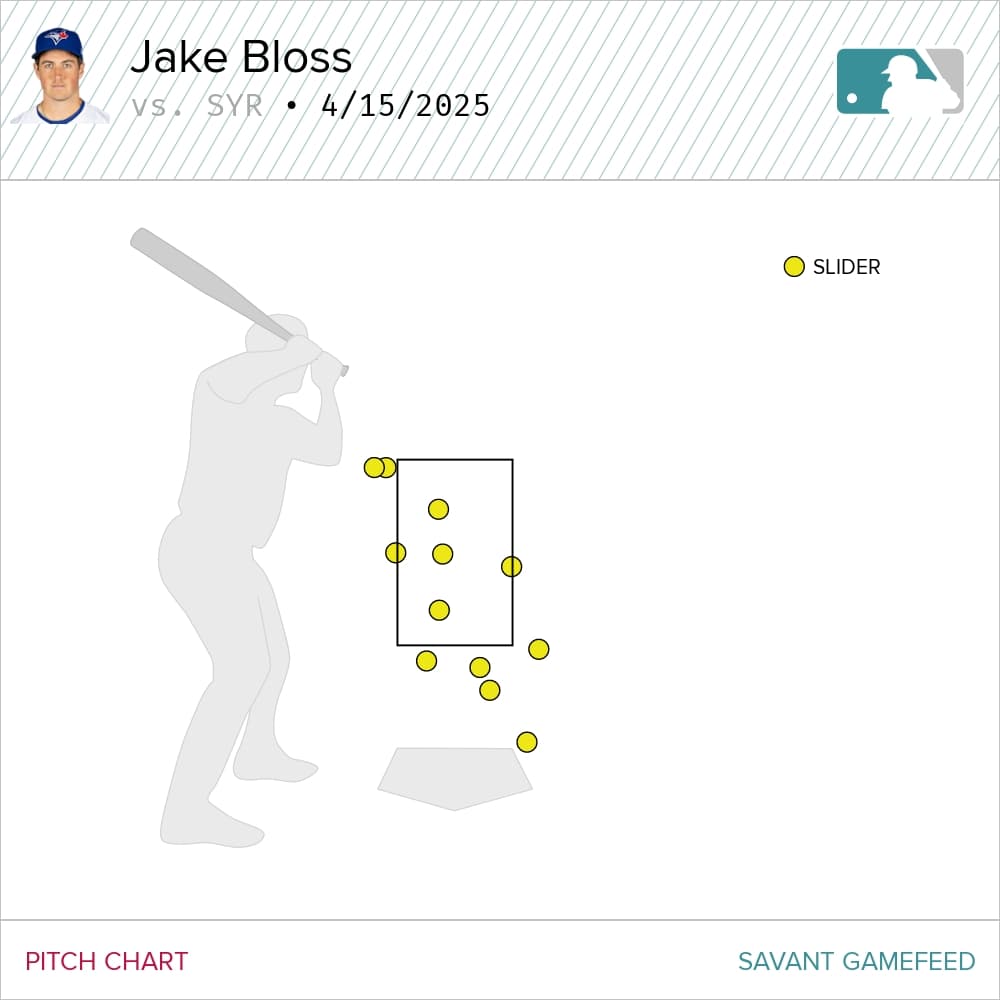
And, as you can gather from the chart below, Bloss had a tough time locating his breaking ball — responsible for half of the hard-hit balls against him — on Tuesday versus Syracuse.
Source: Baseball Savant
Of course, we’re only three starts into Bloss’ third professional campaign, his second full year since being selected in the third round of the 2023 draft. So, there’s still plenty of time to get this train back on track. However, these early-season struggles have been extremely disappointing compared to his final two spring training starts, where he struck out nine and only allowed one walk over five innings of two-hit ball.
But it wasn’t just the results that stood out for Bloss near the end of camp, whose final official appearance came during the organization’s Spring Breakout game versus the Minnesota Twins on Mar. 15. It was his fastball velocity, too, which sat in the 95-96 m.p.h. range and repeatedly touched 98 — a significant step above his 92.8 average to start this season.
The plan coming into the year for Bloss was to bring him along slowly after he climbed three minor-league levels (high-A, double-A, triple-A) before making a trio of major-league starts for Houston last season. At the same time, though, he was also expected to play a crucial role for Toronto as part of its immediate starting pitching depth — plans that have likely since changed.
Just over two weeks into the ’25 season, the Blue Jays’ starting pitching options beyond the major-league level have become even more uncertain than prior to Opening Day, leaving them without an injury-related safety net.
There are plenty of promising cases at the lower levels of the minors, headlined by a pair of 2024 draftees in Trey Yesavage and Khal Stephen at single-A Dunedin, along with Juaron Watts-Brown, Kendry Rojas and Fernando Perez at high-A Vancouver. But the pipeline is rather thin at the upper levels, especially with the likes of Alek Manoah (Tommy John surgery), Ricky Tiedemann (TJ surgery), Adam Macko (torn meniscus), Chad Dallas (TJ surgery), and Adam Kloffenstein (shoulder) currently on the mend.
Losing Max Scherzer (right thumb) to an early-season IL stint put this club in a difficult spot, an obstacle they’ve been able to overcome in the short term due to the surprising emergence of left-hander Easton Lucas, who, outside of his latest outing, had been remarkable across his first two career major league starts.
But what happens if Lucas’ negative regression carries over into his next start, the one after that and the one after that? Where will the Blue Jays turn then, or if another starting pitcher suffers an injury? It almost certainly won’t be Scherzer coming to the rescue, considering he still needs to meet with another hand specialist before building back up as a starter.
Thus, with Bloss off to a horrendous start this season, Toronto appears to be one move away from having to call upon veteran Eric Lauer — who owns an ERA close to seven in three starts with Buffalo this season — or prospect Lazaro Estrada, a 25-year-old righty with just two career triple-A starts under his belt.
Neither of those options would be ideal for the Blue Jays, especially with how heavily they’ve relied on the success of their starting pitching early on, which means keeping their current starting five as healthy and effective as possible will be vital moving forward.
Recent articles from Thomas Hall
Breaking News
- Trade Tree Thursday: Examining how the Blue Jays got MVP-winning Josh Donaldson
- Despite early injury, Alejandro Kirk remained a focal point of the Blue Jays’ success in 2026
- Blue Jays free agent target: Gleyber Torres
- Blue Jays’ Dylan Cease nominated for MLBPA’s outstanding pitcher award
- 5 Blue Jays named 2026 American League Gold Glove finalists