
Jesus Sanchez has joined his new teammates here at the #BlueJays PDC

Reasons to believe Jesús Sánchez can exceed expectations this season
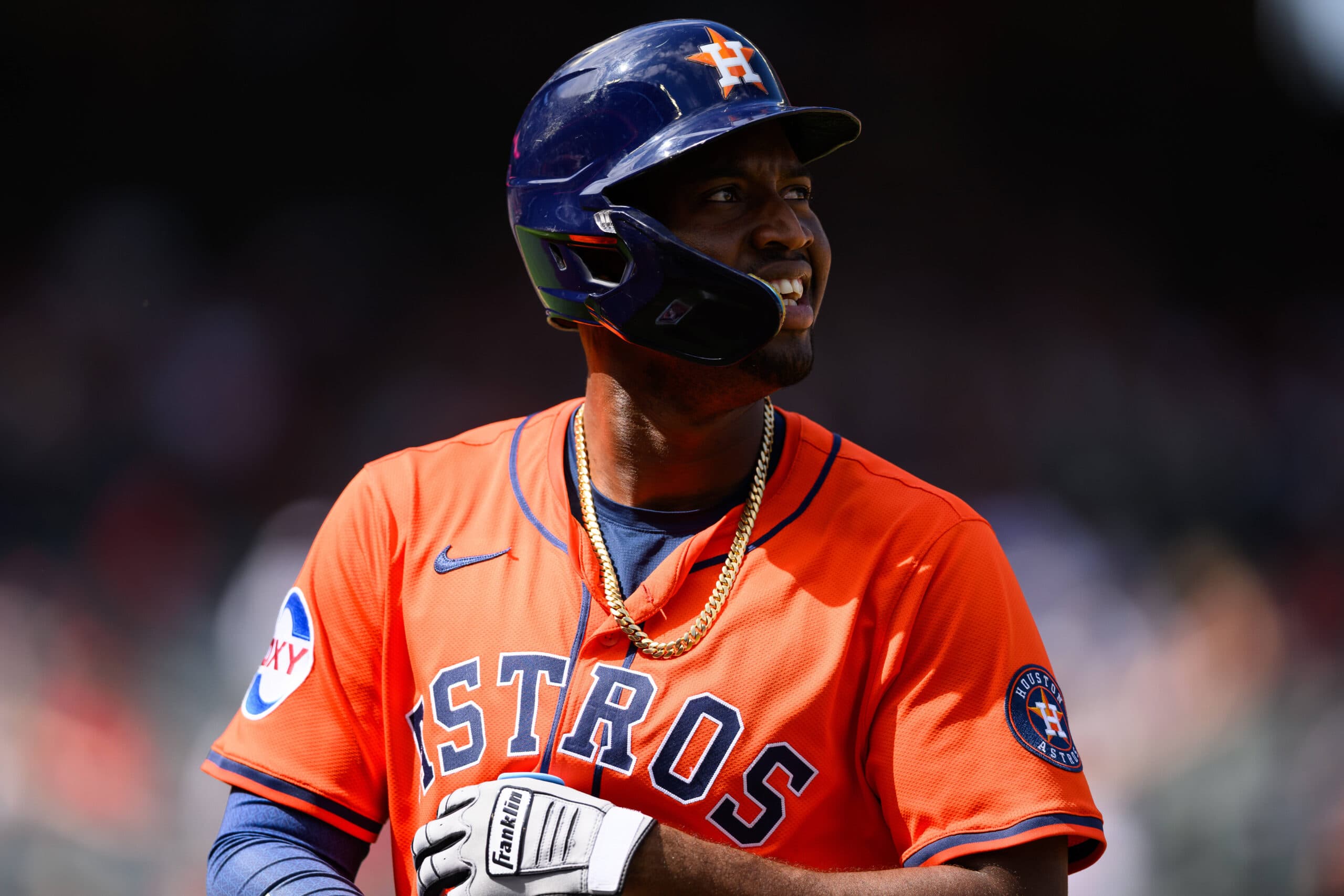
Photo credit: William Liang-Imagn Images

By Thomas Hall
Feb 17, 2026, 15:30 ESTUpdated: Feb 18, 2026, 10:18 EST
In six major league seasons, outfielder Jesús Sánchez — who first emerged as a left-handed-hitting slugger with the Miami Marlins in 2021 — has yet to reap the full benefits of his offensive skill set across an entire season. But now that the 28-year-old has been granted a change of scenery, landing with the reigning American League champions, perhaps he can unlock the best version of himself in ’26.
It’s a gamble the Toronto Blue Jays brass certainly felt comfortable making, or else they wouldn’t have facilitated the Houston Astros’ salary-dump outfielder swap of Sánchez for Joey Loperfido last week.
With this early-spring trade, the organization is mortgaging Loperfido’s long-term potential — a low-cost asset with five additional seasons of club control — in favour of short-term certainty in Sánchez, who features another arbitration-eligible season in 2027 before hitting free agency. It provides this lineup, now without Anthony Santander (left shoulder surgery), with a known commodity that can help address a particular need — power.
While risky, especially when it involves parting with a high-upside prospect in Loperfido, this is the type of all-in move that can often become necessary for teams with World Series aspirations. Granted, Sánchez isn’t coming off a banner year, largely due to his miserable post-trade deadline transition to Houston, which included four home runs, an abysmal .199/.269/.342 slash line and 71 wRC+ (100 league average) in 48 games.
Despite that miserable showing, Toronto’s front office already knows what it has in Sánchez — a power-thumping, middle-of-the-order lefty bat that can help replace Santander’s production.
Of course, Loperfido could ultimately develop into that type of hitter, but the Blue Jays couldn’t afford to leave anything to chance. Following the loss of Santander and the off-season departure of franchise cornerstone Bo Bichette, they needed a big-swing move with certainty like this to ensure their offence doesn’t take a significant step backwards this season, and that’s precisely what Sánchez offers.
He’ll pack quite a punch from the left side.
Sánchez’s biggest strength is his effectiveness against right-handed pitchers. Given how successful the Blue Jays were at maximizing the platoon advantage last season, the 6-foot-4 slugger should perfectly complement how this offence flows, as evidenced by the 37 home runs, .272/.340/.465 slash line and 119 wRC+ he’s posted in 1,053 plate appearances versus righties from the start of 2023 to his pre-Astros tenure.
Toronto now possesses a pure righty masher in Sánchez, whose offensive value comes exclusively as a platoon hitter. That’s one of his primary certainties. Another is that he swings and hits balls hard, with his average bat speed placing in the 90th percentile or higher over the last two seasons, and his max exit velocity achieving that mark in all but one of his six big-league campaigns.
Even with his forgettable performance in Houston, the hard-hitting lefty still managed to produce above-average quality-of-contact metrics, as his barrel rate (11.1 per cent) and average exit velocity (91.3 m.p.h.) placed in the 68th and 79th percentiles, respectively.
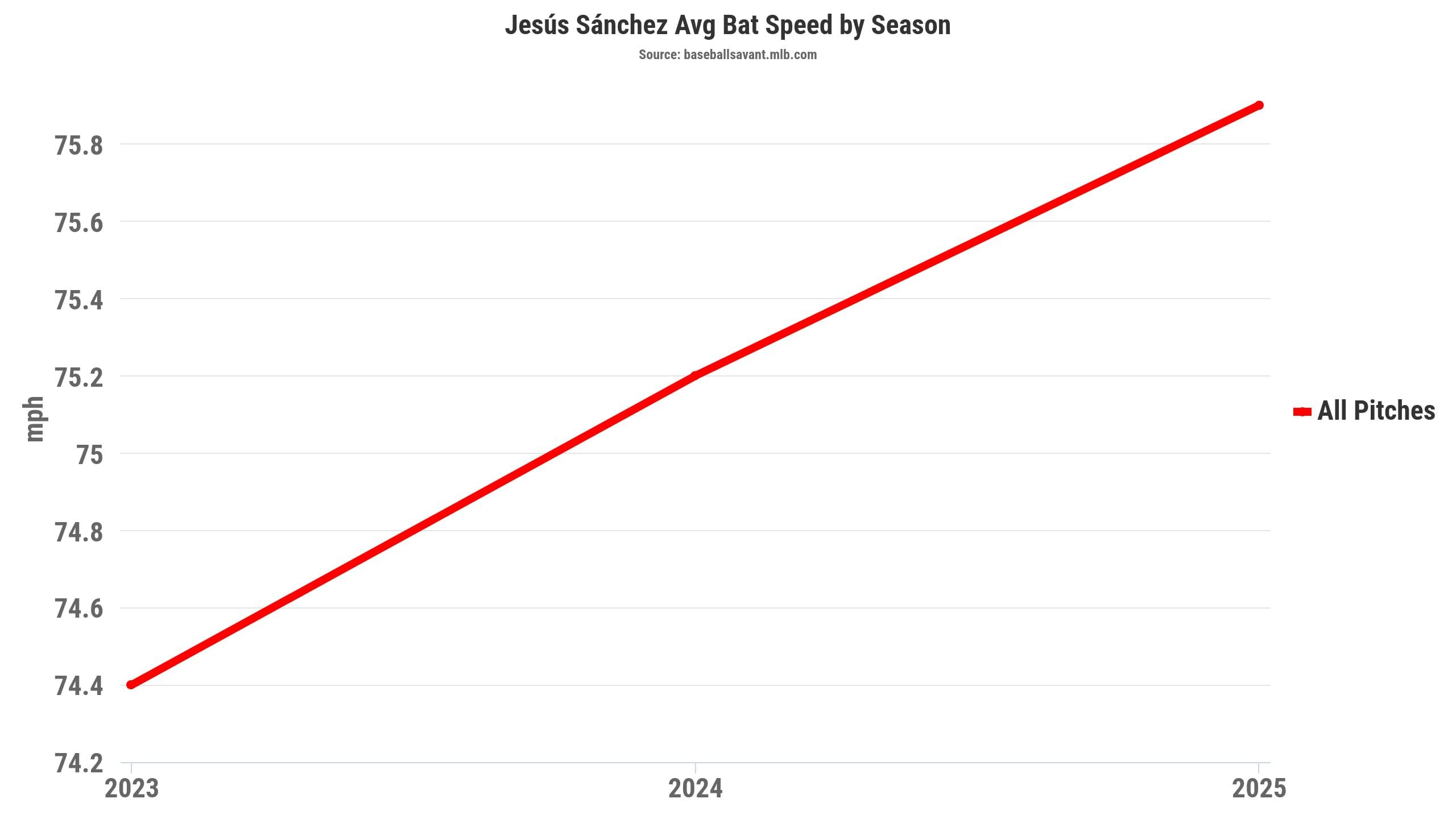
Two years ago, Sánchez’s Baseball Savant player card was covered in bright red, led by his 95th percentile hard-hit rate (51.3 per cent), serving as his best career performance to date. Last season, meanwhile, featured flashes of that ceiling, but largely resembled his floor. That means there’s likely room for growth here, especially if his recent trend of increased bat speed continues in ’26.
Source: Baseball Savant
Sánchez recorded the fastest average bat speed (75.2 m.p.h.) of his career last year, at least since tracking began during the 2023 season, improving it by 0.7 compared to his ’24 reading. Despite that increase, he greatly underperformed his expected results, which he’s done in each of the last two seasons.
Many fellow elite quality-of-contact hitters suffer the same problem. Vladimir Guerrero Jr., who routinely underperforms his expected results, is a perfect example of that. For Sánchez, however, that meant the difference between being “really good” instead of “great” against right-handers during his career year two seasons ago.
Last year, with his actual .421 slugging percentage versus righties coming up well short of his .467 xSLG, the gap between mediocre and good was understandably much thinner.
Heading into this season, continuing to trust the process will be crucial for Sánchez. At some point, luck will start to turn in his direction and help balance out his actual and expected results — and perhaps this is the year where it all comes together, particularly if his quality swing decisions from last season carry over into Year 1 with the Blue Jays.
Sánchez pulled off the trifecta of plate discipline in 2025. He lowered his strikeout (22.1 per cent, career best), whiff (25.9 per cent) and chase rates (30.6 per cent) a season ago. In fact, out of 175 qualified hitters, only eight enjoyed a larger year-to-year whiff rate reduction than the former Marlins thumper, who submitted a 5.3-per-cent improvement.
On top of displaying improved plate discipline, the Dominican-born outfielder also made more contact than he ever has previously, excluding the minuscule 10-game sample size from his 2020 COVID-shortened rookie campaign, posting career-highs with both his contact (75.2 per cent) and zone-contact (85.8 per cent) rates.
There’s plenty worth betting high on here.
Between Sánchez’s elite bat speed and hard-contact output, career-best plate discipline and refined bat-to-ball skills, you can see why Toronto’s brass feels his hitter profile is a worthwhile gamble. He has all the makings of being an impact platoon hitter for this team, especially as he joins an offensive environment that figures to be more conducive to his left-handed power stroke.
Houston’s Daikin Park wasn’t a strong fit for Sánchez, who hit all but one of his 14 home runs last season to either right or centre field, and is at his best when driving balls to the pull side. As a lefty, he rarely benefited from the Crawford Boxes in shallow left field, which offer a home-field advantage for Astros right-handed batters.
Whether that element played a major role in Sánchez’s disappointing transition remains unclear. But it certainly didn’t help, especially in a year that saw him produce an improved 16.9 per cent pull air rate (includes fly balls, line drives and pop-ups) — the highest clip of his career since 2022.
It’ll be interesting to see how Sánchez adapts to Rogers Centre, which has played a bit more pitcher-friendly in recent years, earning a 98 park factor (100 league average) for lefty hitters since 2023. For someone who pulls batted balls as often as he does, though, the cutout down the right-field line, lowering the outfield wall’s height slightly below 11 feet, could push out a few extra fly balls that would’ve previously been outs.
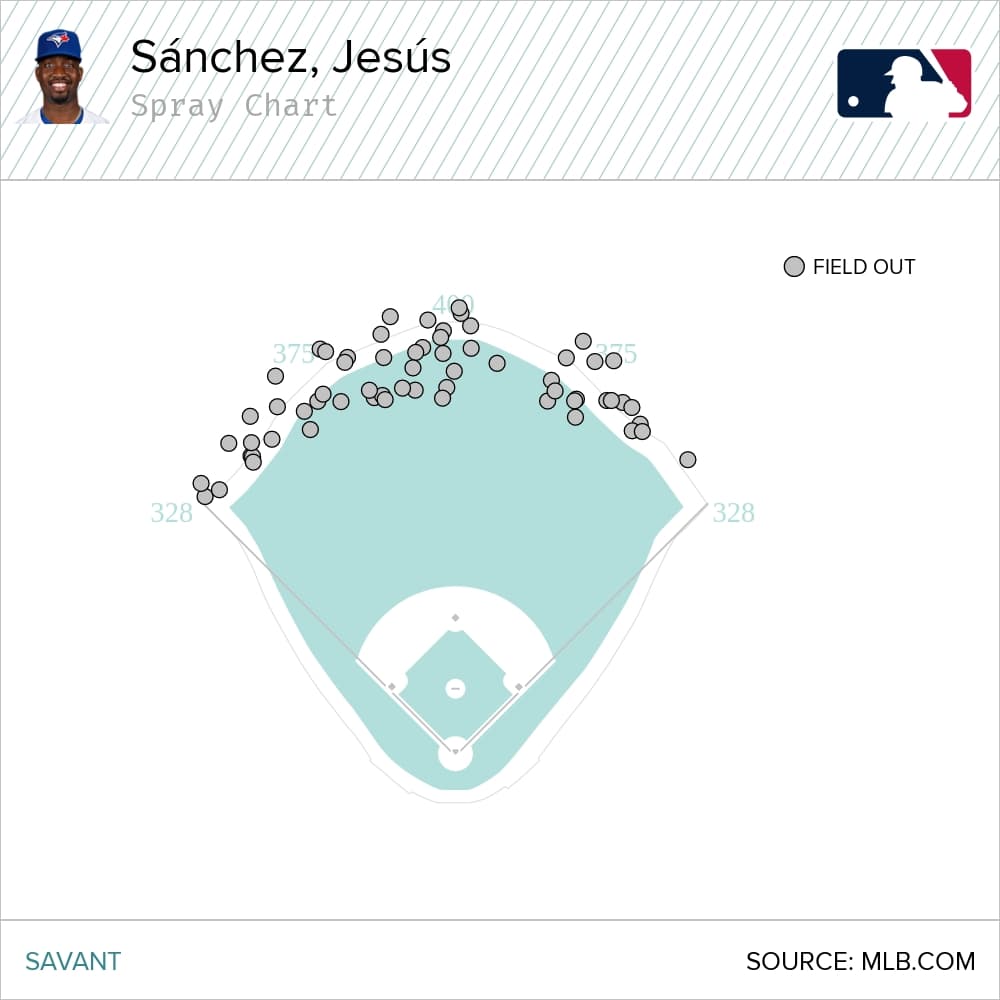
Take a look at the chart below. Every grey dot represents an out that Sánchez has recorded off a right-handed pitcher since 2023, with each ball travelling at least 320 feet — and the field dimensions have been set for Rogers Centre. As you can see, many of those outs would’ve left the yard or likely hit off the wall had he played every single game in Toronto.
Source: Baseball Savant
But it’s not just in Toronto where Sánchez’s production could witness a noticeable jump. Playing in the hitter-friendly confines of the entire AL East should help, too. Fenway Park, for example, is considered the second-best environment for left-handed batters of all 30 ballparks outside of Coors Field, thanks to its 107 park factor.
Yankee Stadium, of course, is perfectly tailored for pull-heavy lefties with that short porch in right field, despite the ballpark’s neutral 100 park factor. Camden Yards, positioned slightly higher on the park factor leaderboard with a 102 score, may also serve as an advantage for Sánchez this season.
For the most part, Sánchez has barely been exposed to the AL East’s hitter-friendly environment in his career, possessing fewer than 100 career road plate appearances against those five interleague opponents with the Marlins. Now with the Blue Jays, he’ll be a regular guest at those venues, putting his skills to the test to see how well they’ll be able to contain his left-handed stroke.
Most, if not all, of the attention surrounding Sánchez will focus on whether he can exceed offensive expectations this season. But he may surprise folks with his defence, which can include a stinker or two, but has the potential to be a difference-maker due to his exceptional arm strength — placed in the 80th percentile (88.9 m.p.h.) in ’25.
While Sánchez’s range graded below average with minus-one outs above average over 977.2 innings last season, his brief tenure in centre field (-3 defensive runs saved, -2 OAA) primarily contributed to that poor showing. He’s much better suited in the corners, where he owns plus-11 DRS and plus-five OAA across 2,777.2 career innings in right, as well as plus-five DRS and plus-one OAA in 582.2 career innings in left.
Based on the 29 bases he’s stolen over the last two seasons, which would rank second on the Blue Jays, behind only George Springer’s 34 during that span, there may also be an opportunity for his arrival to add a bit more speed on the bases for this team — definitely more upside than what Santander could offer with only 10 career stolen bases.
Supplying additional defensive and baserunning value would be like putting a cherry on top of a delicious sundae. It looks nice, but it isn’t entirely necessary. This is all about Sánchez’s bat, after all. Nothing else truly matters beyond that.
Sánchez has already established his base-level expectations for this season, and the Blue Jays are counting on him to deliver. That’s the bare minimum. If he carries over “The Good” from last season, though, he has a real shot at soaring past the bare minimum.
Recent articles from Thomas Hall
Breaking News
- Blue Jays’ Brett Bateman compliments Toronto’s veterans for making him feel comfortable right away in majors
- Blue Jays’ Myles Straw praises Toronto’s market ‘no better place to play baseball’
- How the Toronto Blue Jays should approach free agency this offseason
- Blue Jays’ Davis Schneider reflects on difficult 2026 campaign ‘wasn’t performing the way I wanted to’
- How the 5 Blue Jays 2026 UDFAs fared in their professional debuts