
Six potential trade targets as Blue Jays seek catching partner for Alejandro Kirk
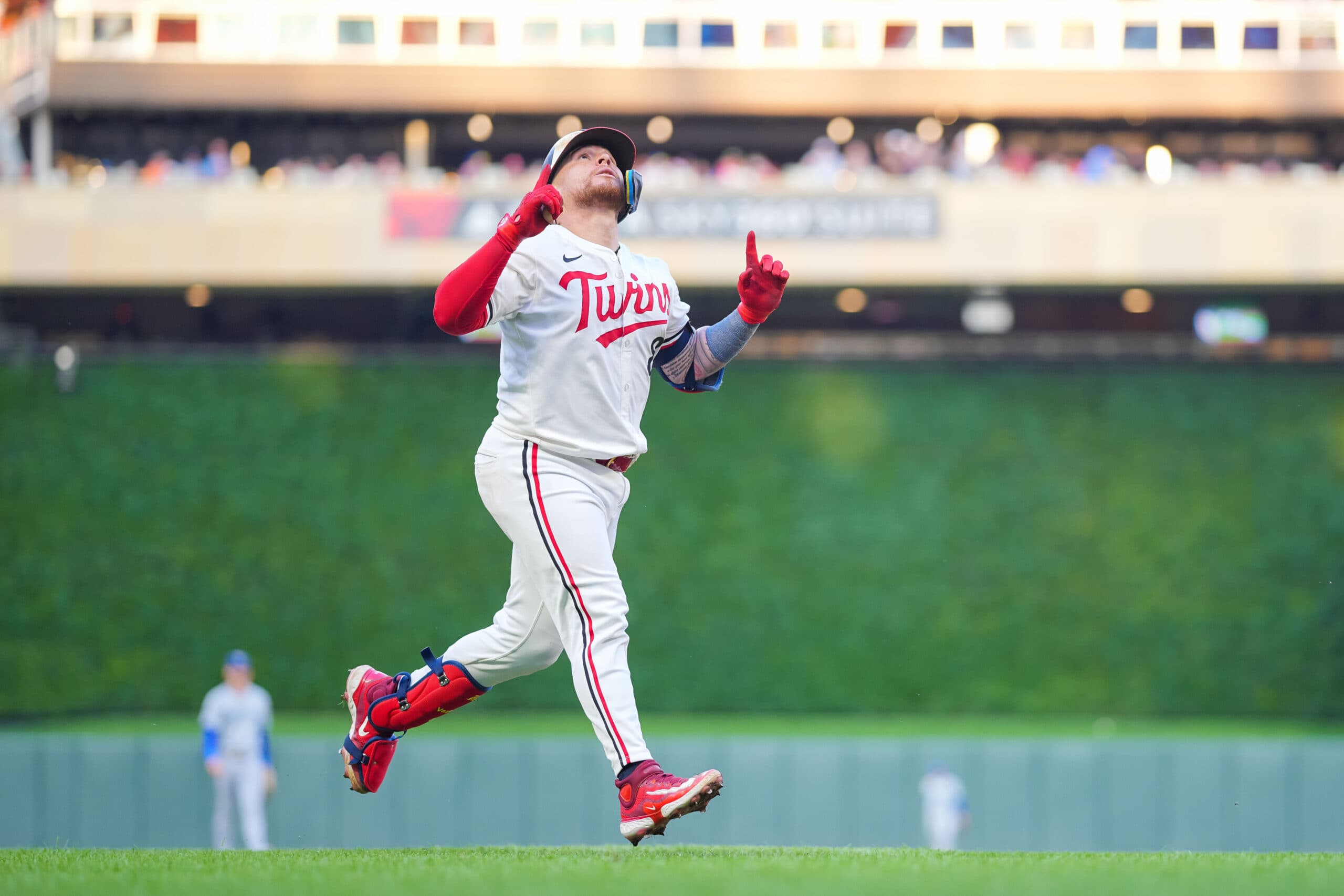
Photo credit: Brad Rempel-USA TODAY Sports

By Thomas Hall
Dec 18, 2024, 14:30 ESTUpdated: Dec 18, 2024, 14:42 EST
Acquiring an impact catcher isn’t a top priority for the Toronto Blue Jays this winter, and understandably so, given the other roster needs they must address. However, the organization could badly use a dependable catching mate for Alejandro Kirk, who made a career-high 89 starts at catcher last season and will likely blow past that mark in 2025.
After designating Nick Raposo for assignment, the Blue Jays only have one other backstop on their 40-man roster besides Kirk: Tyler Heineman, who’ll be out of options next season. It was fine to finish out last season’s schedule with that duo. But relying on them when the club aims to compete for a playoff spot is another story.
Upgrading the backup catcher’s role hasn’t been easy, though, particularly in free agency. This winter’s class wasn’t strong to begin with, headlined by the likes of Danny Jansen (Rays), Kyle Higashioka (Rangers) and Travis d’Arnaud (Angels) — all of whom have since signed.
Now, the open market has been, more or less, cleaned out. It’s down to slim pickings, as James McCann, Elias Díaz and Yasmani Grandal have become the most notable backstops still available. While likely inexpensive to acquire, none of them will probably move the needle forward for Toronto in 2024.
With each passing day, the case for the Blue Jays having to solve their catching situation via trade has seemingly gained momentum as management attempts to fortify a unit that ranked 10th in fWAR (3.3) across the majors in 2024. They must find a 1B option to complement Kirk as the team’s 1A.
Similar to free agency, the trade market is sparse on appealing targets. Still, let’s explore six catchers who could make a sizeable impact as Kirk’s catching partner in ’25.
Christian Vázquez
The Minnesota Twins are set with Ryan Jeffers as their starting catcher, as he’s coming off consecutive impressive performances and isn’t eligible for free agency until after 2026. And for a team looking to save some money, they’re likely open to moving Vázquez.
Entering the final season of his three-year, $30-million contract, Vázquez is on the books for $10 million in 2025 before becoming a free agent this time next year. If the Twins are willing to retain a portion of that amount, the 34-year-old could become far more appealing for the Blue Jays.
There isn’t much offensive upside in his game anymore, other than a well-above-average whiff rate (20.8 per cent in 2024), considering he’s accounted for a measly 63 wRC+ (100 league average) over the last two seasons. But he can still run into one from time to time, given his above-average launch angle sweet spot (36.1 per cent) and squared-up rates (31.1 per cent) from a season ago.
Vázquez’s defence, however, remains his most impactful trait. He ranked in the 84th percentile of the majors in catcher framing runs (six) and maintained an above-average score in pitch blocking, with his blocks above average (three) placing in the 63rd percentile.
Based on his 2025 salary and prolonged offensive woes, the right-handed-hitting backstop’s acquisition cost should be fairly affordable, and he may prefer to return to familiar surroundings in the AL East after spending eight seasons with the Boston Red Sox from 2014-22.
Victor Caratini
Like Minnesota, the Houston Astros already possess a premier starting catcher in Yainer Diaz, who ranked fourth in wRC+ among qualified big-league catchers (min. 300 plate appearances) a season ago. But they too could look to shed an expiring contract in Caratini, who’ll begin the final campaign of a two-year, $12-million contract, clearing a pathway for left-handed backstop César Salazar.
Caratini will earn $6 million in 2025 and is coming off one of his better offensive showings, hitting .269/.336/.408 with eight home runs, 30 RBIs and a career-high 113 wRC+ in 87 games, worth 1.9 fWAR — also a career-high. The switch-hitting catcher also featured intriguing underlying results involving his quality-of-contact and plate discipline metrics.
Defensively, the 31-year-old made a considerable impact, too. In 58 appearances (55 starts) behind the plate, he placed in the 71st percentile or higher in caught stealing above average (two), blocks above average (four) and catcher framing runs (three). And he accomplished that feat despite possessing a 10th percentile average pop time (2.02 seconds).
If the Astros are interested in trading Caratini, it’d be wise for the Blue Jays to be involved.
Jason Delay, Henry Davis
With Joey Bart — acquired from the San Francisco Giants last season — the presumed starter, the Pittsburgh Pirates are in an interesting position this off-season, given the franchise’s surplus of MLB-ready catchers.
A few years ago, the Blue Jays organization faced a similar situation, rostering one of the sport’s top-catching duos (Kirk-Jansen) and a rising star (Gabriel Moreno) emerging onto the major-league scene. But it’s more of an apples-to-oranges comparison to the Pirates’ dilemma, as they must decide between Davis — a former first-overall selection — and a reliable, veteran defender in Delay as Bart’s backup next spring.
Between those two, Davis features the most upside as a 25-year-old backstop and the superior offensive performer. His bat has struggled to take shape in the majors thus far, although he showcased his impressive power tool across 57 games at triple-A last season, mashing 13 bombs accompanied by a .555 SLG and .248 ISO.
Strikeouts, albeit the result of in-zone swing-and-miss rather than chases, have been a concern in recent seasons. But he’s helped offset those totals by earning a sizeable amount of free passes, registering a 10.7-per-cent walk rate during his 37-game major league stint in 2024.
The youngster’s defence remains a work in progress, which is what led to Pittsburgh experimenting with his talents in right field, where he logged over 400 innings in ’23. His future remains at catcher, though, especially after producing a 94th-percentile pop time (1.87 seconds) a season ago.
Delay, meanwhile, offers very little, if any, offensive value but is considered a plus-pitch framer, as evidenced by his 75th-percentile catcher framing runs (four) from ’23.
Pittsburgh may be content with keeping both Davis and Delay into next season. However, based on the organization’s need for impact, cost-effective middle infielders, there could be a pathway for Toronto to utilize its depth to improve behind the plate via trade.
Garrett Stubbs
We’ve now reached the let’s-take-a-flyer-and-see-what-happens portion of this article.
The Philadelphia Phillies may need to turn over the backup catcher position behind starter J.T. Realmuto, with switch-hitter Rafael Marchán out of options and likely to be claimed if he ends up on waivers, possibly making Garrett Stubbs expendable.
Stubbs has two seasons of club control remaining and just signed a one-year deal worth $850,000 last month to avoid arbitration. But if he does become available, acquiring the 31-year-old would add another quality defender of the running game, courtesy of his 81st-percentile caught stealing above average (three) and 92nd-percentile average pop time (1.88 seconds) from last season.
Despite being a well-below-average hitter the last two years, there could be additional upside in the left-handed hitter’s profile if he increases his pull-side batted-ball output, putting his remarkable launch angle sweet-spot rate (40.9 per cent in 2024) to better use.
Nick Fortes
There’s little incentive for the Miami Marlins to trade Fortes, who’s under club control through 2028 and is likely viewed as a stopgap to top catching prospect Agustin Ramirez — the centrepiece in the return from last summer’s Jazz Chisholm Jr. blockbuster with the New York Yankees. Still, there’s always a chance he could be moved now that he’s arbitration-eligible for the first time.
At 28, Fortes is essentially a younger, perhaps less expensive version of Díaz in free agency. Both provide excellent defence, each effectively controlling the running game, with the former specializing in blocking while the latter excels in pitch framing.
Though Fortes struggles with the bat, the right-handed-hitting backstop minimized his swing-and-miss output last season via impressive strikeout (12.2 per cent) and whiff rates (13.2 per cent). Had he earned enough plate appearances to qualify, those percentages would’ve ranked inside the top five percentile — not that Toronto’s offence needs any more low-strikeout hitters.
Recent articles from Thomas Hall
Breaking News
- Spencer Miles dazzled during a rookie season few saw coming
- Examining how the Blue Jays performed defensively in 2026
- Blue Jays free agent target: A.J Minter
- George Springer’s Game 7 ALCS home run one year later
- Trade Tree Tuesday: Trading Orlando Hudson landed the Blue Jays a Hall of Famer, a franchise icon, and is going strong today