
The Realist’s Guide to the 2020 Blue Jays


My tradition at this site for previewing the Blue Jays ahead of Opening Day is to take an optimistic, pessimistic, and realistic look at the team.
I walked through the rose-coloured-glasses, hope-springs-eternal, everything-can-and-will-go-right scenic route on Wednesday, outlining all of the upside on the roster and why it’s absolutely worth being excited about this group.
Since baseball is a cruel game designed to break your heart, we know deep down that the optimistic view is fool’s gold. So, next, I would take the pessimistic approach, in which everything can and will go wrong and we expect the worst.
But this season is a bit different. The doom-and-gloom approach ultimately boils down to Major League Baseball’s tightrope walk over the COVID-19 volcano going incredibly wrong. At the very worst, this season crashes into a wall and goes up in smoke. There’s really no need to write an entire article about how quickly things can implode as teams travel around the United States during a pandemic, I figure, so I’m just going to get into the Realist’s Guide to the 2020 Blue Jays.
I’ll kick this off by saying that the Blue Jays can be a playoff team in 2020. If things were normal and we were heading into a 162-game season, I wouldn’t be saying that. But things aren’t normal, and we’re heading into a 60-game sprint that also features a playoff field that has been expanded to 16 teams.
The top two teams in each division earn playoff berths and the final two wild-card spots in each league will go to the two teams with the next best records, regardless of division and division standing.
So, at a quick glance, if we assume the Yankees and Rays represent the American League East, the Twins and either Cleveland or Chicago represent the Central, and the Astros and Athletics represent the West, that would leave the Jays in a pool of teams like the Angels, Red Sox, Cleveland/Chicago, and Rangers fighting for those final two spots.
It’s still certainly going to be an uphill climb for the Blue Jays, who are coming off of a 67-win season, but it’s possible. At the very least, this team should be playing meaningful baseball all season.

When I took my optimistic approach a couple of days ago, I pointed out that while the Blue Jays were a putrid 67-95 last year, they were a markedly better team at the end of the season than they were at the beginning. After Bo Bichette got called up and the organization’s young core started to find its groove, the Jays went 27-28 over the final two months of the season.
So, given the fact the team added a front-of-the-rotation starter in Hyun-Jin Ryu, some decent veteran pitching depth in Tanner Roark and Chase Anderson, and will be getting Matt Shoemaker back from injury, this team, fueled by internal progression from its young core, this team should, on paper, be even better than the .500-ish team that closed out the 2019 season.
But, unfortunately, the game isn’t played on paper. Things aren’t that simple and not everything will go right just because it seems like it should.
In the Blue Jays’ instance, it’s important to remember that development isn’t always linear. We look at Bo, Vlad, Biggio, and Gurriel setting up the core of an incredibly potent lineup and we just expect each player to take a step forward from where they were last year.
While we can reasonably expect Vlad Jr., now removed from the challenge of manning third base, to improve offensively from the modest .272/.339/.443 line he slashed last year because he’s another year older, another year wiser, and another year stronger, we could also see regressions from Bichette and Gurriel, who hit incredibly well in fairly small sample sizes.
The lineup beyond that core is also incredibly streaky. Travis Shaw and Randal Grichuk are both bounce-back candidates, but neither are automatics. Teoscar Hernandez had an amazing stretch after he adjusted his swing, but, again, the sample size isn’t huge. Rowdy Tellez, Derek Fisher, and Billy McKinney have all hit well at Triple-A, but many, many players have been able to hit at that level but couldn’t take the next step.
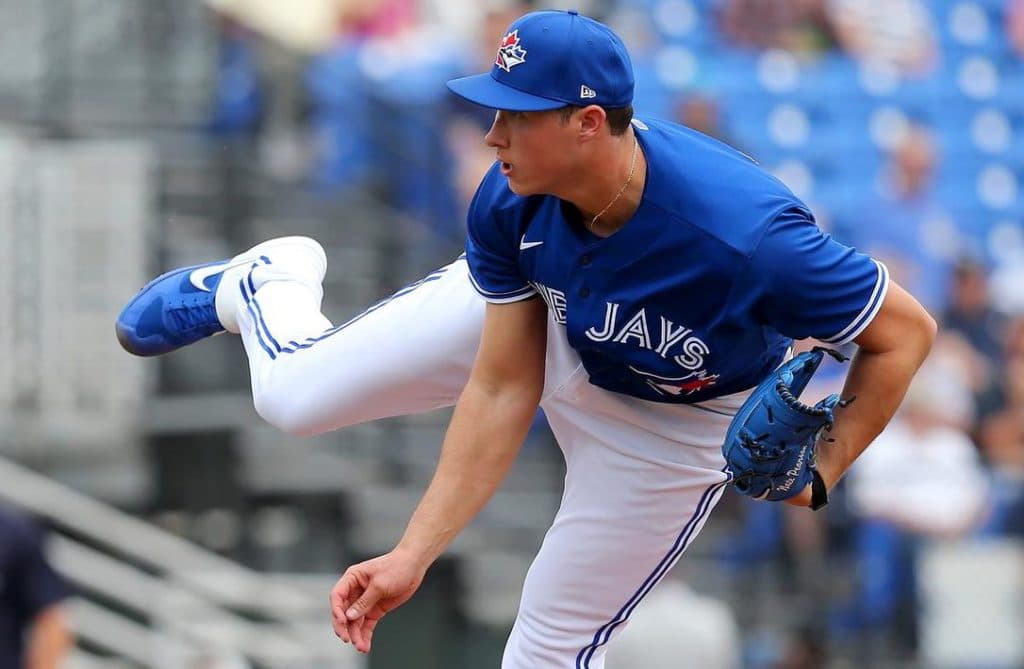
The part of the team that seems unquestionably improved from last year is the pitching. While it’s best to temper expectations and be cautiously optimistic about Toronto’s potentially-potent lineup, even the most cynical can’t argue that this year’s pitching staff isn’t a considerable improvement on last year’s.
A little while back, our old pal Andrew Stoeten took a look at different 12-start samples from Hyun-Jin Ryu last season. His worst 12-start stretch resulted in a 4.06 ERA, which would have made him Toronto’s best starter after Marcus Stroman last season. So, even if Ryu regresses a little bit due to his change of scenery from the National League to the American League East, he’ll be better than pretty much anyone else the Jays have had over the past few years.
And then, looking at the rest of the rotation, you’re subbing out Aaron Sanchez (6.07 ERA over 23 starts), Clay Buchholz (6.56 ERA over 12 starts), Clayton Richard (5.96 ERA over 10 starts) and replacing them with Tanner Roark, Matt Shoemaker, and Chase Anderson. If Trent Thornton is exactly the same as he was last year, simply having stronger veteran starters than Sanchez, Buchholz, and Richard will be a pretty massive upgrade.
And that isn’t even mentioning Nate Pearson, who could feasibly come up and immediately hit the ground running as a top-of-the-rotation starter. Of course, that’s a big ask for a rookie, but it really isn’t unreasonable to assume Pearson can be better than some of the guys who served batting practice for the Blue Jays last season.
Injuries are obviously also a thing, but the Jays have a stronger collection of depth this year than they did last year. Charlie Montoyo won’t have to come out and say “uhhh somebody is going to start tomorrow” and throw Edwin Jackson out there simply because there’s nobody else available. Between Jacob Waguespack, Anthony Kay, Thomas Hatch, and Ryan Borucki, there are plenty of options for depth starters.
And, again, the bar set by the likes of Jackson last year is incredibly low.

When you add it all up, you have a group that warrants cautious optimism.
Again, if this were a normal, 162-game marathon, I would be saying that this group will be “fun to watch” but there would be absolutely zero room for earnest playoff aspirations. But, now that there are eight playoff seeds to fight for and a hell of a lot less time for the law of averages to do its thing, yes, the playoffs are actually possible.
If everything goes right, this team will be surprisingly good. Everything isn’t going to go right, because this is baseball and that just doesn’t happen. But enough should go right that the team is enjoyable to watch all year and they’ll play meaningful baseball right up until the end.
At this stage of the team’s rebuild, that’s perfectly fine.
Breaking News
- George Springer’s Game 7 ALCS home run one year later
- Trade Tree Tuesday: Trading Orlando Hudson landed the Blue Jays a Hall of Famer, a franchise icon, and is going strong today
- Blue Jays: Looking at how Vladimir Guerrero Jr. can rebound in 2027
- Blue Jays’ ace Dylan Cease was terrific in the first season of his seven-year deal
- Blue Jays free agent target: Ian Happ