
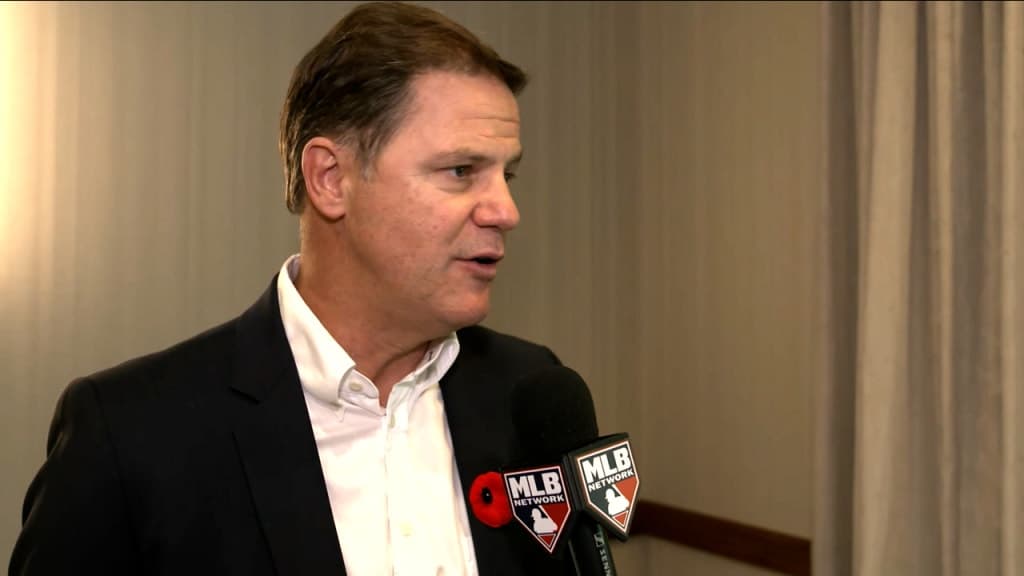
Ross Atkins says the #BlueJays were "grateful to be a part of the process" with Juan Soto. When I asked if that financial flexibility could be used immediately elsewhere, Atkins said: “Every player, every acquisition is unique. I would say that those two are incredibly unique."

With Juan Soto off the board, it’s time for Blue Jays to pivot (again)

By Thomas Hall
Dec 10, 2024, 14:00 ESTUpdated: Dec 10, 2024, 14:33 EST
It is, indeed, time for the Toronto Blue Jays to pivot again.
Cue that infamous scene from Friends of Ross, Chandler and Rachel maneuvering his new couch up the awkward-angled stairwell, which, of course, ended up getting stuck before being torn in half (off-screen) during the end credits of that episode. And therein lies a perfect analogy for the Blue Jays’ current predicament.
Toronto’s roster is the couch in this scenario, while president and CEO Mark Shapiro and general manager Ross Atkins are the ones carrying it up the stairs. But, inevitably, the sofa becomes lodged in the stairwell — a metaphor for whiffing on prized free agent Juan Soto. If they can’t dislodge it, the only choice will be to cut it in half.
Or, in simpler terms, if the front office fails to successfully pivot post-Soto signing, similar to last off-season after Shohei Ohtani joined the Los Angeles Dodgers, significant organizational changes will become inevitable.
Being all-in on pursuing Soto was necessary for a Blue Jays organization looking to make a giant splash this off-season. Moreover, when a generational talent becomes available — which isn’t often, at least outside the last two winters — and your franchise possesses the resources to pursue that player, you do it.
Ultimately, neither pursuit worked out, as this organization is now 0-for-2 in its efforts to land a franchise-altering superstar, with Ohtani (Dodgers) and Soto (Mets) signing elsewhere. Being left at the altar for a second straight off-season was, understandably, heart-wrenching for everyone involved, particularly for a fan base fearful of last winter’s mistakes repeating this year.
As such, that makes what comes next for Toronto all that more vital.
This time a year ago, the Blue Jays had just watched Ohtani officially announce his decision to sign with the Dodgers, leaving them without a clear Plan B. So, the front office pivoted to internal improvements and veteran, complementary additions. They re-signed Kevin Kiermaier (one year, $10.5 million) almost three weeks later. Then, they acquired Isiah Kiner-Falefa (two years, $15 million) a day later before landing Justin Turner (one year, $13 million) last January.
Those signings, of course, did not raise the club’s ceiling in 2024. Instead, that pathway contributed to a last-place finish in the AL East, albeit with an opportunity to secure a top-five position in next season’s draft, depending on the outcome of Tuesday’s lottery draft — where Toronto will have the fifth-highest odds (7.48 per cent) of earning the first-overall selection.
Receiving a favourable bounce or two would help lessen the blow of a disappointing ’24 campaign. Still, it’s certainly not the outcome anyone had envisioned when this team arrived for spring training nearly 12 months ago. Furthermore, it begs the question, how will this off-season be any different?
For starters, Toronto’s front office must take the lessons learned from last winter’s debacle and apply them to its current situation. They still need to raise the ceiling of their roster after missing out on Soto rather than attempt to boost its floor, as they did a year ago. But, of course, words are one thing. Actions are another.
The Blue Jays’ attempts to pry Soto away from New York were unsuccessful. However, taking that journey didn’t force them to sacrifice their pursuit of other marquee free agents, many of whom are also represented by agent Scott Boras. While the undisputed best hitter available is off the board, management can still swing for the fences.
After Soto, the most likely pivot point for Toronto is the starting pitching market, considering top-tier starters Corbin Burnes — a Boras client — and Max Fried remain available. Both hurlers have reportedly garnered plenty of interest from the organization thus far. But they aren’t alone, as the New York Yankees and Boston Red Sox also appear to be heavily involved.
Landing either hurler would likely require the Blue Jays to make a special budgetary exception, as they would’ve done had they signed the now-Mets superstar, with Burnes expected to become the sport’s next $200-million pitcher and Fried likely to command a deal in the $150-$170 million range.
Alternatively, they could apply a similar approach to the next tier of free-agent hitters below Soto.
Toronto’s lineup needs more players who can create damage. Manager John Schneider said as much at the Winter Meetings on Monday. Fortunately, two of the best position players still on the market can do precisely that — sluggers Anthony Santander and Teoscar Hernández.
Asked John Schneider what he'd like to see in an addition to the #BlueJays' lineup: “Someone that can do damage. Having a threat, you want that around Vlad. We make a lot of contact, but we want a guy making a lot of quality contact, too. That stands out to me.”
In all likelihood, the teams that whiffed on Soto — the Blue Jays, Yankees, Red Sox, Phillies and Dodgers — will shift their focus to the likes of Santander and Hernández, hoping to augment their respective lineups with one of the All-Star mashers.
A team like Toronto, though, can also be creative in its pursuit of much-needed offensive upgrades.
The key will be to acquire a reliable middle-of-the-order threat who can help protect franchise pillars Vladimir Guerrero Jr. and Bo Bichette. Since the former of those two features prior third base experience, it could open up first base for an impact bat like Pete Alonso or Christian Walker, with the latter also providing significant defensive upside.
Another potential option could involve keeping Guerrero at first, pivoting to a pursuit of third baseman Alex Bregman, who’s seemingly looking to surpass the six-year, $151-million extension Matt Chapman signed with the San Francisco Giants last September. While the hot corner remains a massive question mark for the Blue Jays, targeting the longtime Houston Astros infielder — whose offensive profile doesn’t feature as much hard-contact output as the hitters named above — may not be the most sensible decision, at least based on his presumed price point.
Atkins and his staff may also use a spread-the-wealth approach, given the number of holes to fill between the offence, bullpen and starting rotation. Instead of making one singular splash, perhaps they prioritize multiple mid-tier additions, such as middle infielders Gleyber Torres and Ha-Seong Kim, while procuring someone like Sean Manaea and a few experienced back-end relievers like Paul Sewald and A.J. Minter in free agency.
Though unlikely, there’s also the possibility of signing Japan’s Roki Sasaki, who was officially posted for MLB clubs on Monday, thus opening a 45-day negotiating window with all 30 teams. At 23, he’s considered an amateur free agent, limiting what he can command via the international bonus pool system, with the current signing period concluding on Dec. 15 and a new one beginning Jan. 15.
Let us not forget about the trade market, either.
Toronto’s front office doesn’t have plenty to work with in that regard because of a bottom-third farm system. At the same time, though, the pipeline does consist of many cost-effective, controllable infielders who could be used as leverage via trade for an impact player or two.
The most obvious trade scenarios likely revolve around the reliever market, especially with All-Star closers Devin Williams and Ryan Helsley reportedly available. But, there seem to be several notable hitters on the block, too, including Cleveland’s Josh Naylor and Lane Thomas, as well as Chicago’s Cody Bellinger and Seiya Suzuki.
As you’ve probably gathered by now, Toronto still has several opportunities to make significant roster improvements, even with Soto no longer available. In saying that, we’ve yet to cover arguably their biggest item of the winter: extending Guerrero, who now likely has even more of a reason to enter free agency — along with Bichette — after next season.
There’s never been more pressure on the front office to thread the needle of an off-season than this year. Up to this point, everything has moved at a snail’s pace, with everyone awaiting Soto’s decision. Now that it’s come, business is expected to pick up.
To avoid repeating last winter’s mistakes, Atkins must choose the right pivot point, whatever that ends up being, to ensure the Blue Jays are better positioned to compete in 2025 and, potentially, in ’26 and beyond.
Recent articles from Thomas Hall
Breaking News
- Blue Jays listed as one of six destinations for Tarik Skubal by MLB.com
- Blue Jays Arizona Fall League check-in: Aaron Parker has found success in limited playing time
- Blue Jays free agent target: Kaima Taira
- Spencer Miles dazzled during a rookie season few saw coming
- Examining how the Blue Jays performed defensively in 2026