
The Red Sox forget how many outs there are and run into an inning ending double play. However, after a lengthy delay, it is deemed the runner on third, despite never tagging up, is allowed to score the run. 2-1 Blue Jays. 🎥: Sportsnet | #BlueJays50

Breakdown of Red Sox-Blue Jays seventh inning run-scoring delay, explanation of “fourth out” rule
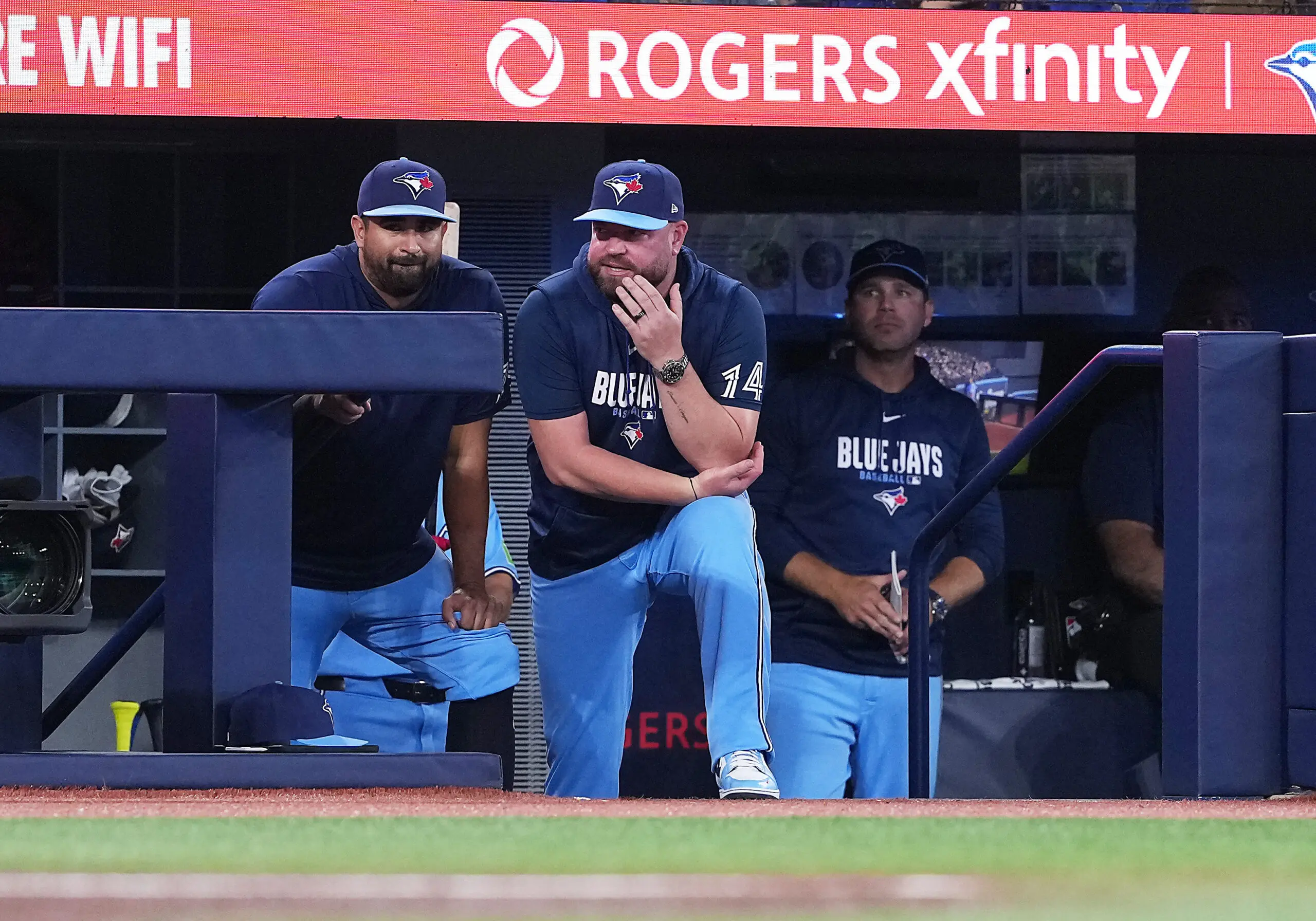
Photo credit: Nick Turchiaro-Imagn Images

By Thomas Hall
Aug 11, 2026, 14:30 EDT
TORONTO — Weird things can often happen at the ballpark when you least expect it, and Monday night’s Blue Jays-Red Sox series opener provided another reminder of precisely that.
Let’s fast-forward to the top of the seventh inning.
Simeon Woods Richardson, beginning his third and final inning of work in his return from Triple-A Buffalo in place of injured starter Jameson Taillon, allowed leadoff singles to Anthony Seigler and Connor Wong, placing Boston’s runners on first and second. Then, after Vladimir Guerrero Jr. made a highlight-reel defensive stab at Nick Sogard’s 104.9-m.p.h. ground ball, he fired to second base to record the first out of the frame.
That allowed Seigler to advance to third, while Sogard reached first safely via the fielder’s choice. The next batter, Ceddanne Rafaela, then flew out to centre-fielder Brett Bateman for the second out — except both of Boston’s baserunners thought that was the third out. So, neither went back to the bag to tag up. Meanwhile, Bateman threw the ball back into the infield to Guerrero, who stepped on first to double-off Sogard.
The Blue Jays believed they had just taken advantage of a baserunning blunder, while preserving their 2-0 lead. In the end, they were only half correct.
That’s when the confusion spun out of control.
During the half-inning break, the umpiring crew — led by crew chief Chris Guccione — halted play before the bottom of the seventh could commence. After meeting with managers from each club, Toronto’s John Schneider and Boston’s interim Chad Tracy, Guccione announced on the stadium’s PA system that the matter in question was whether the runner from third scored before the out at first was recorded, declaring it a timing play.
The lengthy delay, which lasted almost 20 minutes, continued as umpires consulted with the replay review crew in New York regarding a “rules check.” Then followed another announcement:
“After calling New York and getting it all straightened out, the run is going to score. End of the inning. Two runs for Toronto, one run for Boston,” Guccione said.
Still confused about why Seigler was allowed to score on the play despite failing to tag up? Let’s dive into the specifics.
According to Rule 5.09(c)(4), which states, “the appeal play decision takes precedence in determining the out” when that appeal occurs at the conclusion of an inning, the decision to award Boston with a run came down to timing, as it wasn’t a force play.
In simpler terms, once the Blue Jays opted to appeal Sogard left early at first base, it meant they needed to record the out before Seigler crossed home plate. Since that didn’t happen — which Toronto could’ve challenged if it felt otherwise, though Schneider admitted post-game that he didn’t feel the need to “burn a challenge” in that case — next they needed to appeal at third to prevent Seigler’s run from counting, creating what’s called a “fourth out.”
Had the bases been loaded in this situation, that wouldn’t have been necessary, as there would’ve been a force out at any base.
In this scenario, though, the umpires deemed that every Blue Jays infielder departed the field, a threshold of crossing the third-base foul line, before appealing the non-tag at third. Thus, the Red Sox trimmed their deficit to 2-1.
“We had one out, fly ball to the centre-fielder… Both Boston runners, thinking there were two outs, just took off,” Guccione said afterwards, providing his full explanation to a pool reporter. “So, when the second out was made, now we have two runners who have failed to return and tag up correctly. At that time, the guy from third had crossed home plate and the guy who was at first was standing at second.“Toronto knew he hadn’t tagged up and threw to first base to make the third out. Well, that’s a time play, meaning it’s not a force play. If it’s a force play, the run does not score automatically. If it’s a time play — meaning, ‘Was the out made before or after the runner crossed home plate?’ — in this case, the runner crossed before the appeal play was made [at first].“In this case, it’s what you call an apparent fourth out.”
Once Toronto’s players left the field, the run was allowed to score, and the team was “no longer able to appeal” the play at third base.
That’s where Schneider had a bone to pick with the umpiring crew, stating they weren’t “given that opportunity” to appeal.
“After consulting with MLB, they [the umpires] told me that all of my players were across the third base line before [home-plate umpire Charlie Ramos] waved off the run, which I 100 per cent disagree with,” he explained. “I don’t know if Vlad is that fast after he got the ball at first.“Going forward, when that play happens again in the next 100 years, if it’s us, we will record the lead out at third.”
Another piece of this complex puzzle is the scoreboard, which at the beginning of Rafaela’s at-bat incorrectly displayed two outs instead of one. It’s controlled by MLB employees, not by Blue Jays staff, for what it’s worth. Still, that was likely the source behind the Red Sox baserunners forgetting how many outs there were.
At the same time, as Guccione noted, the onus is on umpires, players and coaches alike to know the exact number of outs and strikes and balls at any certain time. Anything that’s displayed around the stadium is strictly “a courtesy to the fans,” adding that “it’s our responsibility as umpires to understand how many outs there are and the correct count.”
If nothing else, both teams — along with baseball’s 28 other clubs — should now be fully aware of how to handle this type of unusual play when/if it happens again down the road. Fortunately for the Blue Jays, despite the Red Sox’s ninth-inning rally that put the tying run 90 feet away, these controversial events didn’t cost them their ninth win in the last 14 games.
More than anything, it allowed them to turn the page quickly to Tuesday’s affair with ace Dylan Cease looking to continue his stellar stretch of late.
PRESENTED BY THE PERFECT 9 COLLECTION

Some baseball traditions never get old. The Perfect 9 Collection is our newest limited-edition collaboration with Blue Jays Today, inspired by the viral 9/9/9 challenge that has become a staple of baseball culture. Whether you’re taking on the challenge or just enjoying a day at the ballpark, this collection celebrates the moments that make baseball unforgettable. Featuring premium Levelwear apparel with elevated fabrics and modern fits, it’s designed for fans who live and breathe the game—on game day and beyond. Limited edition. Premium quality. Built for baseball fans. Shop the Perfect 9 Collection while it lasts. Exclusively at nationgear.ca
Recent articles from Thomas Hall
Breaking News
- Blue Jays’ Vladimir Guerrero Jr. undergoes laser eye surgery
- Ranking the Blue Jays’ 10 worst losses of 2026
- Blue Jays prospect Jake Cook looking to use Arizona Fall League to build on first pro season
- 5 players who appeared for the Blue Jays in 2026 that people might not remember
- Pending free agent Taylor Rogers expresses interest in reuniting with twin Tyler in Toronto