
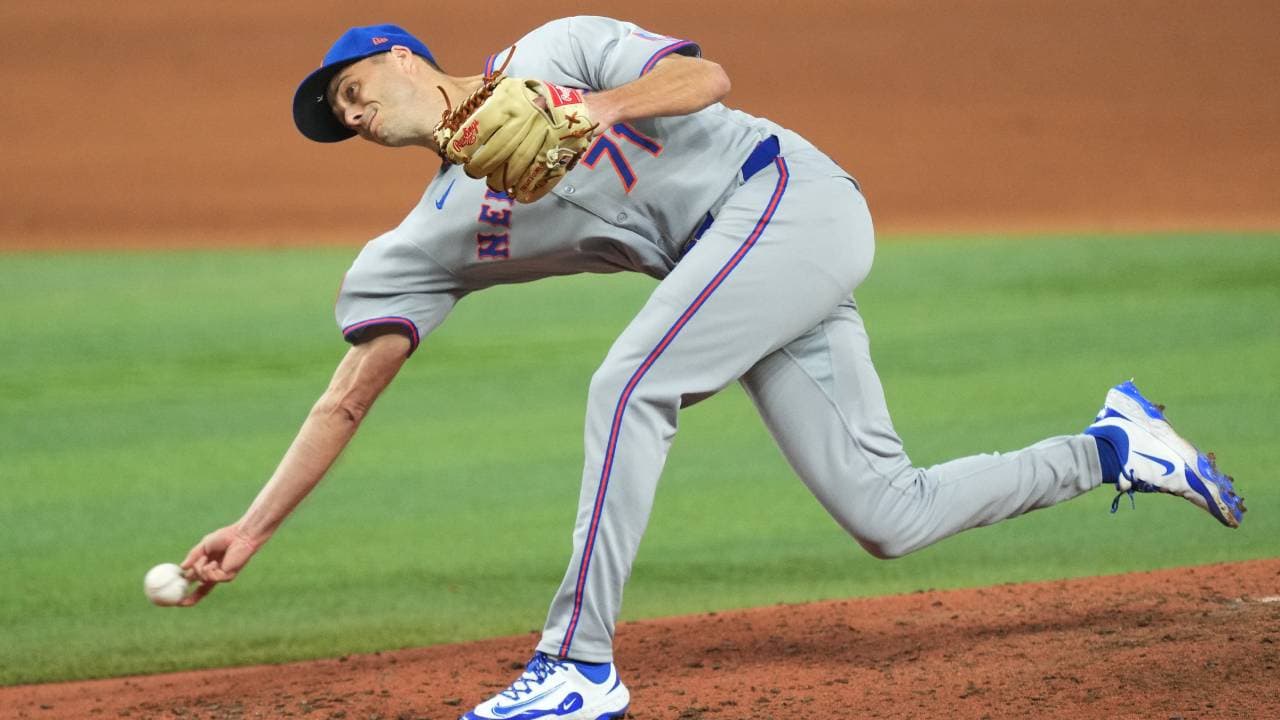
Tyler Rogers releases the ball so low to the ground... that it kicks up Dirt! 😳

How the Blue Jays could deploy Tyler Rogers in 2026

Jan 29, 2026, 18:00 ESTUpdated: Jan 30, 2026, 09:02 EST
After signing the funkiest relief pitcher in baseball this offseason – ground-scraping submariner Tyler Rogers – the Toronto Blue Jays will have unique opportunities to deploy him in 2026.
Rogers is atypical of a modern reliever in many ways. He doesn’t throw hard, averaging 83.5 m.p.h. with his sinker and 74.1 m.p.h. with his slider last season. Both were the slowest of their kind in MLB. Because he doesn’t have electric stuff by way of velocity or movement, he doesn’t strike batters out. Rogers’ 16.1% strikeout rate ranked in the eighth percentile. And of course, the strangest aspect of all is his minus-61-degree arm angle, the lowest in baseball by far. (Hoby Milner’s minus-4-degree slot is the second lowest, and the only other to come in at a negative angle.)
But this wildly awkward-looking delivery is Rogers’ greatest strength. Blue Jays fans became familiar with the havoc an unorthodox arm angle can cause when they watched phenom Trey Yesavage carve up opposing lineups through September and October. While he achieves his results in a vastly different way, Rogers is also remarkably effective thanks to the deceptiveness of his delivery. He’s the only pitcher who throws “underhanded” in MLB. Hitters just aren’t used to it; it makes for an uncomfortable plate appearance.
The most prominent drivers of Rogers’ success are his sky-high ground ball rates and ability to induce weak contact. Of the balls hit in play against Rogers last season, 61.6% were on the ground, a 98th percentile mark. His 85.8 m.p.h. average exit velocity was 99th percentile, his 2.1%-barrel rate 100th.
He allowed only five barrels last season (tied for the least among relivers with at least 60 innings pitched). Hitters simply don’t square him up often. Rogers also rarely walks hitters – he’s posted a 100th percentile walk rate each of the last two seasons. It all came together to produce a 1.98 ERA and 0.94 WHIP over 77.1 innings.
And this wasn’t an outlier season. Rogers’ groundball rate and contact quality numbers have all been 89th percentile or greater for the last five years. He has a 2.76 career ERA. Once upon a time, Rogers’ unsightly delivery would have made him a pariah like Chad Bradford of “Moneyball” fame. A market inefficiency to be exploited by more analytically savvy teams. But Moneyball is dead. Consumed by its own ubiquity. Rogers got paid $37 million over three years. Here’s how the Blue Jays might deploy him out of the bullpen in the upcoming season.
A clean inning
The most obvious, and boring, is for Rogers to enter a fresh frame. This is something the Blue Jays should be comfortable doing in leverage, be it in the seventh or eighth inning of a one-run game or earlier against the heart of an opposing order.
This is ideal because while Rogers is a good reliever, he’s going to allow balls in play, which are prone to variance. Entering him with runners in scoring position in a close game could be a recipe for disaster, as the softly hit ground balls he allows could just as easily go through holes as they could be hit at defenders. Toronto should save most scenarios where runners are on base for strikeout artists like Yimi Garcia and Louis Varland. That is except for the following.
Need a ground ball to limit damage
There are specific scenarios that call for either a ground ball double play to escape a jam or for overall damage control, and Rogers is the man for the job in both cases.
He had the highest groundball rate of any current reliever on the roster last season. So, if they want to gamble with one out and either runners on the corners, or the bases loaded, Rogers is the best bet to induce a roller.
The same goes for if the Blue Jays are up by multiple runs and face a situation with numerous runners on. Rogers allowed only four home runs in 81 appearances last season. A squibber might allow a run or two, but he’s unlikely to allow a game-swinging shot.
After Yesavage
This is by far the most fun and unique of Toronto’s options when it comes to deploying Rogers. The Blue Jays now have the starter with the highest release point and steepest arm angle (Yesavage) and the reliever with the lowest. There’s a five-foot-eight-inch gap between the height at which Yesavage (7.1 feet) and Rogers (1.3 feet) release the ball off the ground.

Talk about changing a hitter's eye level 👀 New @BlueJays teammates Trey Yesavage and Tyler Rogers feature the highest (7.11 ft) and lowest (1.33 ft) release points in the league 😱
Imagine bringing in Rogers directly after Yesavage. Varying looks can be an effective way to throw hitters off. Numbers back that the more times a hitter sees a pitcher in a series, the better they perform against them. Well, there’s no look more varied than the two pitchers with the most disparate deliveries in the majors.
Further, Yesavage and Rogers may be more difficult to prepare for than most pitchers. Just ask Kiké Hernández.
“We start moving the Trajekt, and sure enough, the Trajekt doesn’t get as high as (Yesavage’s) release point,” said Hernández of preparing for Yesavage in the World Series to Adam Ottavino in November. “There are a couple of guys … it’s Yesavage, Verlander and one of the Rogers twins … the submarine guy. The Trajekt doesn’t get that low.”
Having two pitchers that are immune to being replicated by Trajekt pitching machines could prove to be a difference-making competitive advantage for the Blue Jays.
PRESENTED BY OFF THE ROSTER

Introducing Off The Roster—Toronto Sports, Unfiltered! Toronto sports fans, your new favourite conversation has arrived. Hosted by Cabbie Richards, Lindsay Dunn, and Dan Riccio, Off The Roster dives into the city’s legendary plays, brutal trades, OG jerseys, celebrity tweets, and everything in between. Raw, fun, and totally unfiltered, this is Toronto sports like you’ve never heard it before. Tune in live every weekday morning on the Nation Network YouTube channel, or catch episodes wherever you stream podcasts. Proudly brought to you by our founding partner, PROLINE. Off The Roster—the new sound in the 6ix.
Breaking News
- 8 Blue Jays projected for arbitration raises this winter
- Blue Jays prospect Jake Bloss discusses returning to play in Arizona Fall League
- Examining the best fits for the Blue Jays’ outfield and second base needs
- Brett Bateman discusses his first big-league hit ‘just trying to get the barrel on the ball’
- Blue Jays sign three prospects in international free agency