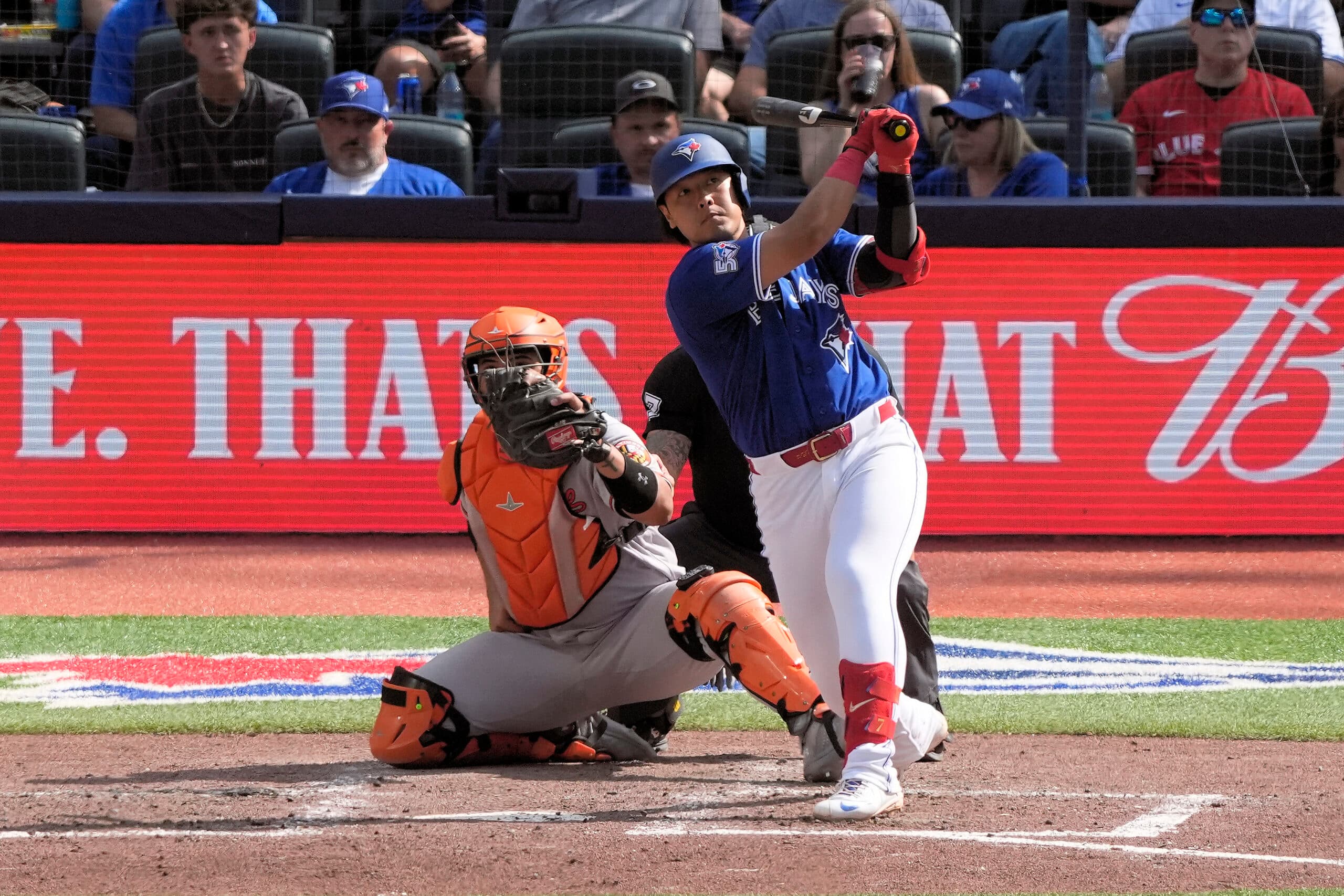
Kazuma Okamoto gave the Toronto Blue Jays the power they signed him for in 2026. The 30-year-old third baseman hit 33 home runs, a franchise rookie record, and led the club in homers and RBIs while batting .232 with a .762 OPS over 156 games. He also struck out 183 times, the most by a Blue Jays hitter in a single season, and the tension between those two numbers set up what will come in his sophomore season. Freshman Year
Okamoto arrived in Major League Baseball with one of the most consistent résumés in Nippon Professional Baseball. He hit 30 or more home runs in six straight seasons from 2018 to 2023, then 27 in 2024, and finished his Yomiuri Giants career with 248 homers and a .277/.361/.521 line. His shortened 2025 was his best, a .327/.416/.598 line with 15 home runs in 69 games. Toronto believed it was buying power with contact skills to match when it signed the corner infielder to a four-year, $60-million deal.
Preseason projections expected Okamoto to transfer with a similar bat, with slightly reduced power. Steamer projected 22 home runs with a 17.0 per cent strikeout rate, and ZiPS projected 21 homers with a 19.0 per cent rate. Okamoto finished with a 113 wRC+, in line with those forecasts, but built it in nearly the opposite way: 33 homers and a 28.8 per cent strikeout rate. His overall value matched the projections, while the road he took to get there flipped. Okamoto’s average dropped 45 points from his .277 career NPB mark, his on-base percentage fell about 50 points from .361, and his strikeouts per walk roughly doubled from 1.65 in NPB to 3.10. The power crossed the Pacific intact, while the contact and on-base skills did not. With that, Statcast suggests the power Okamoto showcased this past season is sustainable. He ended the regular season in 2026 with a 13.1 per cent barrel rate (89th percentile) and a 44.1 per cent hard-hit rate (71st percentile), and his .328 xwOBA sat next to his .332 wOBA, so he was neither lucky nor unlucky.
Highs and Lows
His rookie year played out in two distinct phases. Through April 17, he was hitting .188/.263/.290 with two home runs, and he struck out 32.4 per cent of the time over the first two months. The low point was a 9-for-63 skid starting May 9, with a 38 per cent strikeout rate. The turnaround came in June, but his results never truly settled, and he was streaky for most of the year. He had a .913 OPS in June, hammering seven home runs and winning AL Rookie of the Month. However, his OPS slid to .698 in July and .696 in August before he closed with a .844 OPS in September. The month-to-month swings show streakiness is part of his profile, and 2027 will likely include stretches like July and August, as well as June, when Okamoto is among the best power hitters in MLB. Cross-Examination
Japanese hitters who have previously adjusted from NPB to MLB could help shape expectations and create a spectrum of what year two could look like for Okamoto.
Hideki Matsui came to the New York Yankees from the NPB at 28 and hit .287/.353/.435 with 16 home runs in 2003, then .298/.390/.522 with 31 in 2004. His walks rose from 63 to 88, and his OPS climbed from .788 to .912, and he struck out only 86 and 103 times. Matsui shows what a second-year surge looks like, but from a contact base Okamoto does not have.
Seiya Suzuki is the closer match, a right-handed slugger who arrived at 27. He hit .262/.336/.433 with 14 home runs in 2022 and 110 strikeouts in 397 at-bats, then .285/.357/.485 with 20 homers in 2023. His power peaked in his fourth year, with 32 home runs in 2025. That path could suggest Okamoto’s second season may be a modest but real step forward, with his best power still ahead in years three and four of his deal with Toronto.
Though these success stories are a double-edged sword, Masataka Yoshida is a reminder that improvement is not a guarantee. Arriving at 29, he hit 15 homers with a .783 OPS in 2023, then 10 homers and a .765 OPS in 2024 while missing time to injury. Okamoto, also a late arrival who turns 31 in 2027, is not immune to that dip. Results
The most likely outcome is a step forward, but a more manageable one and certainly not a dramatic leap. If his strikeout rate falls from 28.8 per cent to the 24.6 per cent he posted over July and August, roughly 25 strikeouts become balls in play over about 600 plate appearances. At his hard-hit rate, that could add roughly 13 points to his average and 20 points to his slugging, for a line near .245/.325/.470 with 33 to 36 home runs and a wRC+ around 120.
The upside case is Suzuki’s path. If his contact quality improves along with his strikeout rate, a season of 37 to 40 homers and an OPS above .840 is on the upper end of what is realistic. The risk case is closer to Yoshida in overall offensive value, although a drop to a similar level of power would be a more extreme outcome. If pitchers continue to exploit his chase tendencies and his strikeout rate stays near 29 per cent, Okamoto could hit around .225 with 27 to 30 homers and an OPS near .725 at his floor.
The number to watch is his April strikeout rate. If he opens 2027 near a strikeout rate of 24.6 per cent, my estimate could prove conservative. If he opens near the 32.4 per cent he posted over his first two months in 2026, the Yoshida comparison becomes a little more relevant. However, Okamoto is a streaky hitter capable of turning things around, and his performance could also benefit from a more fortified Blue Jays lineup in 2027. Giving opposing pitchers more dangerous hitters to account for could limit their ability to focus on Okamoto, creating better opportunities for him to capitalize. With his power potential, an improved supporting cast and the ability to get hot for extended stretches, the underlying stats and player examples support a better offensive season in Okamoto’s sophomore MLB season, even if the improvement is incremental rather than dramatic.
PRESENTED BY THE PERFECT 9 COLLECTION
Some baseball traditions never get old.
The Perfect 9 Collection is our newest limited-edition collaboration with Blue Jays Today, inspired by the viral 9/9/9 challenge that has become a staple of baseball culture. Whether you’re taking on the challenge or just enjoying a day at the ballpark, this collection celebrates the moments that make baseball unforgettable. Featuring premium Levelwear apparel with elevated fabrics and modern fits, it’s designed for fans who live and breathe the game—on game day and beyond. Limited edition. Premium quality. Built for baseball fans. Shop the Perfect 9 Collection while it lasts. Exclusively at
nationgear.ca