There was once a time when the offseason truly meant that MLB executives and players took several months “off” from work, but that’s no longer. The latest example in
Blue Jays land is the signing of Dylan Cease to a seven-year/$210 million contract on the eve of American Thanksgiving.
While some of the most impactful transactions take place once free agency opens up, other times, it’s a slow burn to watch even players with the largest pedigree waiting until the new year to find a new home. Case in point: George Springer signed on January 19, 2021.
Just because it’s the holiday season doesn’t mean MLB executives aren’t hard at work behind the scenes. Whether the gift of a big free agent signing or massive trade comes early or late, it’s always exciting for fan bases to find that proverbial gift under the tree come Christmas morning.
These were the biggest late-year transactions the Blue Jays pulled off before the buzzer as the calendar flipped into the new year.
5. Blue Jays acquire Daulton Varsho for Lourdes Gurriel Jr. and Gabriel Moreno (December 23, 2022)
Thankfully, the emergence of Daulton Varsho as an elite defensive centre fielder and a power bat has temporarily put to rest the yearly referendum on whether trading for him made sense. On December 23, 2022, the Blue Jays pulled off a surprise move by dealing outfielder Lourdes Gurriel Jr. and catching prospect Gabriel Moreno for Varsho.
This transaction was the first of many in an organizational shift towards acquiring or signing defensive-minded players in the vein of promoting run prevention over run creation. Considering the Arizona Diamondbacks went to the World Series in year one of this deal, and the Blue Jays flamed out in the Wild Card series, the trade didn’t look good at the onset for the Blue Jays.
But like any deal of this magnitude, it takes several years to evaluate whether the trade panned out for both sides. Three years after the fact, it’s safe to say both the
Blue Jays and D-backs are pleased with the results.
4. Blue Jays acquire Kyle Drabek, Michael Taylor and Travis d’Arnaud for Roy Halladay (December 16, 2009)
Unlike the aforementioned trade, this is one that everyone in baseball saw coming from a mile away. After signing several below-market contract extensions, Blue Jays ace Roy Halladay wasn’t interested in sticking around while Toronto entered a rebuilding phase, so GM J.P. Ricciardi went to work to find Doc a home on a contending team.
The Jays couldn’t push a trade across the finish line at the 2009 trade deadline, but once Ricciardi was fired at the end of the season, newly appointed GM Alex Anthopoulos picked up the baton and resumed trade talks. Not only to do right by Halladay, but to maximize the return for one of the best starting pitchers in MLB.
The Blue Jays received a promising young pitching prospect in the form of Kyle Drabek, Michael Taylor, who Anthopoulos immediately flipped for infielder Brett Wallace, and catching prospect Travis d’Arnaud. Drabek was the centrepiece of the deal, but battled injuries and only pitched in 39 games over portions of five seasons in Toronto.
Halladay, meanwhile, finally got what he was yearning for all those years with the Blue Jays — an opportunity to pitch under the bright lights of October. Doc threw a no-hitter in his postseason debut, and while the San Francisco Giants bounced the Philadelphia Phillies in the 2010 NLCS, Halladay capped his historic 2010 season by winning the second Cy Young Award of his career.
In retrospect, this trade had a minimal impact on the future of the franchise, but it’s included on this list because it signalled the end of an era in Toronto; a 12-year tour by Halladay with the Blue Jays, which then sparked a major rebuilding phase for the franchise.
3. Blue Jays sign Vernon Wells to a 7-year $126M contract extension (December 15, 2006)
Speaking of franchise players, the Blue Jays ensured their All-Star centre fielder would be a mainstay in Toronto for years to come when they inked Vernon Wells to a seven-year, $126 million contract extension on December 15, 2006. It was the single largest deal for either an incumbent Blue Jays player or a free agent.
Even today, Wells’ deal stands as the fifth-largest deal and the third-longest contract extension by a Blue Jay. Considering how many hundreds of millions of dollars this organization has thrown around these past few years, it says a lot that Wells still occupies a spot at the top of this list.
Wells could not have timed things any better, coming off a stellar 2006 campaign when he was named an All-Star and posted a career-high 5.8 fWAR in a single season. Perhaps looking ahead to what life would be like without Wells, the Blue Jays paid above market value for an impact centre fielder at an $18M AAV.
This contract extension also came one year after the organization plunked down $55M for A.J. Burnett and $47M for B.J. Ryan, so the Blue Jays were tripling down on their efforts to remain competitive within the landscape of the American League East. The deal didn’t pan out for the Blue Jays, as they traded away Wells to the LA Angels in January 2011.
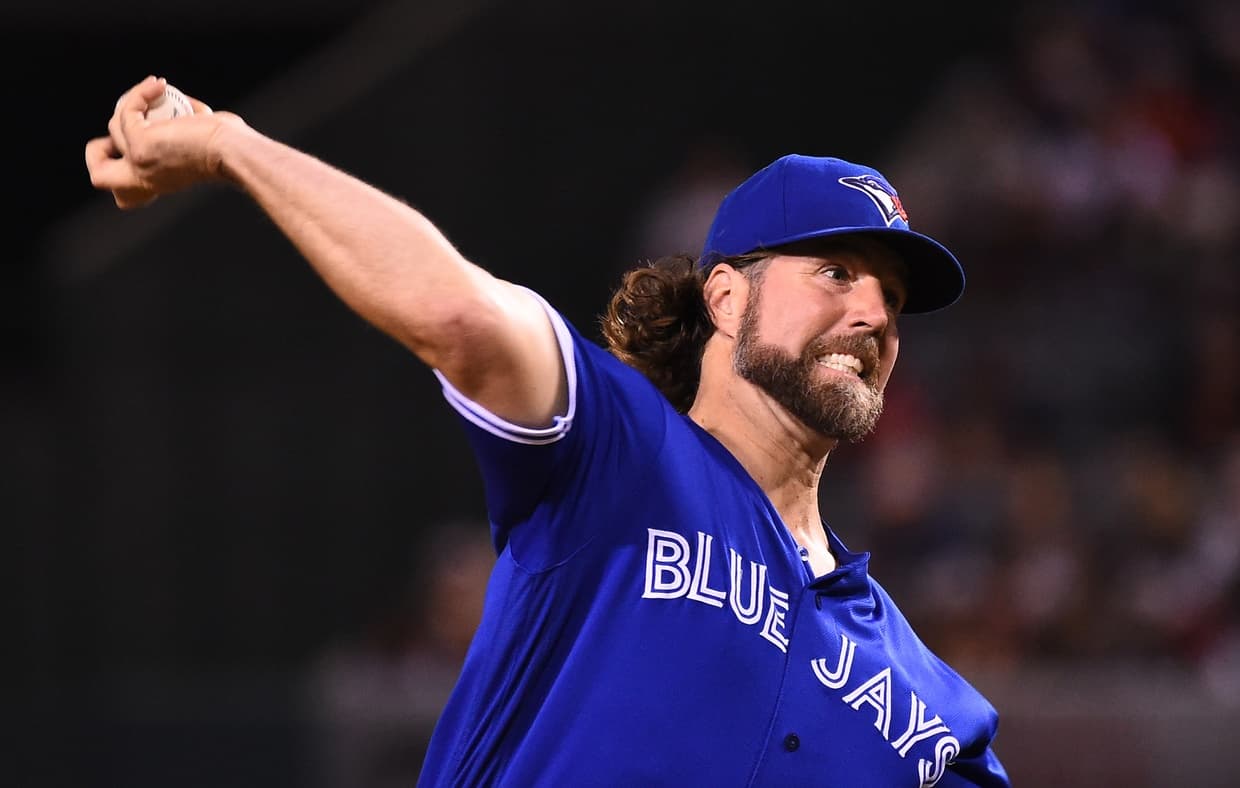
2. Blue Jays acquire R.A. Dickey and Josh Thole for Noah Syndergaard, Travis d’Arnaud, John Buck and Wuilmer Beccera (December 17, 2012)
The offseason of 2012 heading into the 2023 campaign might have been one of the most fun winters to be a Blue Jays fan. But it was a prime example of “the night is darkest just before the dawn”.
The team had a God-awful 73-89 season, but to make matters worse, this was the tail end of John Farrell’s tenure as manager with the Blue Jays before he landed his “dream job” as skipper of the Boston Red Sox. Suffice to say, the Blue Jays needed some good PR after a disastrous 2012 season, both on and off the field.
Anthopoulos pulled the first rabbit out of his hat by pillaging the Miami Marlins in a 12-player fire sale, which saw Jose Reyes, Mark Buehrle, Josh Johnson, Emilio Bonifacio and John Buck come to Toronto. But AA wasn’t done there; he pulled off another monster deal one month later to acquire Cy Young winner
R.A. Dickey, along with his personal catcher, Josh Thole.
These trades didn’t immediately pay dividends, as the Blue Jays failed to live up to their World Series contender billing. But bringing Dickey aboard — along with Buehrle — fortified the starting rotation, and a few years later, the Blue Jays finally reached the postseason for the first time in 22 years.
Parting with Noah Syndergaard was a high price to pay, as he went on to have some success in a Mets uniform, but Dickey was the linchpin in all those trades made by the Blue Jays during the winter of 2012. He never matched the massive success he had with the Mets in 2012, but Dickey was a decent starting pitcher for the Blue Jays.
1. Blue Jays sign free agents Jack Morris and Dave Winfield (December 18 & 19, 1991)
Although these were separate transactions in December 1991, they should be treated as a package deal. On consecutive days, December 18 and 19, 1991, the Blue Jays landed two of the most coveted free agents on the market: veterans Jack Morris and Dave Winfield.
I can’t recall the exact quote, but in a previous interview, Blue Jays president Paul Beeston said something to the effect that he told Morris the team had signed (or was close to signing Winfield) before Morris made things official with Toronto. That may have swayed Morris to sign with the Blue Jays after winning a World Series with the Minnesota Twins a few months prior.
After suffering yet another disappointing exit from the playoffs, the Blue Jays flexed their financial muscle and inked both Morris and Winfield, hoping those veterans would help push the team over the top. And that they did.
By his career norms, Morris underperformed with the Blue Jays in 1992, but it was Winfield who was the golden goose, delivering a go-ahead double in extra innings of Game 6 of the World Series. For that hit alone, Winfield’s contract paid for itself and also nullified any shortcomings by Morris.
Although it was only a one-year pact for Winfield and a two-year deal for Morris, these were arguably two of the biggest contracts signed by the Blue Jays, not only in terms of dollar figures, but in how they changed the perception of the Blue Jays as a big market team with deep pockets.
PRESENTED BY OFF THE ROSTER
Introducing Off The Roster—Toronto Sports, Unfiltered! Toronto sports fans, your new favourite conversation has arrived. Hosted by Cabbie Richards, Lindsay Dunn, and Dan Riccio, Off The Roster dives into the city’s legendary plays, brutal trades, OG jerseys, celebrity tweets, and everything in between. Raw, fun, and totally unfiltered, this is Toronto sports like you’ve never heard it before. Tune in live every weekday morning on the
Nation Network YouTube channel, or catch episodes wherever you stream podcasts. Proudly brought to you by our founding partner, PROLINE. Off The Roster—the new sound in the 6ix.