
"That opportunity (to re-sign Vladimir Guerrero Jr. & Bo Bichette) is still there... It would take a lot on both sides for that to happen this offseason." @BlueJays GM Ross Atkins on the organization's long-term plans for Vlad & Bo with @SNJeffBlair & Kevin Barker. #TOTHECORE

The Blue Jays should consider using the Julio Rodriguez contract model for a long-term deal with Vladimir Guerrero Jr.
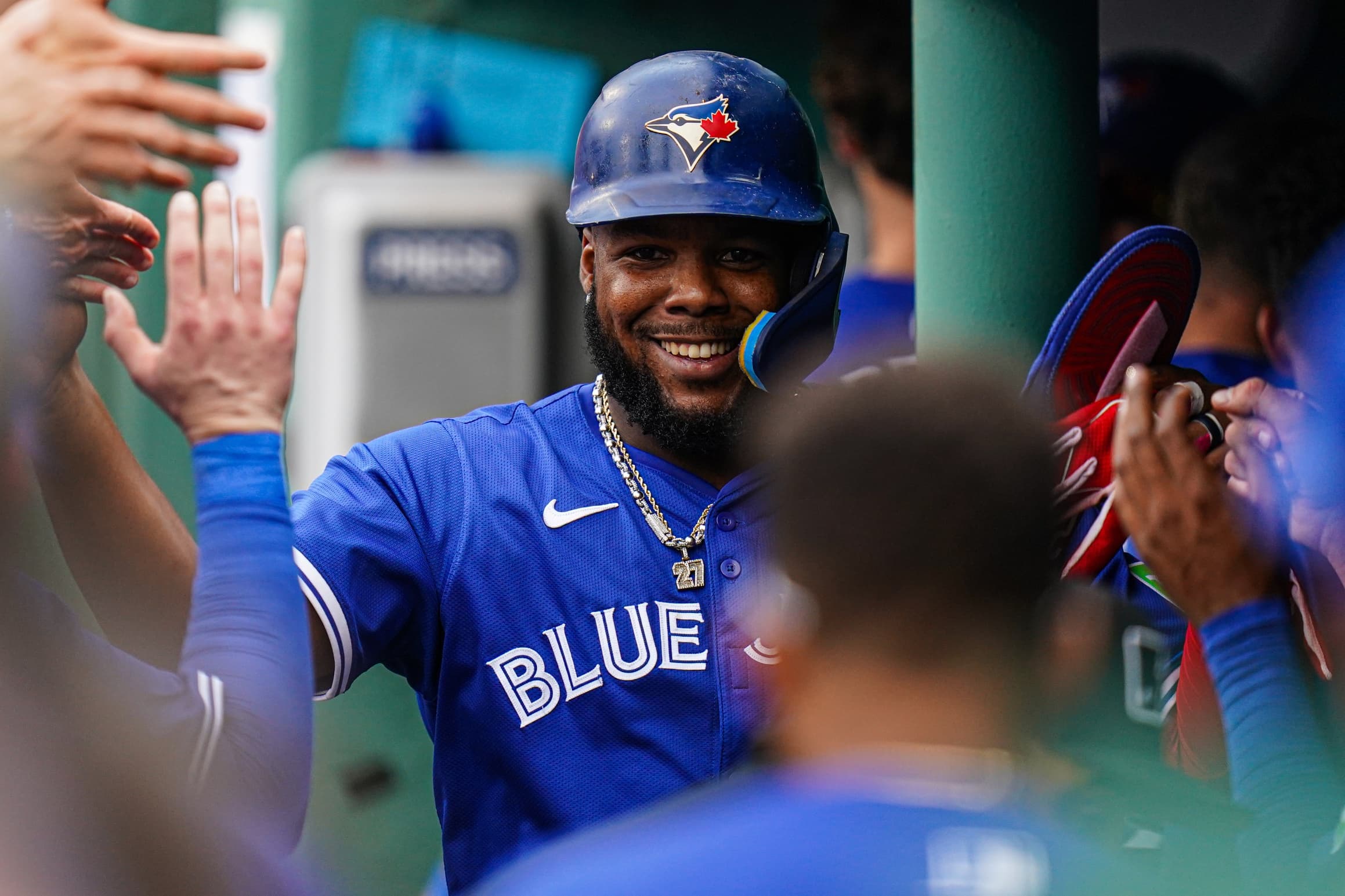
Photo credit: © David Butler II-USA TODAY Sports

Aug 28, 2024, 07:00 EDTUpdated: Aug 27, 2024, 21:55 EDT
One of the biggest questions surrounding the Toronto Blue Jays this offseason is whether they will lock down one of their core players to a long-term deal – a trend that the club has dipped their toes into but hasn’t fully embraced. The front office was able to sign José Berríos to a seven-year pact in 2021 but question marks remain around their two biggest core pieces in Vladimir Guerrero Jr. and Bo Bichette. Both are eligible for free agency next winter.
The current narrative appears to be more centred around Guerrero sticking around versus Bichette, at least if the social media channels had a say in the matter. The Montreal-born slugger has found a resurgence at the plate after a slow start to the campaign while Bichette has struggled to find not only consistency in the batter’s box but also on the field, with a calf injury sending him to the IL on two separate occasions this year. If the Jays want to extend at least Guerrero in this scenario, the deal needs to get done this winter to limit any outside noise from the free agent market that is just one campaign away. Guerrero is also arbitration-eligible this offseason and that is a process that Jays likely want to avoid should they wish to have long-term discussions on the table.
The toughest task is finding the sweet spot on an extension for the first baseman, as his stats have been in flux over the years that has seen comparisons be hard to come by when looking for middle ground. Factoring in that Guerrero plays a position that doesn’t command the attention of a spot like a shortstop, third base, or centre field, it is boom or bust with his bat that becomes the calling card for extension talks.
Throwing numbers out seems a bit trivial because it depends on the length of the contract he would be signing to gain any ground, but for a short-sighted comparison’s sake, the current highest contracts for a first baseman in the league (who all signed long-term deals) are Freddie Freeman ($27 MM) and Paul Goldschmidt ($26 MM). This comparison of course does not factor in Guerrero’s age compared to the others at the time of free agency, years of experience, or one of the handful of other arguments to be had – adding only to the intrigue that is finding that common ground between player and club. Another wrinkle into the mix is Pete Alonso’s pending free agency, a hard-hitting first baseman who could determine a bit of the market for Guerrero’s services.
While there are a few different ways the Jays front office could handle this topic, one idea to consider is a structured contract similar to what Julio Rodriguez locked down with the Seattle Mariners late in the 2022 season.
It is a very complex contract in the grand scheme of things. It features multiple options, both player and club format, and also rewards the outfielder depending on where he ranks in terms of MVP balloting.
Overall, the breakdown is that Rodriguez is in line to make $210 MM over the next 12 years given the options at both his and the Mariners’ disposal but could stand to earn $470 MM over the length of the deal. After the 2029 season (and making $120 MM), the Mariners have to decide between extending Rodriguez for eight or ten seasons or declining their option, which would allow the outfielder to exercise his player option for another five years at $90 MM (meeting that minimum $210 MM) or decline, heading to free agency at 30-years-old. Focusing on the Mariner’s options, the determining factor for the amount of money Rodriguez can earn is dependent on how many MVP finishes or wins he accumulates through the first eight seasons of the deal.
The contract maxes out (under the options) if he wins two MVP awards or finishes in the top five on four different occasions in that timeframe, which would put him in the upper echelon of players who have achieved that feat that early into their respective careers. The value of the deal decreases if Rodriguez doesn’t find himself in the MVP voting conversation from the time he signed the deal through the 2029 season, a tactic that puts more onus on the player to perform at a high level to reap the rewards. The Mariners benefit if the centre fielder continues to play at a high level and the player benefits in terms of salary for his efforts or can still hit free agency at a prime age should the club decide they don’t want to spend the money over the rest of the deal.
This is a peculiar contract and one that isn’t replicated with frequency across the league but the Jays are no stranger to options trees, a tactic they employed with Chad Green (to a much lesser extent) as he was returning from Tommy John surgery at the time of his signing.
For the Blue Jays, a contract of this nature removes some of the guesswork out of the equation when it comes to finding a specific average value for the first baseman who has found both the ups and downs at the plate over his career. While he hasn’t produced a season flirting with the Mendoza line, fans have seen a dominant Guerrero in 2021 and the latter half of this campaign but have seen the opposite at the plate, reflecting how the 2024 season started and the 117 OPS+ he put up last season.
That isn’t a bad mark when compared across the league by any means but for Guerrero, a player the Blue Jays rely heavily on for offensive production and one that already earns towards the top of salary books for this squad, is a stat line that is below what is expected from someone who many expect or consider to be a generational hitter. It’s a tough benchmark to live up to, there is no doubt there. But the fact of the matter is if you want to earn the big bucks (think $25-30 MM per year), this is the expectation and sets the precedent as a player where the club is going to build the team around to find postseason success – something that has eluded this team since 2016.

Vladimir Guerrero Jr. has 56 hits since the All-Star break in 132 at-bats. That's a .424 average with 13 home runs and 16 doubles in 36 games!
For his career, Guerrero owns a .286/.362/.501 mark with 157 home runs, 491 RBIs, and a .863 OPS and a 137 OPS+ through 791 games. He has four All-Star appearances to his credit as well as a Silver Slugger Award, a Gold Glove Award, a Hank Aaron Award, and a Home Run Derby belt to his collection while tying for the league lead in home runs (48) back in 2021, narrowly missing on that AL MVP award to Shohei Ohtani. The biggest knock on an extension for Guerero is his inconsistent track record, something my colleague Ian Hunter outlined well.
Guerrero is no doubt a talented player and considering how much he has been vocal about staying in Toronto, it seems like a natural match to keep him around long-term (or at least a very clever marketing tactic that benefits him). Any extension with hundreds of millions of dollars on the line is going to come with considerable risk, whether it is performance issues, off-the-field dilemmas, or injuries hampering said player’s career.
For Guerrero and the Blue Jays, a deal similar in nature (not value-wise – let’s make that clear as they are two completely different players) that is incentive-based might be more complicated on paper but should benefit both club and player if the Jays slugger continues to trend towards the player fans are witnessing now compared to the start of the season. It eliminates some of the risks of a long-term deal in terms of value commitment (less money for fewer accomplishments per se) for the team but also benefits Guerrero if he continues to be a prominent bat for this team, which in turn benefits the team.
Regardless of whatever type of contract shakes out between the two sides, the fact of the matter remains the same: if the Blue Jays want to keep Guerrero Jr. around for a long time, they need to do it this winter.
Recent articles from Tyson Shushkewich
Breaking News
- Blue Jays listed as one of six destinations for Tarik Skubal by MLB.com
- Blue Jays Arizona Fall League check-in: Aaron Parker has found success in limited playing time
- Blue Jays free agent target: Kaima Taira
- Spencer Miles dazzled during a rookie season few saw coming
- Examining how the Blue Jays performed defensively in 2026