
Coming in at #4 in our top 10 Blue Jays playoff moments in franchise history. Edwin Encarnacion wins in with a walk-off homerun to beat the Orioles in the 2016 Wild Card game! 🎥 MLB

Trade Tree Tuesday: Trading Orlando Hudson landed the Blue Jays a Hall of Famer, a franchise icon, and is going strong today
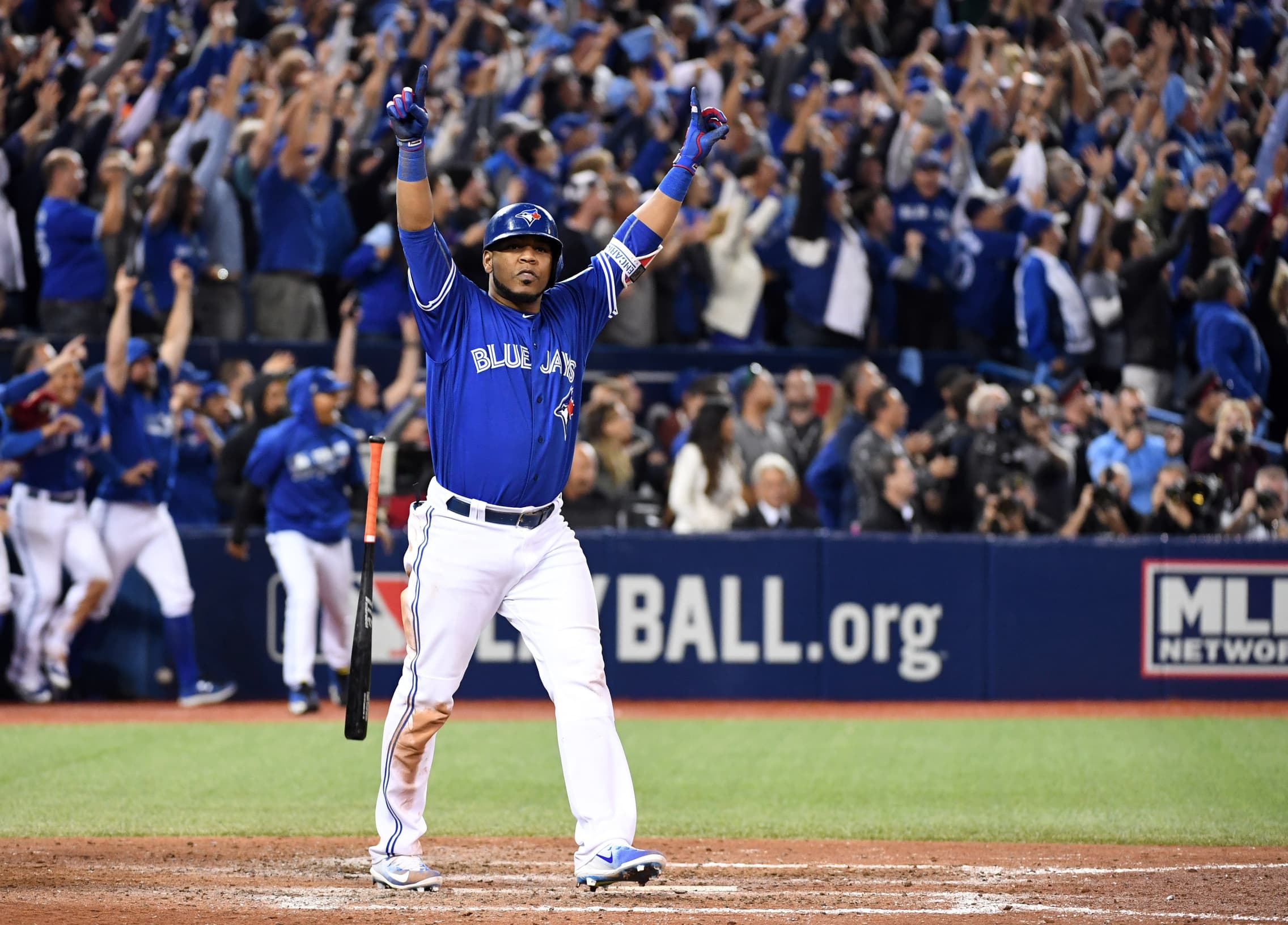
Photo credit: © Nick Turchiaro - Imagn Images

Oct 20, 2026, 17:00 EDTUpdated: Oct 20, 2026, 16:27 EDT
On June 3rd, 1997, the Toronto Blue Jays made a transaction that still has ramifications to the team three decades later.
In the 43rd round of the 1997 MLB Draft, the Jays selected Orlando Hudson. The second baseman went on to have a strong career, going to the 2007 and 2009 All-Star Games, winning four Gold Gloves in a five-year period. His stint with the Blue Jays was short, playing parts of just four seasons with the team.
But late in 2005, the Blue Jays traded Hudson, beginning a trade tree that continues to this day. Let’s take a look at the fall out of the Orlando Hudson trade.
The early beginnings of the Orlando Hudson trade tree
Hudson spent four seasons with the team, becoming a regular big leaguer in 2003. In 521 plate appearances, the second baseman slashed .268/.327/.395 with nine home runs for an 88 wRC+, giving him a 1.4 fWAR. In 2004, he slashed .270/.341/.438 with 12 home runs in 551 plate appearances, giving him a 100 wRC+ and a career-best 3.7 fWAR.
The second baseman’s final season with the Jays was in 2005, slashing .271/.315/.412 with 10 home runs in 501 plate appearances for an 89 wRC+ and 2.5 fWAR, winning the American League Gold Glove that year.
On December 27th, 2005, the Jays sent Hudson and Miguel Batista to the Arizona Diamondbacks for Troy Glaus and Sergio Santos. Hudson’s best years came in the National League West, winning back-to-back Gold Gloves with the Diamondbacks in 2006 and 2007, representing the team in the 2007 All-Star Game.
After another season with the Diamondbacks in 2008, he joined the 2009 Los Angeles Dodgers, winning another Gold Glove and appeared in another All-Star Game. He played three more big league seasons, one with the Minnesota Twins, parts of two with the San Diego Padres, and 51 games with the Chicago White Sox before retiring.
Batista, who signed with the team during the 2003-04 off-season, spent two seasons with the organization, appearing in 109 with an ERA above 4. A former Diamondback, his best years came with the team before joining the Jays, and following his Jays’ tenure, he bounced around the league as swingmen typically do. Funnily enough, his final minor league games came in 2013 with the Blue Jays’ Triple-A team.
Santos spent several seasons in the Blue Jays’ organization, but was claimed by the Twins in May 2008. In 2010, he made his big league debut with the Chicago White Sox, and was eventually traded back to the Blue Jays where he spent parts of three seasons from 2012 until 2014. In 2013, he posted a 1.75 ERA and 1.84 FIP in 25.2 innings of work.
But the acquisition that kept this trade tree growing was Glaus.
Troy Glaus
The corner infielder was a darn good player in his prime, and in 2006, he was named an All-Star for the fourth and final time in his career. That season saw him slashed .252/.355/.513 with 38 home runs in 634 plate appearances. He also earned MVP votes that season, finishing 30th in American League voting.
That season turned out to be one of the better statistical seasons from the Blue Jays from their 1993 World Series victory until they made the 2015 postseason. Their 87-75 record in 2006 was only bested by their 88-74 record in 1998, backed by a strong season by Roger Clemens.
Glaus wasn’t as productive in the power department in 2007, but it was still a good season. Overall, he slashed.262/.366/.473 with 20 home runs in 456 plate appearances, good for a 122 wRC+, besting his 119 wRC+ the season before.
The Jays finished with an 83-79 record in 2007, the second of three consecutive seasons where they hit the 80+ win mark, but due to there only being on Wild Card spot, the Jays’ postseason drought continued.
On January 14th, 2008, the Jays sent Glaus to the St. Louis Cardinals for Rolen. Glaus went on to slashed .270/.372/.483 with 27 home runs in 637 plate appearances with the National League Central team, his last productive season in the big leagues.
Scott Rolen, and the diverging trade tree
Rolen is now in the Baseball Hall of Fame, but his lone full season with the Blue Jays was far from his best. In 2008, the third baseman slashed .262/.349/.431 with 11 home runs in 467 plate appearances, good for a 108 wRC+ and 2.7 fWAR. Earlier in his career, he consistently hit upward of 25 home runs and finished with an fWAR above 4.5.
Beginning the 2009 season on the team, Rolen production improved, slashing .320/.370/.476 with eight home runs in 373 plate appearances, good for a 122 wRC+ and 3.1 fWAR.
The 2009 season wasn’t a great one for the Blue Jays, and nearing the trade deadline day, the Jays owned a 49-53 record, well outside the wild card race. On July 31st, the Jays sent Rolen to the Cincinnati Reds for Josh Roenicke, Zach Stewart, and a struggling mid-20s corner infielder.
Roenicke spent parts of two seasons with the Blue Jays, posting a 6.38 ERA and 4.42 FIP in 36.2 innings of work. Following the 2010 season, Roenicke was claimed off waivers. That struggling mid-20s corner infielder hit eight home runs in 173 plate appearances following the trade, but was claimed off waivers by the Oakland Athletics in November 2010.
Thankfully, he re-signed with the Blue Jays and became a franchise icon, because that struggling mid-20s corner infielder was Edwin Encarnación.
Here, the trade tree splits into two notable pathways, we’ll start with the Stewart branch, as it’s the branch no longer active.
Zach Stewart netted the Jays Colby Rasmus
Stewart appeared in three games with the Blue Jays in 2011, posting a 4.86 ERA and 4.47 FIP in 16.2 innings of work. On July 27th, 2011, he and Jason Frasor were traded to the Chicago White Sox for Edwin Jackson and Mark Teahen.
Stewart appeared in 10 games with the White Sox to end the 2011 season, then 18 more games in 2012 before starting two games for the Boston Red Sox in 2012. That spelled the end of his big league career. Frasor, who had been a Blue Jay since 2004, joined the team in 2012. He had a solid big league career. Teahen appeared in 27 games with the Jays, his final big league action.
Jackson’s first stint lasted just a few hours, as he was packaged alongside Octavio Dotel, Marc Rzepczynski, and Corey Patterson to the Cardinals for Colby Rasmus, Trever Miller, Brian Tallet, and P.J. Walters.
Rasmus was the notable player in this trade. He struggled to end the 2011 season, but slashed .223/.289/.400 with 23 home runs in 625 plate appearances with the Jays in 2012, good for an 82 wRC+ and 1.2 fWAR.
The outfielder’s 2013 season was far better, slashing .275/.338/.501 with 22 home runs in 458 plate appearances, giving him a 130 wRC+ to match his career-best, and a 3.9 fWAR, his second best fWAR of his career. Rasmus’ final season with the Jays was in 2014, slashing .225/.287/.448 with 18 home runs in 376 plate appearances for a 104 wRC+ and 1.5 fWAR.
In the 2014-15 off-season, Rasmus signed with the Houston Astros, ending this branch of the trade tree. Miller appeared in six games with the Jays before being released in 2011. Tallet, who spent five seasons with the Blue Jays from 2006-2010, only threw one-third of an inning in 2011, giving up two earned runs. He was released shortly after. Walters only appeared in one game with the Blue Jays before electing free agency.
Edwin Encarnación
I buried the lede a bit with Encarnación, but we all know who he is. After re-signing with the Jays during the 2009-10 off-season, the first baseman/designated hitter broke out into one of the best power bats in team history. In seven seasons with the team from 2010-2016, he slashed .269/.357/.526 with 231 home runs in 4,030 plate appearances, good for a 139 wRC+.
Even after re-signing in 2010, it took two seasons for Encarnación to become the player he did, mashing 42 home runs in 2012, setting a career-high. From the 2012 season until the 2019 season, he never hit fewer than 32 home runs, and hit 36 home runs in 2013, 34 in 2014, 39 in 2015, and 42 in 2016.
One of his final home runs as a Blue Jay was one of the biggest home runs in team history, hitting a walk off blast in extra innings of the 2016 Wild Card game. A few months later, his tenure with the Jays came to an unceremonious end, as he signed with the Cleveland Guardians.
Post-Encarnación days
Encarnación departed the Blue Jays in free agency, but due to the Competitive Bargaining Agreement at the time, the Blue Jays received a compensation pick following the first round of the 2017 MLB Draft. With the 28th overall pick, the Jays selected Nate Pearson.
Once a top 100 prospect, Pearson’s career hasn’t lived up to the potential it once had, injuries playing a big part in that. Debuting in 2020, Pearson finished with a 6 ERA and 7.19 FIP in 18 innings of work, starting four of the five games he appeared in. That essentially ended his career as a starter.
Still, there was some potential out of the bullpen, as Pearson was (and still is) capable of reaching triple-digits with his heater, paired with a nasty curveball. He found some success in 2021, posting a 4.20 ERA and 4.64 FIP in 15 innings of work, but didn’t appear in a big league game in 2022.
A full-time reliever by 2023, Pearson appeared in a then-career high 35 games, owning a 4.85 ERA and FIP in 42.2 innings of work, with a rather disappointing 23.6 K% given his repertoire. Pearson regularly featured in the Blue Jays’ bullpen in 2024, but posted a 5.63 ERA and 4.64 FIP in 40 innings of work, though his K% climbed to 28%.
With the Blue Jays well out of the postseason race, they sold at the deadline, which included trading the former top 100 prospect. On July 27th, 2024, the Jays sent Pearson to the Cubs for Yohendrick Piñango and Josh Rivera, two players who are currently in the organization.
Pearson was solid for the Cubs to end the 2024 season, but struggled in his 11 outings with them in 2025. His most recent season was split between the Houston Astros and Kansas City Royals, where he posted a 4.11 ERA and 3.97 FIP in 46 innings of work, a career-best year for the 30-year-old.
Rivera, a 26-year-old shortstop, was a top 30 prospect at the time of the trade, but has had a couple of unimpressive seasons in the Blue Jays organization. He played 102 games with the Triple-A Bisons in 2026, slashing .212/.280/.376 with 11 home runs for a 73 wRC+, made worse by a 33.2 K%
If this trade tree remains active for the foreseeable future, it’ll be because of Piñango. The outfielder had a solid showing at times in his rookie season, slashing .260/.306/.396 with five home runs in 180 plate appearances with the 2026 Blue Jays. In Triple-A, Piñango slashed .269/.351/.455 with 11 home runs in 308 plate appearances.
With subpar defence in the outfield, Piñango’s future may lie as a designated hitter, but there’s some pop in his bat. Still on the 40-man roster, his future from here on out is unknown, but he has the type of profile that could be traded or could somehow figure it out in his late 20s, much like Encarnación did.
Cynthia Ryley Delaney is a Nation Network writer for Blue Jays Nation, DFOEdmonton, and DFOCalgary. She can be followed on Twitter @CynthiaRDelaney.
Breaking News
- Trade Tree Tuesday: Trading Orlando Hudson landed the Blue Jays a Hall of Famer, a franchise icon, and is going strong today
- Blue Jays: Looking at how Vladimir Guerrero Jr. can rebound in 2027
- Blue Jays’ ace Dylan Cease was terrific in the first season of his seven-year deal
- Blue Jays free agent target: Ian Happ
- NPB’s Hanshin Tigers agree to post Teruaki Satō