
Danny Jansen pads the lead for the @BlueJays!

An uncertain trade market could extend Danny Jansen’s Blue Jays tenure beyond July 30 deadline
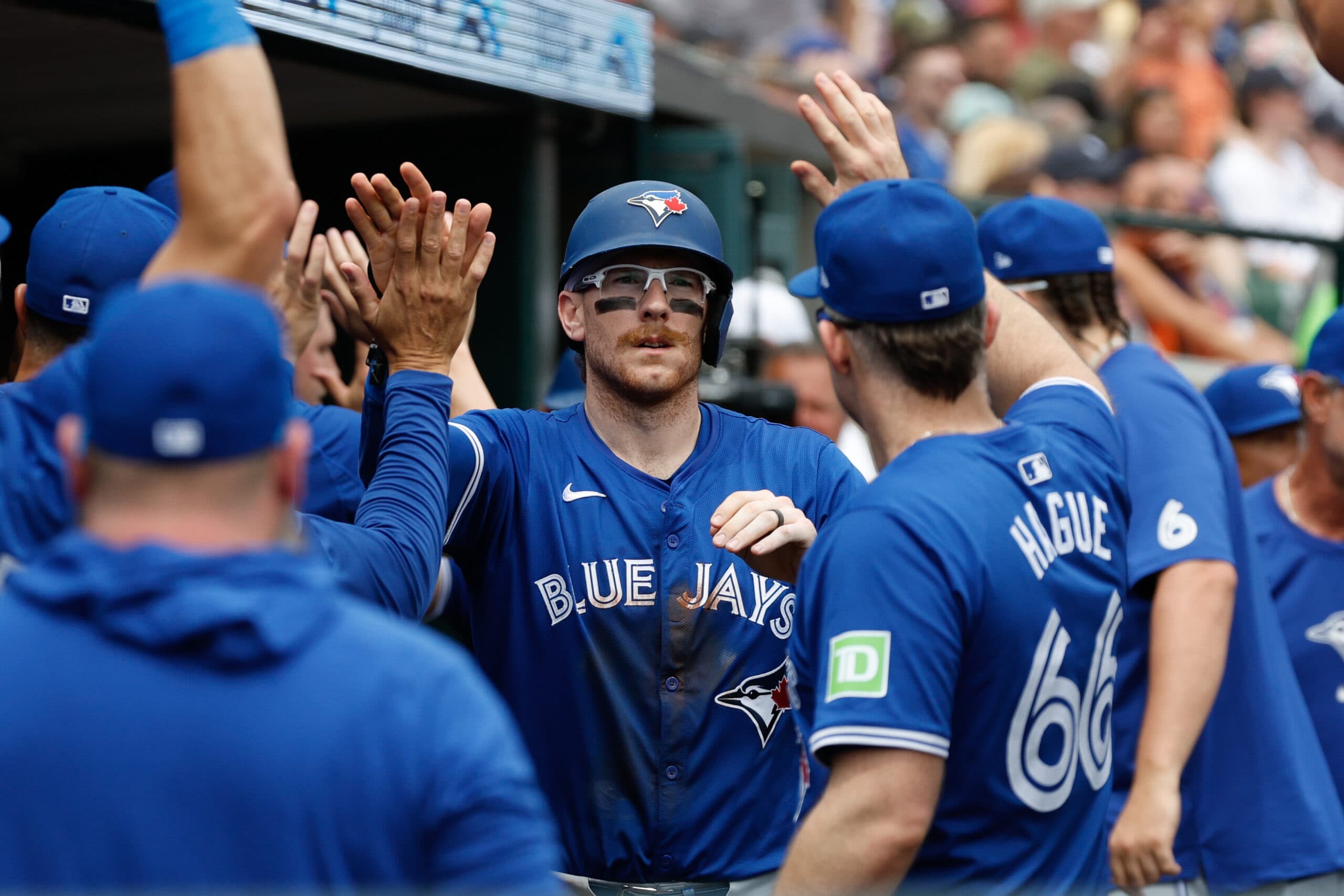
Photo credit: Brian Bradshaw Sevald-USA TODAY Sports

By Thomas Hall
Jul 9, 2024, 15:30 EDTUpdated: Jul 9, 2024, 15:44 EDT
Between now and the July 30 trade deadline, the Toronto Blue Jays must assess which players they’ll be looking to sell for future assets to help maintain their competitive window in 2025 and ’26. But it’s unclear if Danny Jansen — a free agent after ’24 — will be among those on the move.
Realistically speaking, since the front office doesn’t appear to have much of an appetite for a rebuild, chances are the organization’s top priority will be fielding offers on players who can enter free agency after this season. Though that includes Jansen, as well as Yusei Kikuchi, Yimi García, Justin Turner, and a few others, his trade market may be vastly different compared to the other soon-to-be free agents.
Why might that be? Catchers are a different breed than everyone else and are rarely dealt in season. Take last season, for example. The Pirates-Rangers trade for Austin Hedges was the only notable one involving a backstop to occur ahead of the deadline. Then, the year before that, Christian Vázquez and former Blue Jay Reese McGuire were the highest-profile catchers traded mid-season.
Acquiring a catcher during the middle of the season comes with plenty of obstacles, like having to learn an entire pitching staff on the fly and the club’s defensive strategies and tendencies. Plus, most organizations are typically content with their current big-league catching duo at this point of the year, limiting the market for rental backstops.
That’s why most front offices shift their attention elsewhere, focusing on more pressing needs leading up to the trade deadline. And that could very well happen with Jansen’s market this year. The one difference-maker with him, of course, is his bat.
Jansen, when healthy, has become one of the top offensive catchers in baseball. Entering this season, he led all qualified big-league catchers (min. 750 plate appearances) in slugging percentage (.487) and isolated power (.250), ranking sixth in wRC+ (121), eighth in offensive WAR (16.6) and 10th in home runs (43) from 2021-23. That should make him an appealing target, either as a catcher or DH.
But for whom? And which team would be willing to submit a worthwhile offer for the 29-year-old slugger?
There are a handful of playoff contenders that, from a statistical perspective, would benefit from acquiring Jansen. In the American League, you have the Guardians, Mariners, Astros, Red Sox and Tigers, one team that could utilize him at catcher and DH. Over in the National League, potential suitors include the Brewers, D-Backs, Padres, Mets, Giants and Pirates.
That’s a list of over 10 teams who may or may not pursue Jansen. However, there’s a strong case to be made with every one of those clubs about why they wouldn’t trade for a catcher or DH type prior to July 30.
Let’s begin with Cleveland here. Jansen would be a huge upgrade over Hedges as a backup, and he’d take some pressure off Bo Naylor’s struggling bat. But the Guardians likely need an impact starter more than an offensive boost behind the plate, as does a team like the Astros. Still, perhaps it’d become more feasible if the Blue Jays packaged their primary catcher with Kikuchi.
Seattle also seems like a realistic fit, especially after outrighting Seby Zavala to triple-A. Cal Raleigh remains the starting catcher, but Mitch Garver — a former catcher, now primary DH — will have to occasionally strap on the gear moving forward. Acquiring Jansen would surely help, although Toronto may have to take a salary back or send cash to offset Jansen’s remaining $5.2-million salary — which should better its return — for an organization that had to shed payroll last winter.
Boston and Detroit, meanwhile, find themselves in similar situations. Neither team has received resounding offensive results from its catching depth this season, but both seem unlikely to make a significant change behind the plate, particularly for a rental. The Red Sox have needs elsewhere — like adding more swing-and-miss to the bullpen — while the Tigers might sell, entering Tuesday’s slate seven games out of a playoff spot.
Moving to the NL, the Central-leading Brewers make plenty of sense for Jansen, who’d form a one-two punch with All-Star William Contreras and provide another option to rotate through the DH position. Like Boston and Houston, though, Milwaukee desperately seeks starting pitching help, even after acquiring Aaron Civale from Tampa Bay last week.
The Padres also fall into that category, and GM A. J. Preller may ultimately devote his energy to chasing the biggest fish in the sea, White Sox ace Garrett Crochet. But the catching tandem of Kyle Higashioka and Luis Campusano has largely been an offensive anchor thus far, and the Blue Jays could take one of them off their hands to help facilitate a trade.
A potential Jansen-to-Arizona trade would certainly raise some eyebrows in these parts, reuniting him with former Blue Jays Gabriel Moreno, Lourdes Gurriel Jr. and Randal Grichuk. The D-Backs could use a bit more offence at catcher, although they might not view that as a primary concern, given the injuries to their starting rotation. Plus, with Joc Pederson as an everyday DH, there may be little playing time to offer.
It could be a long shot for the Mets, Giants or Pirates to make a serious play for Jansen. All three clubs enter play Tuesday at least one game below .500 — but remain in the crowded NL wild-card race — and likely haven’t decided whether to buy, sell or stand pat ahead of the trade deadline. As such, that group’s interest level in acquiring a rental catcher probably isn’t high.
There are two other teams with needs at catcher and DH who could be a fit for Jansen, the Cubs and Rangers, but are probably too far out of contention to buy rather than sell leading up to July 30.
Another element that could impact Jansen’s trade market is he’s gone ice cold at the dish over the last month-plus, hitting .101/.203/.145 with only three extra-base hits (all doubles) and 16 strikeouts in 24 games since June 3. In that time, his wRC+ has dropped 59 points on the year, plummeting from 156 to 97, three per cent below league average.
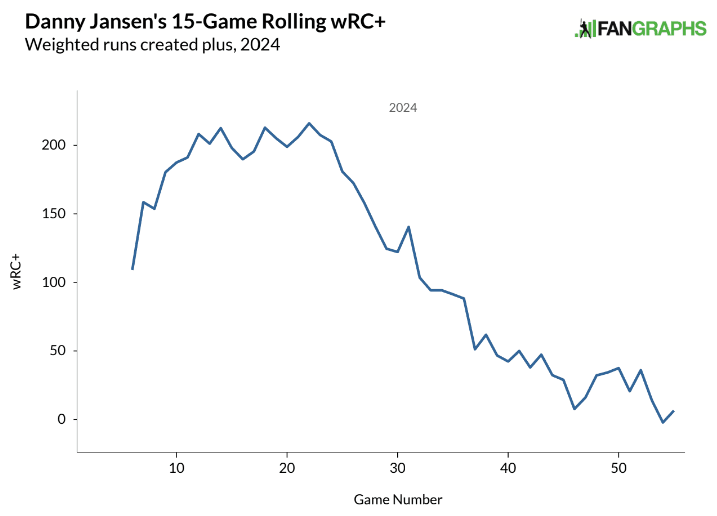
Source: FanGraphs
There’s still time before the trade deadline for Jansen to string together a couple of strong weeks at the plate to revitalize his value, further convincing teams he can help carry a lineup down the stretch. But if his struggles continue, it may cause those on the fence of pursuing him to jump off completely.
Given these factors, it’s fair to wonder if the Blue Jays are better off holding onto their longest-tenured player through July 30. This organization has become very thin at the catching position in 2024 and would be dangerously low without Jansen, forcing Brian Serven up from triple-A Buffalo again.
That’d be less of a problem if Alejandro Kirk had returned to the 2022 All-Star that excelled to a 129 wRC+ two seasons ago. Instead, he has struck out nearly five percent more than he’s walked in 49 games this season, posting a career-worst 73 wRC+, tied for 31st out of 37 big-league catchers with at least 150 plate appearances.
Toronto would, of course, run the risk of losing Jansen for nothing in free agency by removing him from the trade block. But by trading him, they’d have a significantly wounded depth chart that won’t be easy to improve, considering he’ll likely headline this winter’s thin crop of free-agent catchers.
Predicting Jansen’s upcoming free agency is also complicated, given how much time he’s spent on the IL over his seven major league seasons. But there’s no question the Blue Jays value him immensely, and they’d be in a very tight situation without him next season.
This organization desires to remain competitive in 2025, and understandably so. After all, everyone has jobs on the line, relying on the success of this reset/reboot expected to occur over the next three weeks and into the off-season.
Keeping Jansen and reopening contract negotiations after this season could help lead this thing in the right direction — which you could argue probably should’ve happened long before now.
Recent articles from Thomas Hall
Breaking News
- Trade Tree Thursday: Examining how the Blue Jays got MVP-winning Josh Donaldson
- Despite early injury, Alejandro Kirk remained a focal point of the Blue Jays’ success in 2026
- Blue Jays free agent target: Gleyber Torres
- Blue Jays’ Dylan Cease nominated for MLBPA’s outstanding pitcher award
- 5 Blue Jays named 2026 American League Gold Glove finalists