
The T-Bird flies again: How this Blue Jays logo muscled its way back into fans’ hearts


By Ian Hunter
Jun 22, 2026, 16:00 EDTUpdated: Jun 22, 2026, 14:03 EDT
What’s old is new again in Blue Jays Land. As part of their 50th season celebration, the Toronto Blue Jays have gone back into the vault and revitalized their old logos from eras past.
Where the team once unveiled a design and seemingly never spoke of it again, they’ve embraced history with open arms, including all the previous logos the team has donned over the last 50 years.
That includes one bird that was the Blue Jays’ primary logo for a fleeting moment, and one of the most polarizing characters in club history: the T-Bird.
By 1999, the Toronto Blue Jays had only ever used two primary logos in the team’s then 22-year history: the original retro logo from 1977 to 1996, and a slightly different bird from 1997 to 2002.
The tides began shifting in the early 2000s as the “third jersey” craze took hold in professional sports, and alternate uniforms became all the rage in Major League Baseball. Not wanting to be left on the sidelines, the Blue Jays developed an alternate logo of their own.
The team approached the Toronto-based advertising agency, Echo Advertising. Ken Priestley was the art director, and as a firm that had experience creating promotional materials for concerts, theatre, and sports teams like the Toronto Maple Leafs and Toronto Raptors, Echo was well-equipped to revamp the Blue Jays logo.
Echo Advertising’s resume included creating promotional items like booklets which advertised the Maple Leafs’ new home at the Air Canada Centre, as well as promotional material for the Rolling Stones’ Bridges to Babylon tour.
Yet this was the agency’s first foray into creating a logo from scratch for a professional sports team. The Blue Jays gave the firm a few parameters, but Priestley and his team had creative freedom to do as they saw fit. Priestley submitted a handful of drafts, and the Blue Jays were pleased with the initial results.
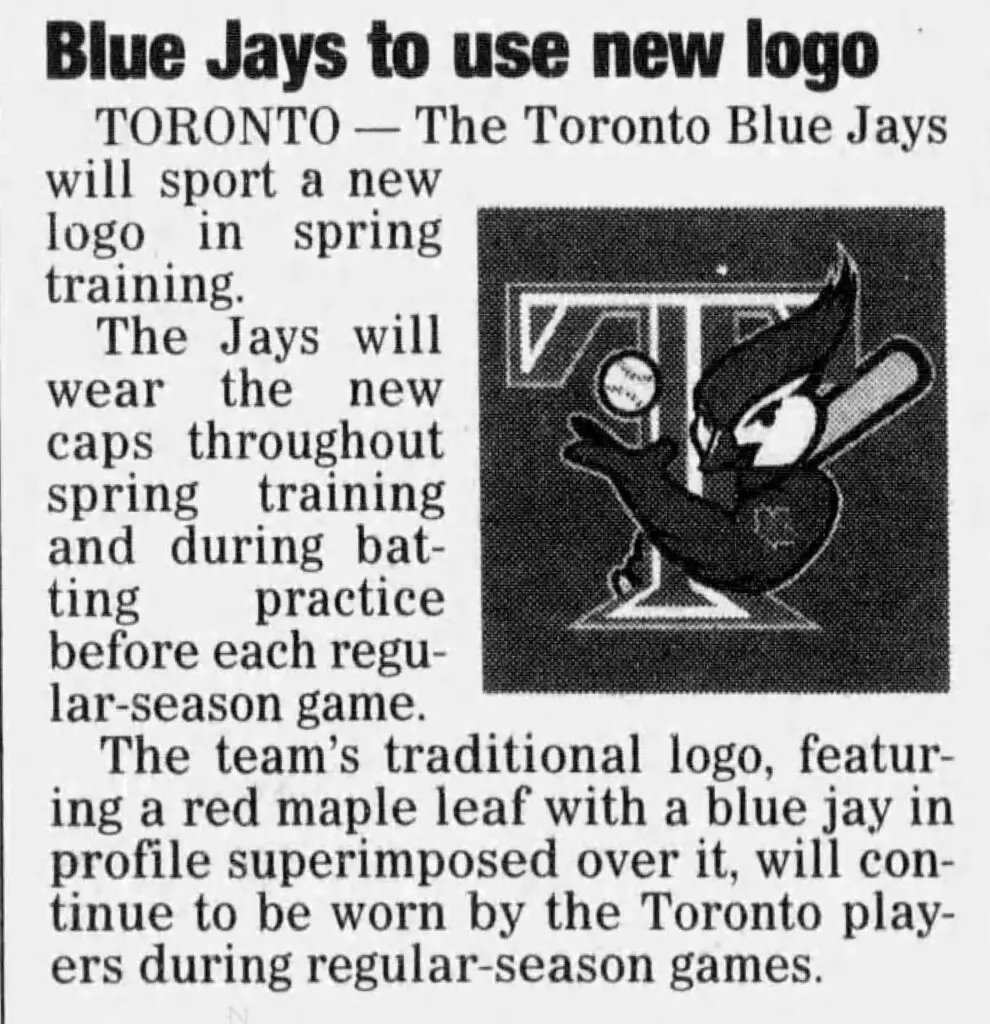
In previous iterations of the Blue Jays logo, only the head of the bird was visible. But in this new one, the firm wanted to add more personality to the bird by adding some physical characteristics which would make it a little more domineering than before.
Winnipeg Sun
They drew inspiration from the Baltimore Orioles’ cartoonish bird logo, which, oddly enough, made its own resurgence with that team beginning in 2012. Where the Blue Jays’ original logo was very kid-friendly, the T-Bird was the next phase in the bird’s evolution into a more youthful, dynamic, and vibrant character.
“The original bird we designed was a little friendlier,” Priestley said. “He ended up a little more intense-looking. One of the Blue Jays coaches commented that he wanted the bird to look tougher; that the wings should be more muscular, and it should have a more intense look to it.”
Also known by some fans as the “muscle bird,” the bird looks similar to the current iteration of the Blue Jays’ primary mascot, Ace. It’s a blue jay that looks like it never skipped arm day, with a swath of slick blue hair in the back, and a maple leaf tattoo on the left arm to reiterate the Canadian identity.
In January 2000, the Blue Jays announced they’d use the new T-Bird logo as part of their spring training uniforms, as well as a third alternate kit which would be worn sporadically throughout the regular season.
While the T is a primary figure of the logo, Priestley initially proposed the bird would be wrapped around the letter J for “Jays.” That idea was rejected by Major League Baseball, and so Echo Advertising pivoted and changed it to a T for “Toronto.”
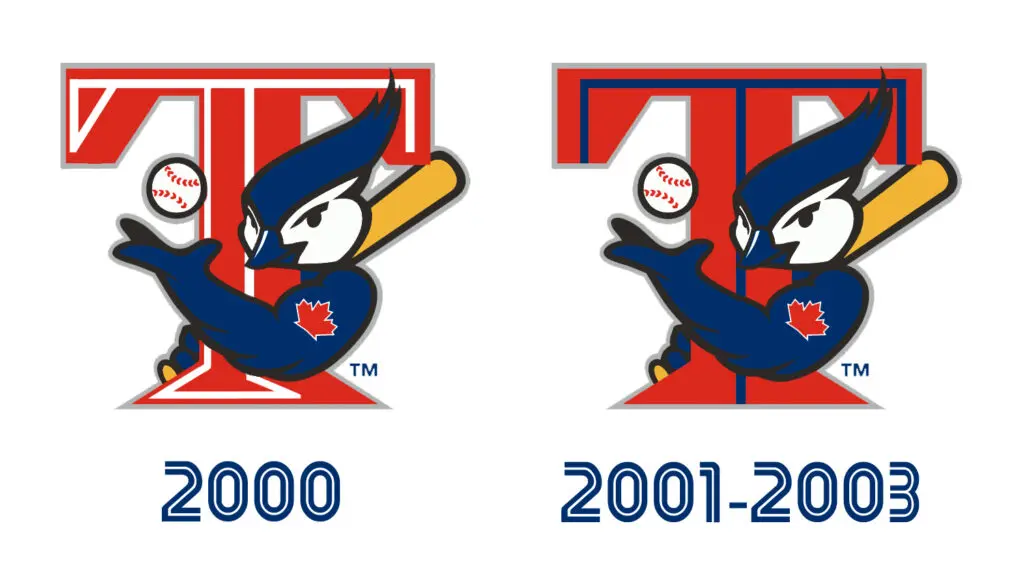
During the first year of the logo in 2000, the T had some triangular serifs on the inner edges of the letter, which made it look similar to the Texas Rangers’ T in their logo. For the 2001 season, the white lining was swapped for blue, to mimic the Blue Jays’ famous split-letter font.
Chris Creamer/SportsLogos.net
By 2003, the T-bird became the primary logo for the Blue Jays, appearing on both the cap and the sleeve of the uniform. That was never in the initial plans for the logo, as it was originally treated more like a specialty design. But Priestley was pleasantly surprised to learn that what began as more of a novelty logo was soon elevated as the face of the franchise.
“It was unbelievable,” Priestley said. “I remember discussing it with my creative director at the time, and he said it was fantastic. It instantly becomes part of the team’s history. Even if it was only for a few years, it kept showing up occasionally. The fact that it came out of nowhere was really exciting.”
According to the Toronto Sun, the rationale behind choosing the T-bird as the team’s primary logo for the 2003 campaign was that research deemed the old logo to be outdated, so the T-bird was a stopgap until the team unveiled a revamped logo heading into the 2004 season.
As with any design change, there are always critics, and Priestley noted that many in the media weren’t fans of the new T-Bird design upon its release, and in the years afterwards. By the time the “Angry Bird” design came out in 2004, Bob Elliott said this in the Toronto Sun.
“We don’t have a problem getting rid of the giant ‘T’ in the current logo. We never understood the ‘T’ since the team was trying to sell merchandise to the people in the hinterlands … and the ‘T’ stands for Toronto, and everyone hates Toronto.”
For its time at the turn of the century, the T-Bird was an appropriate sports logo for its era. It accomplished what Priestley and Echo Advertising wanted to do, which was to give more personality to the logo and create a character that fans could identify with.

In 2026, the T-Bird was given new life. Often featured on promotional material for the Blue Jays’ 50th season, it’s become a fan favourite again. Younger fans are discovering the logo for the first time, and maybe even some harsh critics from the past have come around on its design.
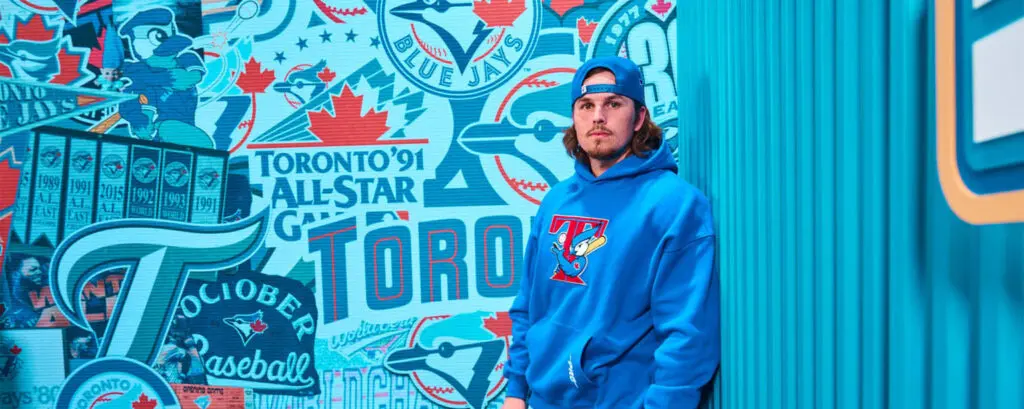
The T-Bird was revived for the Blue Jays’ Y2K weekend and was featured on their retro hoodie giveaway on April 24. Along with the Angry Bird logo, the original Blue Jays logo, and the adaptation logo used in the late 90s, all of them were given their equal place in Blue Jays history for a promotional giveaway.
In the Jays Shop at Rogers Centre, there are T-Bird varsity jackets, hoodies, and crewneck sweaters available as a time capsule of Blue Jays fashion in the early 2000s.

BlueJays.com
Where the feedback on the T-Bird logo may have skewed negative upon its initial release in 2000, like every design, it becomes in vogue again for a new generation.
Often connected to franchise cornerstone players like Roy Halladay and Carlos Delgado, the T-Bird holds a special place in the hearts of Blue Jays fans who endured one of the roughest patches of franchise history.
Therein lies the difficulty in designing a timeless logo that won’t look dated in a few years. You either try to get ahead of the curve and create something ultra-modern, but risk the logo being cast aside in a few years. Or, you design an homage to a previous logo in the hopes of tapping into that nostalgia factor.
Priestley and Echo Advertising tried something different with the T-Bird logo, which, in retrospect, should be commended. Given the passage of 20-plus years, the T-Bird is being viewed through rose-coloured glasses.
BlueJays.com
The logo has been given a second life, something its original designer is thankful to witness all these years later.
“A few years ago, a kid stopped me in the street because he talked to one of my neighbours, and he brought his jersey over for me to sign,” Priestley said. “He said: ‘You’re the best logo designer.’
“I always try to see that side to it. It’s so nice, especially after the initial reviews of the logo. Now, it’s fantastic.”
PRESENTED BY THE BLUEJAYSNATION NEWSLETTER

Stay ahead of the first pitch! From breaking news, unexpected trades and must-read analysis, BlueJaysNation delivers the insight serious Jays fans rely on—straight to your inbox. Sign up for the Bluejaysnation newsletter here!