
Blue Jays’ Kazuma Okamoto must continue adjusting to sustain success
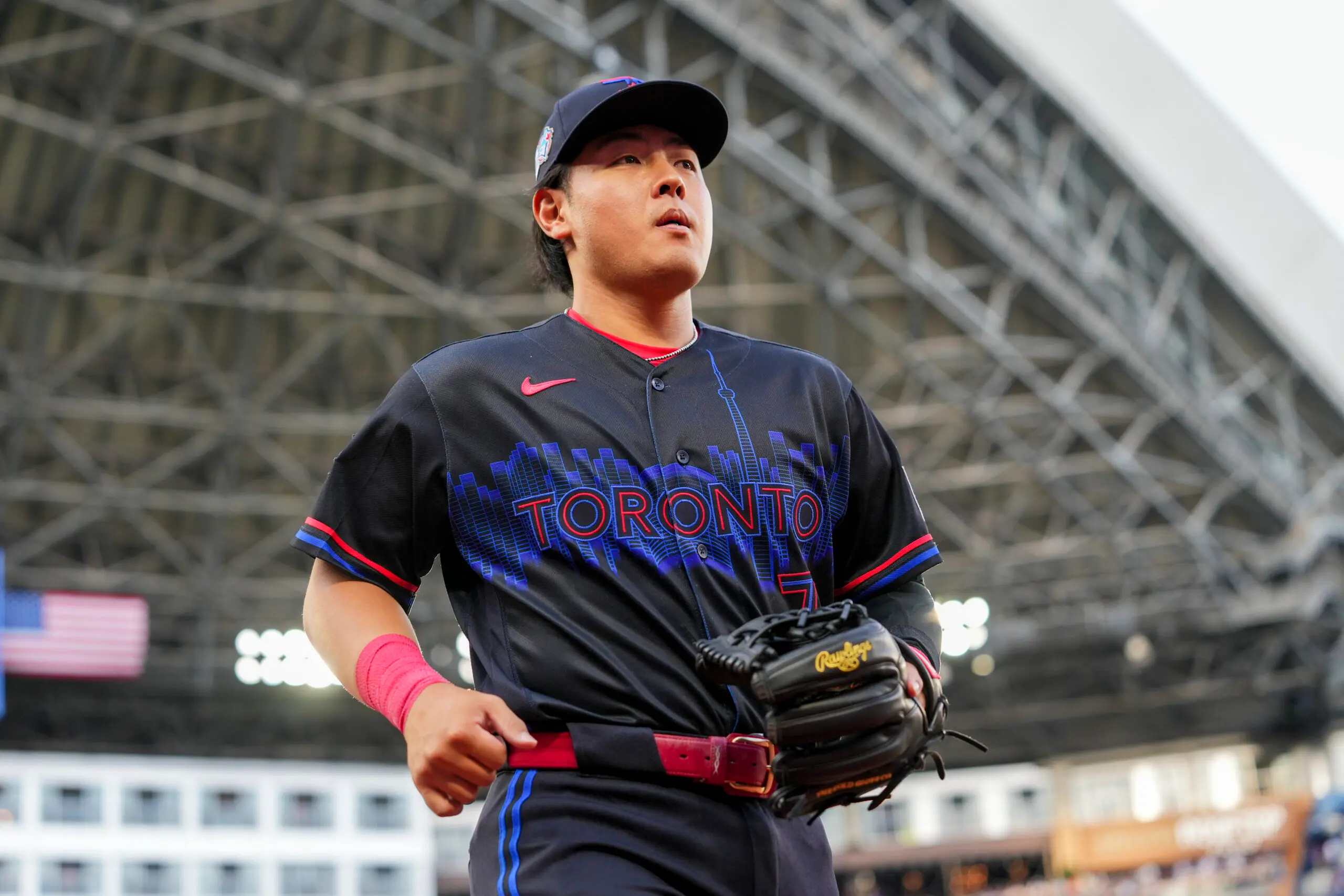
Photo credit: © Kevin Sousa-Imagn Images

Aug 27, 2026, 14:30 EDTUpdated: Aug 27, 2026, 16:26 EDT
Baseball is a game of adjustments, and no Toronto Blue Jay has typified that better this season than Kazuma Okamoto.
The Japanese third baseman’s first year in Major League Baseball has been defined by adjustments and counter-adjustments, ebbs and flows; home runs and strikeouts. It makes sense that a newcomer to the majors could be the poster boy for this kind of chess match as he learns the league and it learns him.
He’s had plenty to adapt to overall, both on and off the field. Moving across the world, learning a new language and culture, and discovering quesadillas is just the start of a list of changes that surely goes on much longer.
On the field, there’s the increased velocity and nastier stuff of MLB pitching, a more gruelling schedule and the increased speed of the game. So it made sense that pitchers started by coming right at Okamoto with fastballs to see if he could catch up.
He saw a fastball 58% of the time over his first 11 games, and crushed them, slugging .548, including a double on a 96 mph heater thrown by Yoshinobu Yamamoto and a pair of homers off 96 mph thrown by Luis Morales, and 99 mph thrown by Chase Dollander.
Eight of his first nine hits came on fastballs. It was MLB’s turn to adjust first. And they did, spamming him with breaking balls. Over the remaining 19 games in April, Okamoto saw spin more than any other Blue Jay hitter — 40% of the pitches he faced. Most were located down and away. It made sense for pitchers to test his ability to recognize breaking balls and try to get a hitter that historically did most of his damage to the pull side to either roll over for weak contact or whiff entirely.
After getting off to a hot start against the hard stuff, Okamoto sputtered, hitting .218 and slugging .373 over the first month, numbers that were dragged down by his .194 average and .290 slug against spin. Now it was Okamoto’s turn to counter. And he did. Okamoto moved back in the box and closer to the plate, giving him slightly more time to identify pitches and make decisions, and allowing him to better reach pitches on the outer half.
He exploded with a 10-game hitting streak which that included five homers in the first five contests. A pair of those round-trippers came against breaking stuff and he slugged a ludicrous 1.125 against curveball- and-slider-type pitches over this span.
The expected response from MLB was to start pounding Okamoto inside, given his increased proximity to the plate. This didn’t really happen. The number of fastballs Okamoto faced either inside or on the inner third of the plate increased only from 19% to 23% over the rest of May, before dipping back down to normal levels. He was hit by pitches in three consecutive games at the end of the month, but he wasn’t fed a significant diet of inside heat.
Instead, spin has remained Okamoto’s weakness. The adjustment never fully stuck, and opposing pitchers have continued to relentlessly hook glove-side breaking pitches towards the outside of the plate against him.
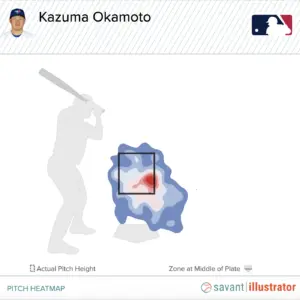
Since that early-May hot streak, Okamoto’s slashed .197/.272/.368 against breaking balls with strikeout and whiff rates north of 40%. He’s moved slightly farther from the plate, now in between where he started and where he was at his closest. And he’s only moved back slightly further in the box.
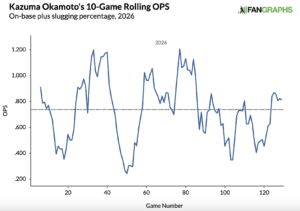
All season, his boom-or-bust production has come in hot-and-cold fits spanning five to 15 games. The only other time he really seemed to figure out his approach against breakers was a six-game stretch in late June when he homered four times, including one off a sweeper and another double off a slider. Both were hung in the middle of the strike zone.
Meanwhile, 17 of his team-leading 26 homers have come off fastballs, and he’s slugging .465 against them. He has only six long balls and a .396 slug against spin. The way he’s struggled to pick up and make contact on pitches with movement has also been surprising, considering he always ran low strikeout and high walk rates in Japan. During his last season in NPB, he walked as much as he struck out.
That’s been the biggest change in his offensive profile, as the improved stuff, particularly the breaking balls, appears to have him stumped for now. Instead of the high-floor plate appearance Okamoto was expected to provide with his mix of discernment and bat-to-ball skills, he’s instead been an all-or-nothing three-true-outcomes hitter.
The result is a player who is the sole source of significant power for an anemic Blue Jays offence, hitting over 20% of their home runs and also leading with a .207 isolated slugging. But despite that, he grades out as only a slightly above-average hitter with a 106 wRC+. His 159 strikeouts rank eighth in MLB and are almost double the Blue Jays next swing-and-misser (Andres Gimenez, 81).
Okamoto’s plate appearances end in one of the three true outcomes (home run, walk or strikeout) 43.6% of the time. He barely trails the 43.7% Blue Jays high José Bautista set in 2011. But Joey Bats led the American League in walks that season and had more free passes than strikeouts.
The third baseman did hit a couple of homers last week, but overall his output has trended downward since mid-July (.200/.255/.348). It feels like another adjustment could be coming. He’s proven he can do it before, and he must continue evolving to find sustained success in MLB.
Breaking News
- Blue Jays: John Klein and his chances of landing on the 2027 big league roster
- Patrick Corbin steadied the Blue Jays’ rotation early before fading as the season went on
- Mason Fluharty became the Blue Jays’ high-leverage lefty thanks to durability and strong performances
- Blue Jays free agent target: Hiromi Itoh
- 2 Blue Jays who had better seasons in 2026 than 2025