
Kaz Okamoto does it again! His two run home run gets the Jays within one! 🎥: Sportsnet | #BlueJays50

Adjustments behind Kazuma Okamoto’s booming offensive turnaround
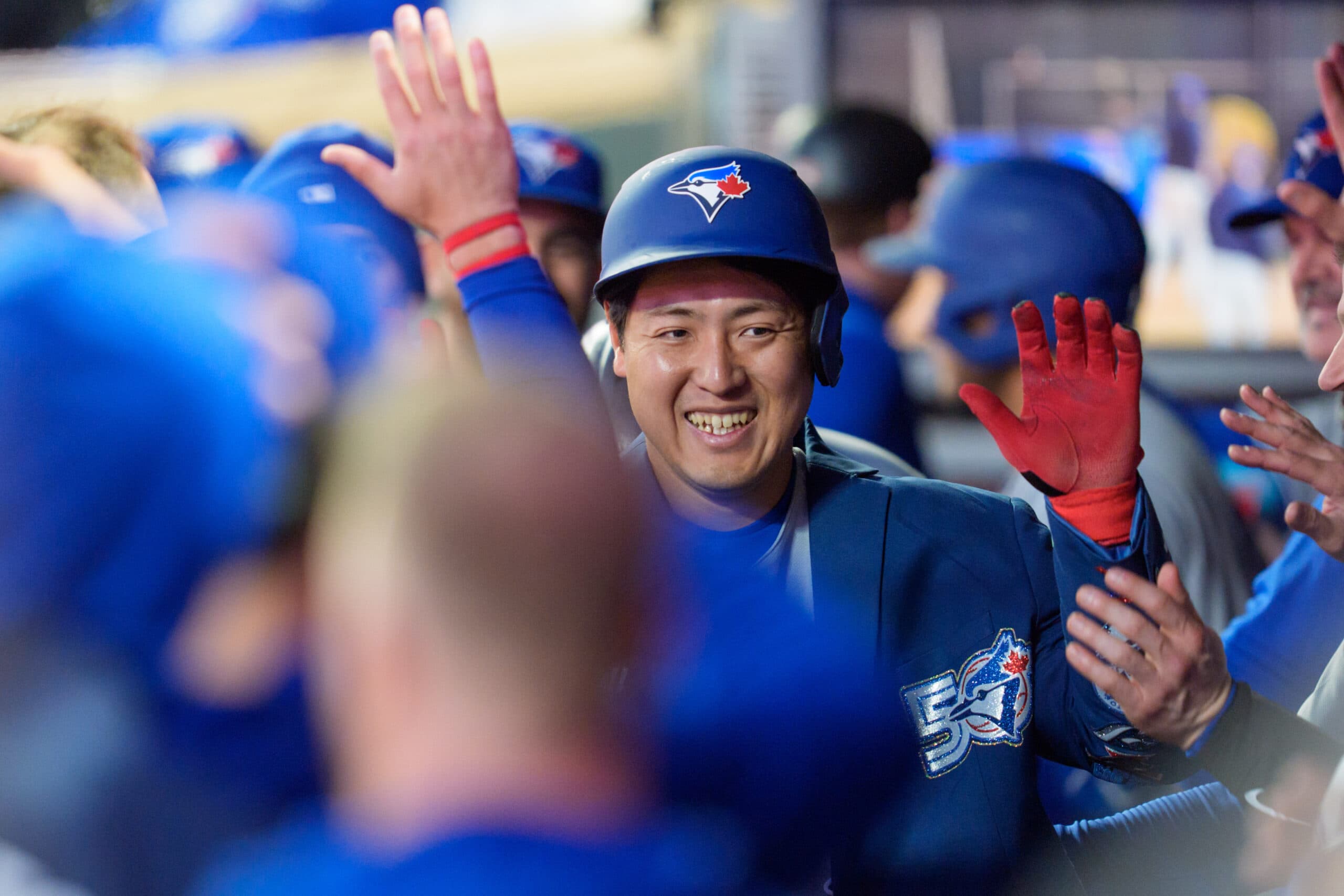
Photo credit: Matt Blewett-Imagn Images

By Thomas Hall
May 5, 2026, 15:00 EDTUpdated: May 5, 2026, 15:16 EDT
Transitioning from Nippon Professional Baseball to Major League Baseball presents many challenges, as Japanese superstar Kazuma Okamoto has discovered since his inaugural campaign in North America began nearly six weeks ago. From the gruelling 162-game schedule, travelling to new cities and ballparks, facing pitchers he’s never faced before and experiencing a drastically different cuisine (quesadillas have become an instant favourite), there’s been plenty to adjust to in short order.
But Okamoto has taken them each in stride. Now, less than 150 plate appearances into his Toronto Blue Jays career, he’s quickly emerged as this team’s most productive hitter of late.
Opening week featured a surprising offensive surge from Okamoto, who went 7-for-24 (.292) with a pair of home runs and three RBIs over his first six games. The 29-year-old infielder, a six-time NPB All-Star, hit the ground running following his MLB debut — until the rest of the sport adjusted to him, that is.
Not long after, the right-handed-hitting slugger’s results began to crater as opposing pitchers targeted the outer half of the strike zone against him, further impacting his transitional process versus high-velocity fastballs and sharp-breaking secondary pitches.
The number of quality at-bats declined substantially, while his swing-and-miss totals trended in the other direction. He needed to adjust to the adjustment that had been made against him. So, that’s precisely what he’s done over these past few weeks.
Okamoto’s turning point can be traced back to Apr. 18, the Blue Jays’ second contest in a three-game series at Chase Field versus the Arizona Diamondbacks. In 16 games since then, he’s blasted seven home runs and driven in 18 — now leading the team in both categories this season — while slashing .293/.388/.672 with a 189 wRC+ (100 league average).
As you can likely gather, Okamoto has been Toronto’s best hitter during this span, and by a wide margin, as his 189 wRC+ holds a 50-point lead over Vladimir Guerrero Jr.’s for first entering Tuesday’s contest against the Tampa Bay Rays. Additionally, he’s also been worth a team-leading 0.9 fWAR, accounting for nearly half a win more than Guerrero.
At a time when this lineup isn’t at full strength, with George Springer playing through a fractured big left toe and Addison Barger and Alejandro Kirk on the IL, they’ve needed a surge like this from Okamoto to help keep them afloat until others return.
That’ll likely be soon, as Springer is slated to return to the starting lineup on Tuesday after fouling a ball off his left toe for the second time in as many months last weekend, and Barger could rejoin this group as soon as Wednesday’s series finale at Tropicana Field. However, they’ll still need Okamoto to remain a critical piece of the equation, too.
Thus, increasing the importance of the sustainability behind his offensive turnaround, making the four key adjustments that have fueled it much more significant.
New batter’s box position
Over the last few weeks, Okamoto has made a pretty substantial change to his positioning in the batter’s box, standing much further back and a tad closer to the plate than he had previously. The idea behind it is to provide him with an extra split-second or two before triggering his swing and to help him barrel up those outside pitches — and so far they’ve been met with immense success.
Prior to Apr. 18, the centre of Okamoto’s body stood, on average, 20.9 inches back from the front edge of the plate (as you can see below). Measuring from the back of his heels, he also began each swing standing 28.7 inches off the plate (again, on average).
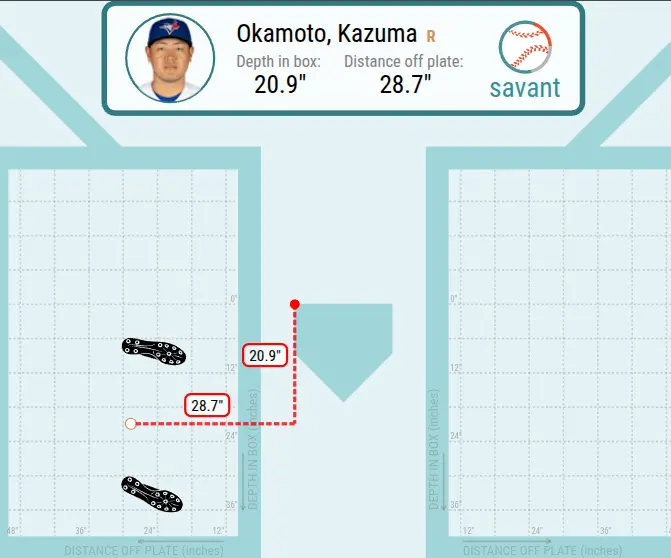
Source: Baseball Savant
Since then, however, Okamoto has not only moved deeper in the batter’s box — to the point that his back foot now touches the chalk — but also closer to the plate.
Compared to earlier, his starting point is now nearly seven inches further away from the pitcher’s mound and almost two inches tighter to the edge of the dish.
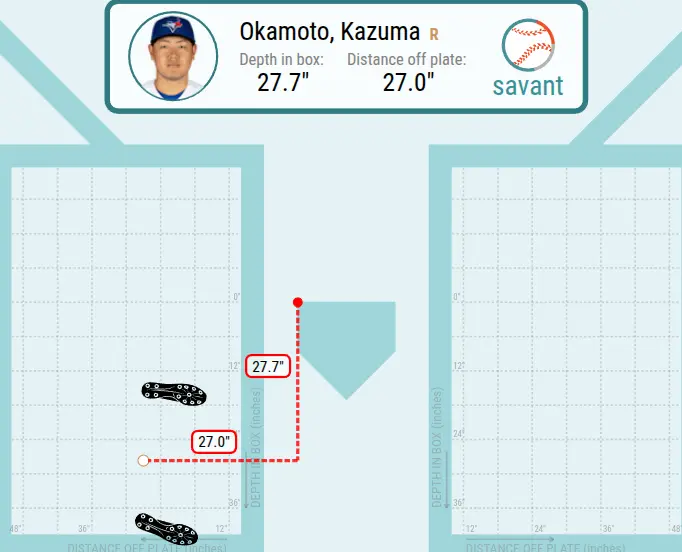
Source: Baseball Savant
Now that Okamoto is beginning to prove he can create damage against those outer-half pitches, the next logical move for opposing pitchers is to attack the inside quadrant of the strike zone, especially now that he’s standing closer to the plate.
The only problem with that game plan, though, is that’s where he does his best work. He’s daring the opposition to throw him inside fastballs after making these adjustments. Because with his swing, he’s at his most dangerous when he’s pulling fly balls and line drives.
It won’t always be this simple. But right now, simple is working just fine.
Swinging harder
Less than a week into May, Okamoto has been tearing the cover off the ball — quite literally, honestly.
The hard-hitting third baseman has elevated his quality-of-contact metrics since that pivotal point of Apr. 18, and there’s been a primary contributing factor at the root of this uptick — his bat speed. It averaged around 73 m.p.h. for most of March/April, then received a boost in the few weeks before the calendar flipped to May, and it’s continued to soar ever since.
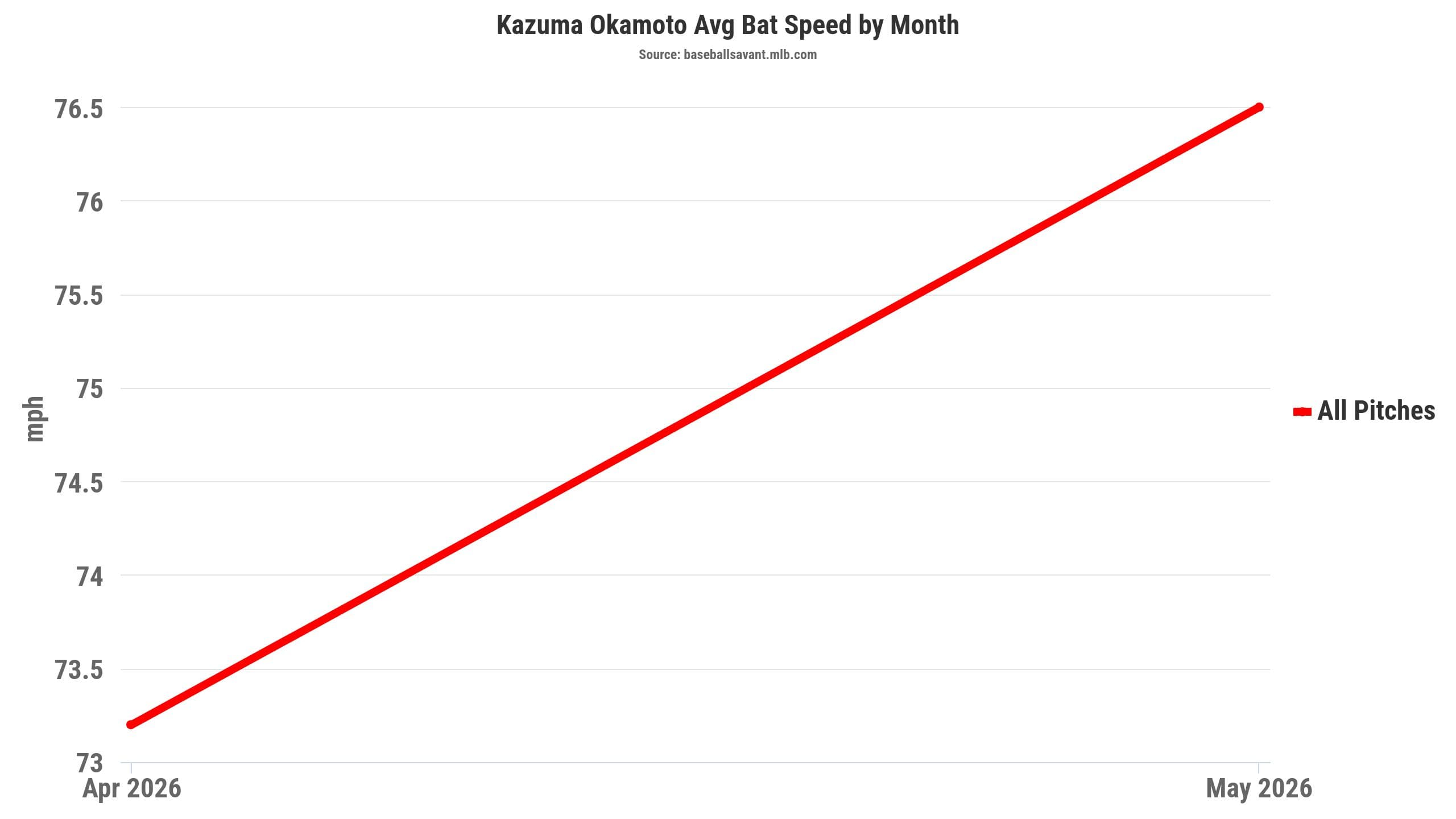
Source: Baseball Savant
It’s only taken four games this month for Okamoto to produce three of his five hardest swings on the year, including his season-high 86.3-m.p.h. swing on a foul ball versus the Minnesota Twins on May 1. As a result, his average bat speed has climbed from 73.2 m.p.h. in April to 76.5 this month thus far.
By swinging harder, balls have been going out harder, too, bumping his hard-hit rate up to 58.5 per cent and his barrel rate to 20.1 per cent since Apr. 18. For the season, he’s now put himself near the top of the sport in this department, with his hard-hit and barrel rates ranking in the 93rd and 88th percentiles, respectively, with his 93.2 m.p.h. average exit velocity sitting in the 94th.
Since quality of contact is usually one of the most dependable resources for predicting future results, this tells us Okamoto’s current surge likely hasn’t reached its peak just yet.
Improved swing decisions/plate discipline
Okamoto has found one of his biggest strengths again: his knowledge of the strike zone.
In Japan, that was a big part of what made him such a dangerous hitter. Not only could he create damage, but he’d also post low swing-and-miss totals and reach safely consistently via walks — leading to double-digit walk rates in five of his eight seasons with the Yomiuri Giants, as well as just one campaign with a strikeout rate of at least 20 per cent.
Early on with the Blue Jays, replicating that disciplined approach hasn’t been easy for Okamoto. He’d often expand the strike zone and struggle to make contact, particularly early in counts, offering at the first pitch over a quarter of the time in April. Lately, however, it’s been a completely different story.
BB% | K% | Whiff% | Chase% | |
Through Apr. 17 | 9.2 | 32.9 | 35.1 | 25.3 |
Since Apr. 18 | 13.4 | 25.4 | 29.1 | 11.3 |
On top of displaying improved discipline, part of Okamoto’s increasingly positive swing decisions has helped him generate more contact, raising his overall clip from 66.2 per cent through Apr. 17 to 69.1 since then.
This has transformed him back into a complete, all-around hitter again — and precisely the player that Toronto’s brass felt was worth the four-year, $60 million investment last winter.
Pulling for power
As a six-time 30-home-run hitter in Japan, pulling fly balls and line drives had been a regular occurrence for Okamoto during his NPB days. It’s an area that has been missing from his craft in North America, though — at least until now.
Okamoto’s output in that regard has increased significantly since Apr. 18, improving his pull rate on those batted balls to 53.8 per cent. That’s an increase of nearly 20 per cent compared to before. As you probably already guessed, his results on pulled fly balls and line drives have exploded in this span, featuring a .615/.615/1.615 slash line with four home runs and an .887 xwOBA across 13 plate appearances.
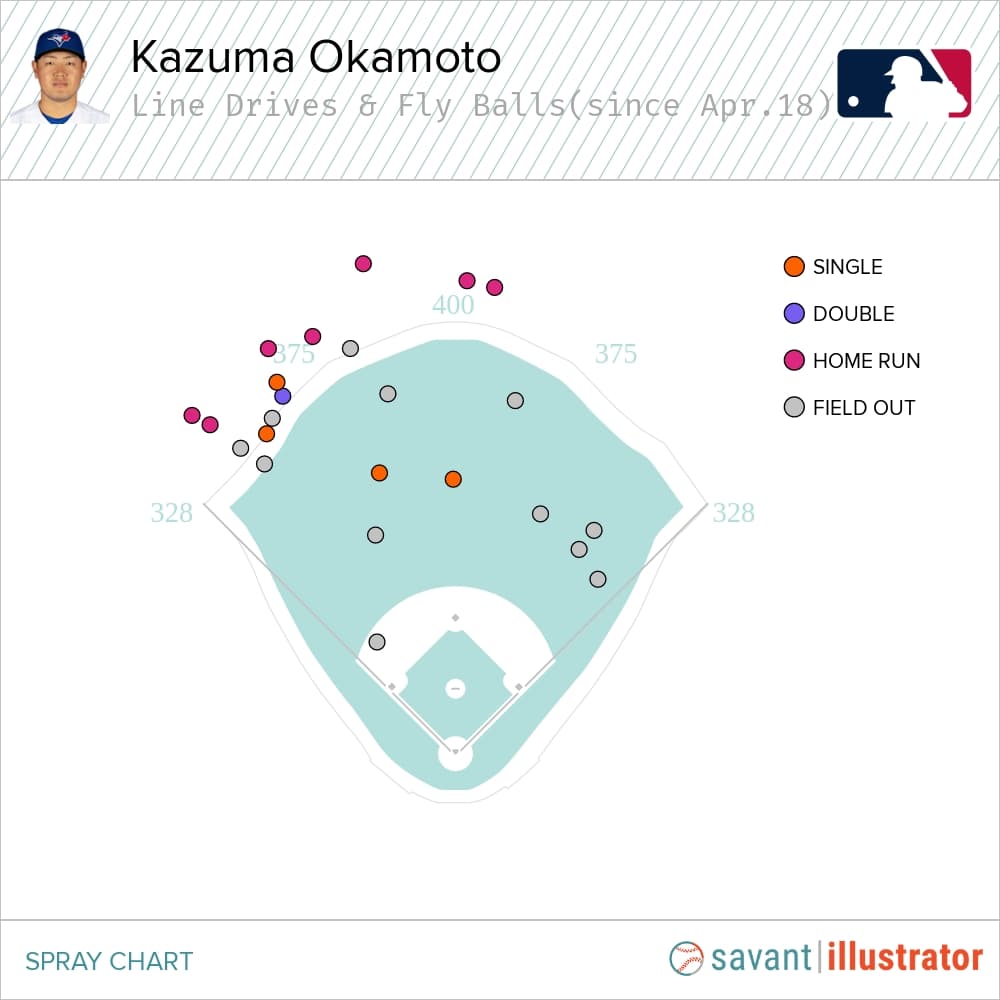
Source: Baseball Savant
The more that sample size grows, the higher Okamoto’s pull air rate (27.1 per cent) — which includes non-ground balls — will likely continue to rise, with it already sitting just outside the sport’s top 25, per Baseball Savant.
And the more fly balls and line drives that he pulls, the larger his team-leading home run total (nine) will grow, too.
CHECK OUT OFF THE ROSTER – NEW EPISODES EVERY WEEKDAY

Off The Roster is Toronto sports. Hosted by Cabbie Richards, Lindsay Dunn, and Dan Riccio, this is the go-to morning conversation for everything happening in the 6ix – Hockey, Baseball, Basketball and everything in between. From breakout performances and questionable trades to throwback jerseys, viral moments, and the stories fans are actually talking about—it’s smart, sharp, and never scripted. Live weekday mornings on the Nation Network YouTube channel and available wherever you stream podcasts, the show delivers real opinions, real chemistry, and real Toronto energy. Missed an episode? Catch up anytime. Off The Roster—The new sound of the 6ix.
Recent articles from Thomas Hall
Breaking News
- Amidst an injury-riddled season, Max Scherzer gave Blue Jays fans moments that will be remembered forever
- Blue Jays free agent target: Seiya Suzuki
- Trey Yesavage flashed dominance but rookie season largely marred by injuries
- Pending free agent Luis Urias is spending the offseason playing in Liga Mexicana del Pacífico
- Blue Jays free agent target: Jazz Chisholm Jr.