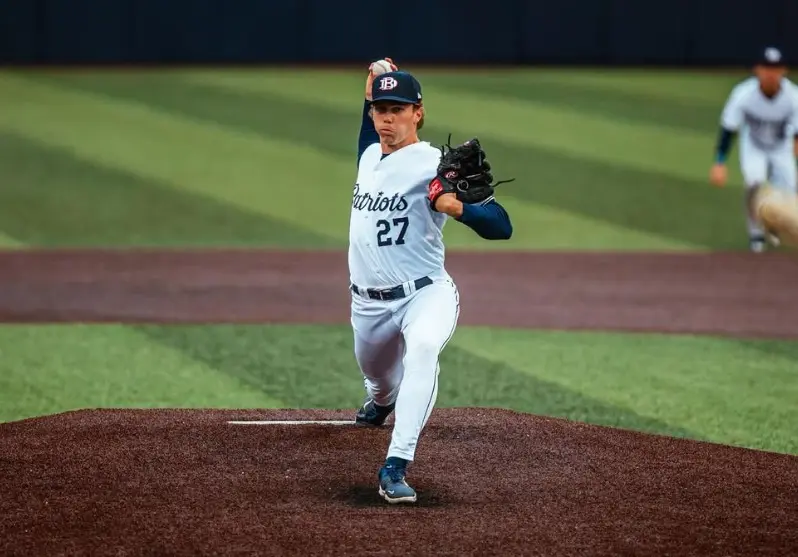
When first talking to Blue Jays prospect Micah Bucknam, it doesn’t take long for his thorough and thoughtful approach to shine through. Fresh off a workout at a local facility nearby his parents’ new home in Chicago, Bucknam is upbeat and quickly touches on the importance of maximizing his downtime in the offseason, balancing his workload with rest and recovery, taking time to disconnect from baseball and spend time with family and his desire to understand the psychology of facing a zero-out bases-loaded situation.
And that’s all within the first three minutes of our conversation.
The 22-year-old right-hander from Abbotsford, B.C., was selected by the Toronto Blue Jays in the fourth round of the 2025 MLB Draft and took the time to describe the intentional approach he’s taking as he builds towards his first professional season.
This includes near-daily work on the mental aspects of the game, from learning how to scout, visualization work and reading H.A. Dorfman’s “The Mental ABC’s of Pitching.” This is on top of the already rigorous fitness routine of a high-performance pitcher.
Still, Bucknam credits the biggest leap he took as a pitcher to the work he did incorporating data and technology with pitching coach Cale Johnson in his final year of college at Dallas Baptist University, saying that the pitcher he was at LSU and DBU “were like two different people, in a good way.”
“I think that just understanding it was a big thing,” Bucknam says, speaking to Blue Jays Nation. “Understanding the why behind what you’re doing. I’m very cerebral. The way I think is like, I don’t want somebody to just tell me, ‘Hey, this is what you should do.’ I want to understand, ‘OK, why are you doing this?’
“And for me, if I understand the why, I have more conviction behind what I’m doing. And I believe this, with my whole heart, if you have more conviction behind something, you’re going to have more success at it.”
Now that younger pitchers are increasingly inundated with information that extends far past the simple reading on a radar gun, the longtime debate between numbers and feel has taken on a new meaning. For a recent draftee like Bucknam, who credits much of his development to the use of advanced tech like force-plate mounds, Edgertronic cameras and Trackman data, where does the thinking end and the throwing begin?
It starts with sitting down in an office, off the mound, with a pitching coach, interpreting what the data is telling them and identifying the adjustments to mechanics and grip that can be made to alter the pitch in question.
As Bucknam says, “understanding the why behind it.”
Next is finding a cue that Bucknam can use in side sessions to put what they’ve learned into practice.
So, when he adjusted the grip of his breaking ball to a gyro slider, or what started as a gyro slider and turned into what he termed a “death ball” in pitching slang, it was trying the throw the baseball like a football – a prompt that’s become common for pitchers trying to learn this pitch type. Then, when it comes time to toe the rubber against opposing hitters, Bucknam puts all the information and preparation out of his head. Instead, he allows the work he’s put in to materialize naturally from his subconscious while execution stays front of his mind.
“And so, once you get that mental cue, then you can kind of go and be like, ‘OK, in the in-game session, I don’t think about any of that’,” says Bucknam. “It’s go out and execute the pitch. Like trust your process, trust what you’ve done, go out and execute it.
“I think for me, being able to marry those pieces … it’s a gradual pace. Like once you learn about the why, then going and trying out that why and then ultimately trusting the why.”
That slider that Bucknam’s throwing like a football, used to be a curve. With the help of Johnson, he “split” his old breaking ball into two, distinct offerings. Now he has that tighter, harder “death ball” slider and a slower curve with more depth. Bucknam says he’s been more successful after diversifying his arsenal, as splitting the pitch into two has given him the option to go vertical to a lefty, horizontal to a righty, and to both speed hitters up and slow them down. The ability to be effective against both sides of the platoon will certainly be important if Bucknam is going to remain a starter as he looks to ascend the minors.
“I think there are a lot of people who go out there, and they just try to chase numbers,” says Bucknam. “And that’s not a bad thing, but when you chase numbers, and it doesn’t (work), say you have four outlier pitches, but they don’t work together. As a hitter, I can stand up there and be like, OK, everything’s an outlier, so I just know what it’s going to look like. But when you have pitches that work together, that tunnel well off each other, it’s like, ‘I don’t know what’s coming.’”
Bucknam knows a thing or two about outlier stuff, too.
He was part of the 2023 College World Series champion LSU Tigers team that also included recent National League Cy Young winner Paul Skenes.
“I remember the first bullpen,” says Bucknam. “I walked in to watch Paul, and I just saw the numbers on the Trackman and him throwing. I’m like, ‘it’s Day 1, man, what are we doing?’ Like, this guy’s a freak.” But more than just witnessing the sheer force of his repertoire or picking up any specific pitching tips from Skenes, Bucknam says that what he learned most from being around the now MLB superstar was work ethic.
Skenes was already great, but Bucknam says it was enlightening to see a pitcher who was already so talented not get complacent, and instead want to get better every day. While being six-foot-five, 250 pounds helps, as Bucknam noted, Skenes never rested on his laurels. Instead, he ensured he was always learning, evolving and adjusting his routines to reflect that, Bucknam says.
“It’s like watching a Navy SEAL work,” says Bucknam. “It really is. It’s like watching somebody who’s really excellent at their job, and there’s very minimal room for error, go about their business the right way.
“And I think that just being able to learn that and then obviously talk with him and just see that there’s this learning mentality and this mindset. Like he used to read books on the StairMaster and different psychology books and things like that. And so other guys on our team would start reading those books. I think that just being around him gave a lot of good foundational pieces to learn in the future and grow.”
Since being drafted to pro ball himself and getting to work at the Blue Jays’ lauded Player Development Complex in Dunedin, Fla., there hasn’t been any pitch splitting. Bucknam knows the Blue Jays drafted him for a reason. They like what he has to offer. After all, this is the second time Toronto selected him – the first came in the 16th round of the 2021 draft. From there they’re looking to build on the strong foundation he’s already established and further refine his process, and Bucknam is excited to be working with an organization that has “a lot of smart people” and that does “a lot of stuff from a biomechanics standpoint of understanding, ‘OK, what do we need to maximize to get the most out of you?’”
“So, I’m excited about, obviously, taking those things and going into the season,” says Bucknam. “Many people have told me, obviously, it’s my first offseason, but what you do in the offseason really shows up in the season. I’m hoping that’s right and true.”
If it is, the meticulous work that Bucknam’s put in is sure to pay dividends next season and beyond.
PRESENTED BY VIVID SEATS