
Five questions surrounding Blue Jays ahead of make-or-break second half
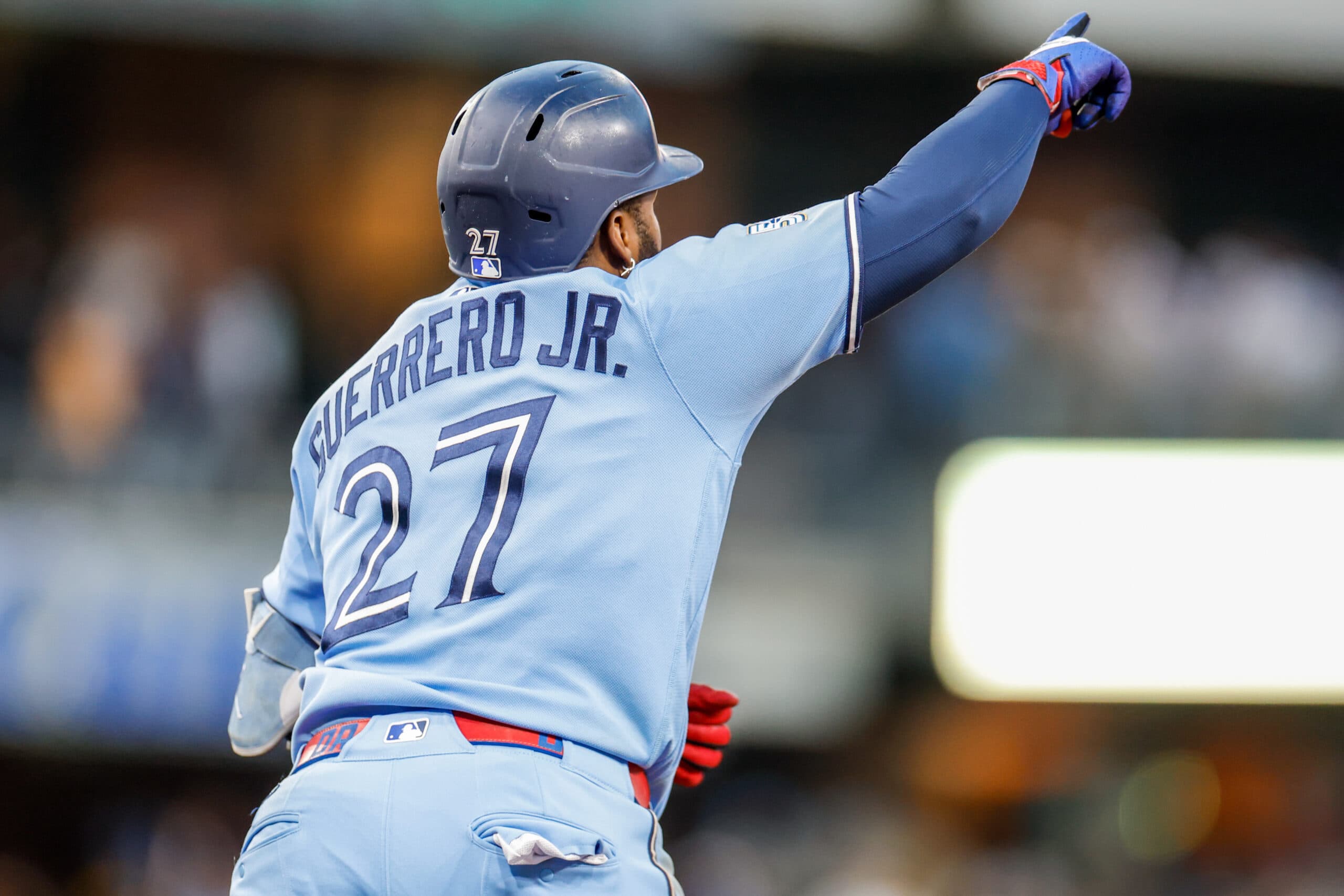
Photo credit: David Frerker-Imagn Images

By Thomas Hall
Jul 14, 2026, 15:00 EDTUpdated: Jul 14, 2026, 15:25 EDT
These 2026 Toronto Blue Jays will have a lot to prove when the unofficial second half commences on Friday, marking the beginning of a pivotal make-or-break stretch for their dwindling playoff hopes.
At 45-51 with 66 games remaining, this club has just over a third of the season left to turn things around and surge from the American League East’s basement to post-season contention. Not an easy assignment, of course, considering five teams separate them from the final wild-card seed. But it’s not impossible.
The rest of the AL — outside of the Tampa Bay Rays and New York Yankees — isn’t exactly pulling away from the pack, which is why the Blue Jays, despite being six games under .500, are only 2.5 games out of a playoff spot — but are 12 back of the division-leading Rays.
The goal has never been to “sneak in through the wild card,” especially coming off a World Series appearance. However, given the franchise’s current position, it’s fair to assume the goal posts have shifted here. Now, the focus is likely: make it to the dance and see what happens.
For that to happen, the Blue Jays must answer these five important questions in the two-plus weeks leading up to the Aug. 3 trade deadline.
Can Blue Jays (finally) get hot?
Last season, Toronto’s longest winning streak spanned 10 games. This year, meanwhile, they haven’t strung together more than four straight wins.
That 10-game heater from last summer, which included a season-turning four-game sweep of the Yankees, helped propel the Blue Jays towards their first division title in a decade — and also meant avoiding an unpredictable best-of-three wild-card series, earning a first-round bye straight to the division series.
But they just haven’t been able to generate that type of momentum in ’26 thus far.
It’s felt like a constant battle between taking steps forward and backward, with the latter prevailing more often than not. Let’s rewind to May, for example. The Blue Jays enjoyed a pair of four-game winning streaks over the final two weeks of that month. The second, which marked a return to .500, was immediately undone by a four-game losing skid that carried over into June, and they’ve struggled to keep their heads above water ever since.
For as big a deficit as they’ve dug themselves, there’s still time to climb out of it should a long-awaited hot streak follow out of the All-Star break. Maybe it won’t be as long as last season’s 10-gamer, or match the franchise record of 11 straight wins, but even a six or seven-game heater would be meaningful in this case.
Needless to say, the Blue Jays need to catch fire soon to make up ground in the muddy AL standings.
Is another second-half surge coming for Vladdy?
Boy, the Blue Jays certainly hope there is.
That’s been the script through the previous seven seasons of Vladimir Guerrero Jr.’s major league career, as he’s routinely heated up at the plate post-ASG following respectable, albeit underwhelming, first-half performances. And this year, more than any, he could badly use a second-half bump.
AVG/OBP/SLG | OPS | wRC+ | |
Career 1st half (excluding ’26) | .281/.365/.480 | .846 | 134 |
2nd half | .297/.366/.513 | .880 | 141 |
Despite homering twice in four games before the break, Guerrero remains on pace to endure the worst offensive season of his career, projected to finish with 10 home runs — the only time he’s finished with fewer than 15 came during the pandemic-shortened 2020 campaign. Even if his bat ignites, his streak of 20 or more homers in five consecutive seasons is very much in jeopardy.
The 27-year-old’s slash line of .262/.346/.357, accompanied by a wRC+ that’s one per cent below league average (100) through 91 games, offers the impression of a middling complementary, down-the-roster hitter — not that of a franchise cornerstone, who’s in the first season of a 14-year, $500 million extension.
All it can take is one swing for everything to click. But it doesn’t appear that Guerrero is anywhere close to breaking out of the worst stretch of his professional career. The arrow is a long way off from pointing upward, particularly amid a season-low average bat speed (75.1 m.p.h.) for July.
Who becomes the fifth starter?
This is a debate between sticking with Spencer Miles or giving it one last shot with Max Scherzer. Neither scenario is particularly ideal, but these are the only two options Toronto can choose from at the moment.
We’re running out of ways to describe Miles’ excellent rookie campaign, which, of note, currently sits at 60.0 innings this season. There isn’t a blueprint that can tell the Blue Jays’ brass how to thread the needle here regarding the 25-year-old’s workload. No pitcher has ever been in this position before, having arrived to the majors as a Rule 5 selection without throwing more than 14.2 career innings.
Miles is the guinea pig of this experiment, one that other teams will likely attempt to replicate in future seasons, considering how well the original has gone — he’s pitched to a 2.85 ERA and 3.02 FIP with a 15.6 per cent strikeout-minus-walk rate (K-BB%) in 26 games (three starts + several bulk appearances), worth 0.9 fWAR. But back to the matter at hand.
Coming out of the All-Star break, the Blue Jays will need a fifth starter twice, on July 21 and 26, before their next off-day following a 13-game stretch. After that, should they become buyers at the trade deadline and fortify the starting rotation, additional help should be on the way.
Manager John Schneider has already stated his preference is to locate a traditional starter for those spots. With Scherzer expected to make a rehab outing in the Florida Complex League this week, the 41-year-old is already lined up as a potential candidate. Results matter here, too, and if the future Hall-of-Fame hurler’s struggles continue, they might call upon another Miles-featured bullpen day or let him start altogether to provide the former with an extra rehab start.
How close is George Springer to heating up?
One of the biggest departures from last season’s offence to this year’s has been Springer’s return-to-decline performance, with his wRC+ plummeting from 166 — top three among baseball’s best in 2025, behind only Shohei Ohtani (172) and Aaron Judge (204) — to 91, the lowest of his career.
As a full-time DH (or offensive player), Springer’s woes have kept his fWAR rating at an even zero this season, meaning his contributions — or lack thereof — are equal to those of a replacement-level player. For context, he accounted for 5.2 fWAR a season ago, the second-highest of his 13 major league seasons.
If you’ll remember, Springer’s bat also started slow last season, until his multi-homer performance against the Yankees on Canada Day paved the way for the hottest three-month stretch from an age-35 season in baseball history. And now that we’re three months removed from when he initially fractured his big left toe, his offensive results have started to trend upward again.
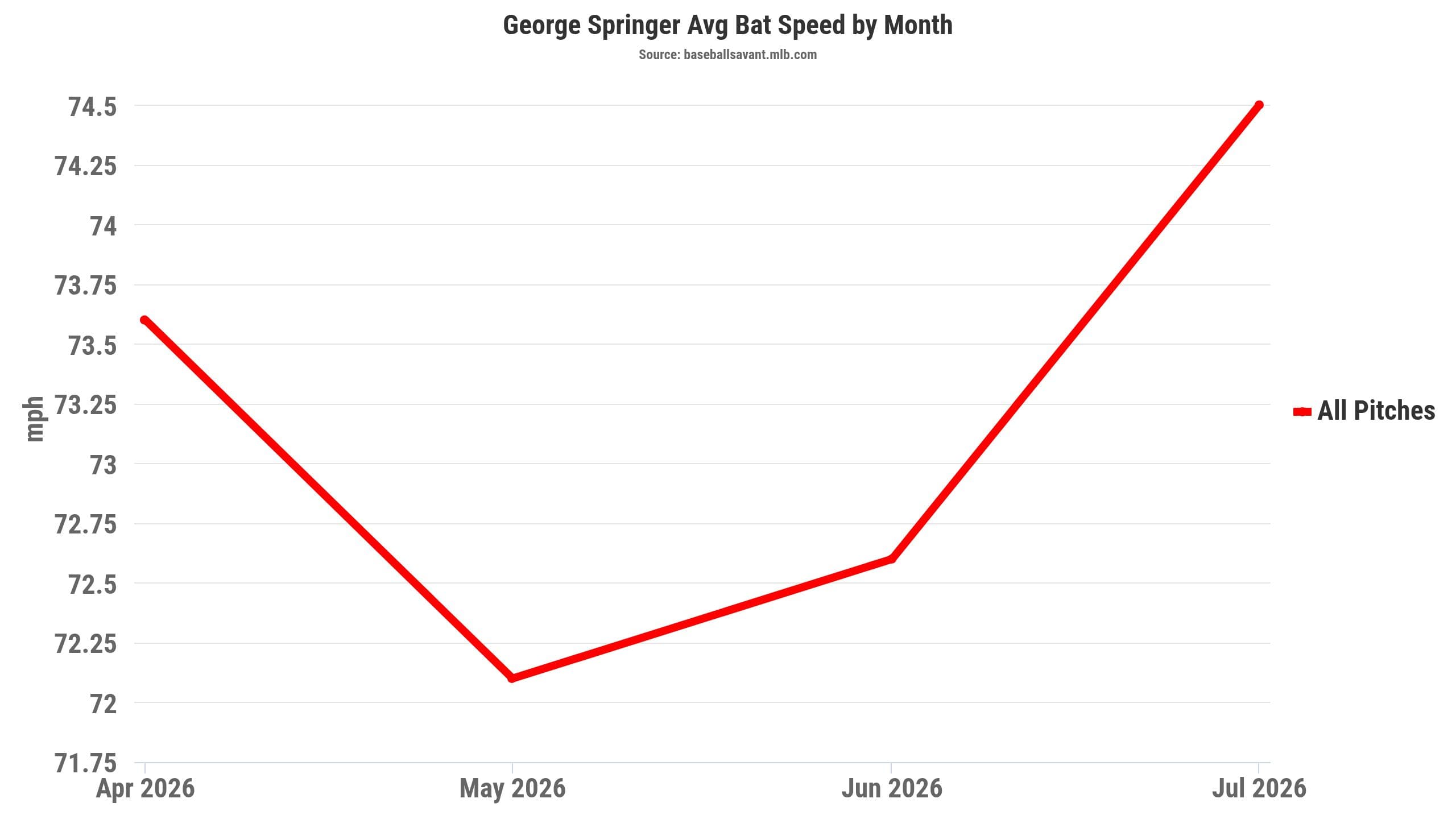
In 20 games since June 10, the 36-year-old slugger owns four home runs — nearly half of his overall total of nine — and is slashing .253/.348/.443 with a 122 wRC+. He’s also swinging harder (season-high average bat speed of 74.5 m.p.h. this month), hitting balls harder (41.7 per cent hard-hit rate since June 10) and missing less (season-best 10.7 per cent whiff rate this month).
Source: Baseball Savant
If you had to choose between Guerrero and Springer right now, you’d probably select the latter as the player who’s closest to a second-half offensive surge, and the final tally likely wouldn’t be close.
The Blue Jays, in reality, need both of these guys to level out closer to their career norms to have any chance of making a run this season. But, at the very least, a red-hot George Springer — even if it’s only for a few weeks — would make quite the difference for this lineup.
Will Blue Jays sell, buy or do a little of both?
The next few weeks will determine how aggressive the Blue Jays’ front office ends up being by the Aug. 3 trade deadline.
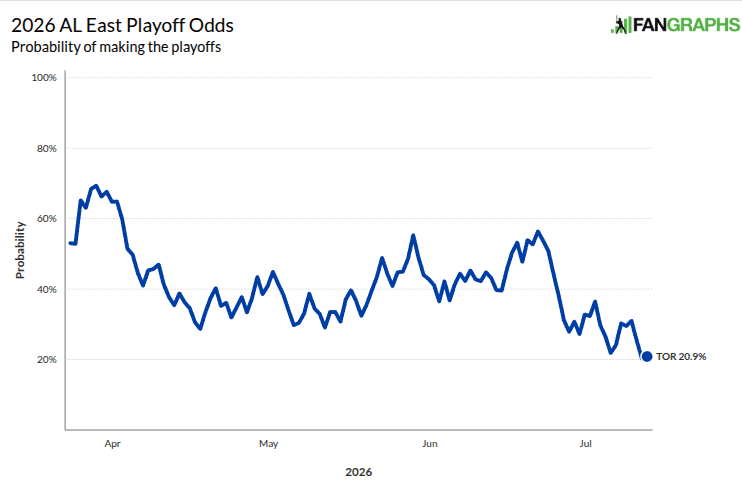
They’re currently stuck in the middle of a crowded, albeit mediocre, AL wild-card race with their post-season odds sitting at a season-low 20.9 per cent, according to FanGraphs. Only three teams feature shorter odds of making the playoffs in the AL: the Athletics (1.4 per cent), Royals (0.2 per cent) and Angels (0.1 per cent).
Source: FanGraphs
If Toronto’s odds dip below 20 per cent near the end of July, the organization will have no choice but to explore selling impending free agents such as Kevin Gausman, Daulton Varsho, Shane Bieber and even Springer. In an extreme sellers’ market, they’d be looking to replicate the success of their 2024 sell-off that helped replenish a farm system that’s been impactful two years later.
We’re not there quite yet, though. The Blue Jays serving as buyers — perhaps modest ones — is still the likeliest Aug. 3 scenario. With a Competitive Balance Tax payroll north of $300 million, positioned inside a relatively weak AL, there won’t be much appetite for selling if they remain in the wild-card hunt.
Barring an extended losing skid, there’s a pretty high chance of Toronto acquiring a starting pitcher either under club control or signed through at least 2027 — and a high-leverage reliever who meets those requirements, too.
CHECK OUT OFF THE ROSTER – NEW EPISODES EVERY WEEKDAY
Off The Roster is Toronto sports. Hosted by Cabbie Richards, Lindsay Dunn, and Dan Riccio, this is the go-to morning conversation for everything happening in the 6ix – Hockey, Baseball, Basketball and everything in between. From breakout performances and questionable trades to throwback jerseys, viral moments, and the stories fans are actually talking about—it’s smart, sharp, and never scripted. Live weekday mornings on the Nation Network YouTube channel and available wherever you stream podcasts, the show delivers real opinions, real chemistry, and real Toronto energy. Missed an episode? Catch up anytime. Off The Roster—The new sound of the 6ix.
Recent articles from Thomas Hall
Breaking News
- Addison Barger’s injury-plagued season left a hole in the Blue Jays’ lineup in 2026
- Blue Jays free agent target: Robbie Ray
- Jake Bloss continues strong showing in Arizona Fall League with six strikeout performance
- Blue Jays listed as one of six destinations for Tarik Skubal by MLB.com
- Blue Jays Arizona Fall League check-in: Aaron Parker has found success in limited playing time