
Examining how the Blue Jays performed defensively in 2026
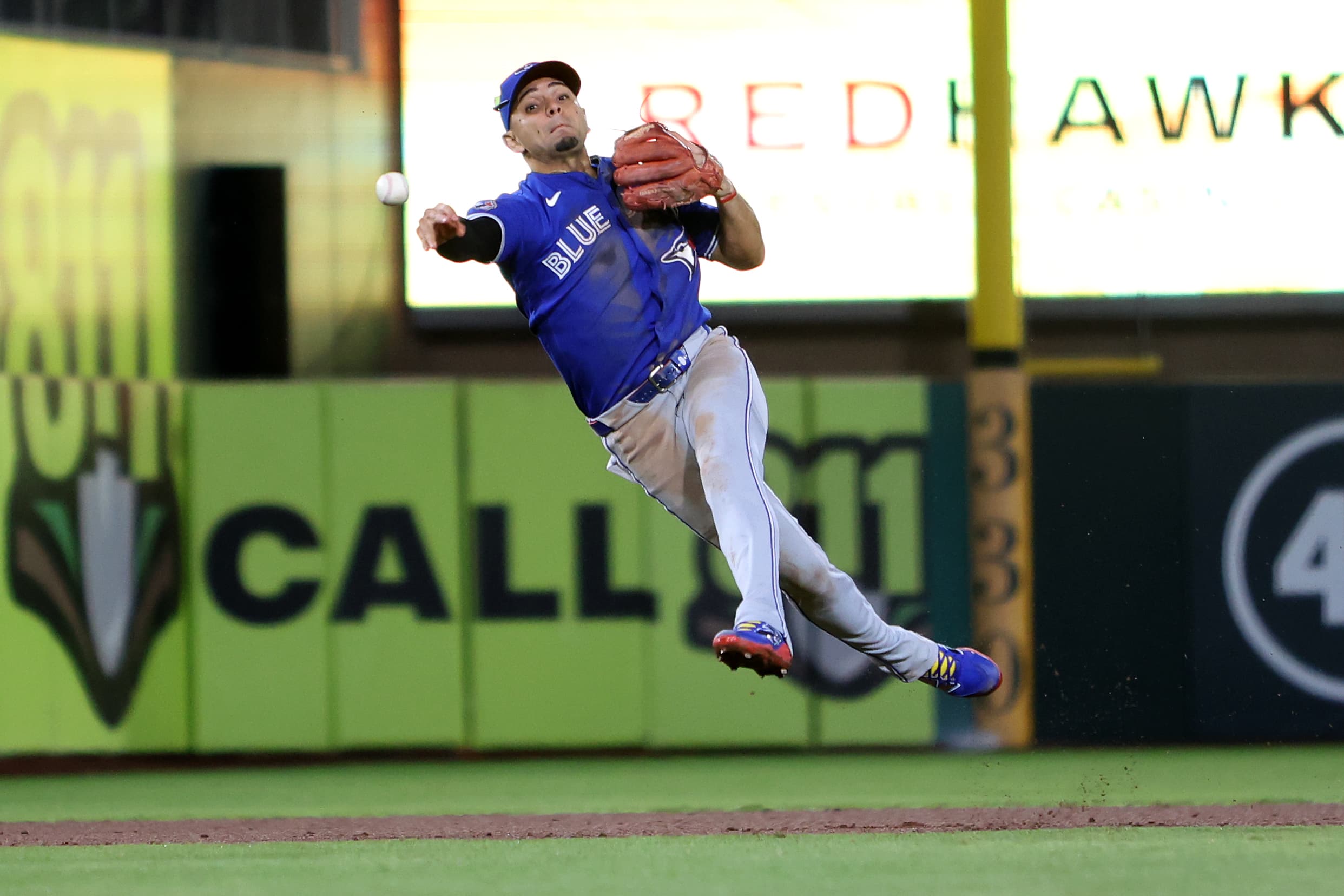
Photo credit: © Dennis Lee-Imagn Images

By Kylie Tait
Oct 21, 2026, 09:00 EDTUpdated: Oct 20, 2026, 12:09 EDT
Team defence has been a big focus for the Toronto Blue Jays’ front office the past few years.
Last week, five Blue Jays earned Gold Glove nominations, which tied the Chicago Cubs for the most nominations by a team in 2026. Yet 2026 seemed to be a sloppy year defensively for the Blue Jays. So were the Blue Jays actually a good defensive team in 2026?
It’s no surprise that the Cubs were well represented in the nominations. They led the league in fielding percentage (.990), Fielding Run Value (73), Defensive Runs Saved (115), Outs Above Average (74), and had the fewest errors (61). Simply put, the Cubs were baseball’s best defensive team.
On the other hand, the Blue Jays’ defence didn’t pass the eye test. If they seemed sloppier in 2026, that’s because they were. Their 99 errors were the fifth-most in MLB and the most for a Blue Jays team in the past five years. They were also tied for the second-lowest fielding percentage (.983).
However, the Blue Jays also finished second in FRV (45) and even improved slightly over 2025 (43). They also finished sixth in DRS (51) and 11th in OAA (14). So while standard defensive metrics don’t favour the 2026 Blue Jays, advanced metrics do.
Errors have never been a great way to assess defence because of their subjective scoring, but also because even the best players make mistakes. There’s a very minimal correlation between a team’s errors and their FRV.
Of the four teams with more errors than the Blue Jays in 2026 (San Francisco Giants, Washington Nationals, Miami Marlins, and Colorado Rockies), the Marlins ranked the highest in FRV with 14. Similarly, of the five teams with the fewest errors (Cubs, Arizona Diamondbacks, San Diego Padres, Los Angeles Dodgers, and Atlanta Braves), the Dodgers are the only team outside the top ten in FRV.
So while errors are not a great measure of a team’s defence, the Blue Jays are a bit of an outlier in being one of the most error-prone teams, while also being one of the best defences.
The biggest reason why the Blue Jays are rated so highly in advanced defensive stats is the catching tandem of Alejandro Kirk and Brandon Valenzuela. Valenzuela was one of the five Blue Jays nominated for a Gold Glove. He finished second in the American League in DRS (9) and third in FRV (11). Kirk finished with six DRS and 11 FRV, but wasn’t nominated for a Gold Glove due to a lack of playing time because of his thumb injury.
The Blue Jays catchers led MLB in FRV (28) by a significant margin over the New York Yankees in second (18). Even without any contributions from the rest of their positions, the Blue Jays would still have had the sixth-highest FRV in MLB with just their catchers. They also led MLB in DRS (22).
This highlights a theme when trying to assess the Blue Jays’ defence in 2026, which is that they’re bolstered by very high highs. The Gold Glove nominees, minus Jose Soriano, account for 41 FRV, while the rest of the team accounts for four FRV. Adding Kirk to the nominees, those five Blue Jays were worth 52 FRV, while the rest of the team was worth -7.
That doesn’t mean the Blue Jays didn’t have other good fielders in 2026. Brett Bateman had four FRV and six DRS, despite being called up to the Blue Jays in August. Myles Straw also remained a reliable outfield option.
But the Blue Jays’ defence also suffered from one of their most reliable fielders becoming one of their weakest. Ernie Clement had 10 FRV and 22 DRS in 2025 while playing every infield position. He was nominated for Gold Gloves as a third baseman and a utility player.
Clement’s defence regressed significantly in 2026. He had -3 FRV and one DRS with 13 errors. Part of the issue may have been his utilization. With Bo Bichette gone, Andrés Giménez moved to shortstop, while Clement became the Blue Jays’ everyday second baseman and Kazuma Okamoto took over at third. Clement seems much better suited to a utility role, so the Blue Jays will probably be in the market for a middle infielder this off-season.
Okamoto also didn’t have a great year defensively at third base. He led the team in errors with 20. He also finished with -3 FRV, 1 DRS, and -2 OAA. He was brought into the Blue Jays for his offensive qualities rather than his defensive, but that is an area of improvement for him ahead of 2027.
In the outfield, the Blue Jays suffered from poor fielding, in particular from Jesús Sánchez and Yohendrick Piñango. They were the worst-rated Blue Jays by FRV (-9 for Sanchez and -5 for Piñango). Neither player finished the season with the Blue Jays. Sánchez was designated for assignment, while Piñango finished the season in Triple-A. Piñango showed promise offensively, but he’ll need to make big improvements to his fielding to be a regular member of the Blue Jays going forward.
The other area that cost the Blue Jays’ defence heavily was the pitching staff. Blue Jays pitchers had the most errors (20), the second-worst fielding percentage (.920), and tied for the third-worst DRS in MLB (-7). The worst pitchers for the Blue Jays by DRS were Dylan Cease (-3), Spencer Arrighetti (-2), and Brendon Little (-2). Soriano proved to be an effective fielder, hence his Gold Glove nomination, but the Blue Jays’ pitching staff as a whole needs to work on their fielding.
Defence has been a priority for the Blue Jays over the past several seasons. They led MLB in FRV in 2024 and 2025 and were awarded the team Gold Glove award in 2023 and 2024. The Blue Jays who were nominated for Gold Gloves earned them, but the team has a lot to clean up ahead of 2027.
Breaking News
- Examining how the Blue Jays performed defensively in 2026
- Blue Jays free agent target: A.J Minter
- George Springer’s Game 7 ALCS home run one year later
- Trade Tree Tuesday: Trading Orlando Hudson landed the Blue Jays a Hall of Famer, a franchise icon, and is going strong today
- Blue Jays: Looking at how Vladimir Guerrero Jr. can rebound in 2027