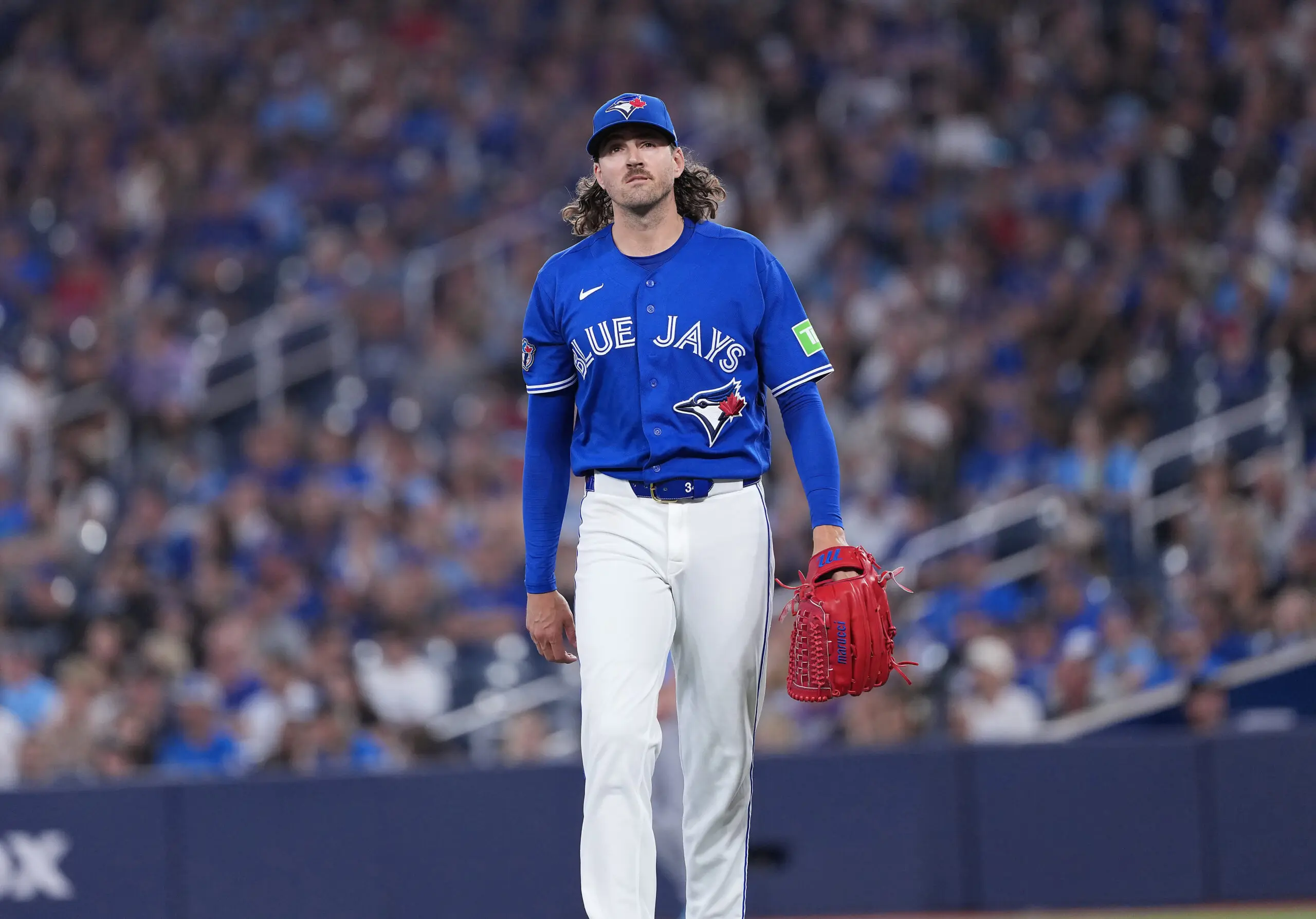
This topic sure looked a lot different just a few weeks ago.
With the Toronto Blue Jays holding a 5-8 record out of the All-Star break, they’ve quickly gone from being on the bubble of the American League wild-card race to now sitting closer to the bottom of the standings. That’s certainly not where you want to be with less than a week until the Aug. 3 trade deadline.
Not even a year removed from advancing to Game 7 of the World Series, this team will soon begin to dismantle pieces of the roster that helped turn the 2025 season into something magical. They’ve kicked this can down the road as far as they could. But they’re about to run out of road.
The disappointing reality behind this recent skid is that it’ll soon force the Blue Jays into sell mode. How significant that sell-off will be, however, remains unclear. In all likelihood, the trade market will probably dictate that for them.
For an organization with a $300-plus million payroll, there’s also a chance this won’t be a black-and-white situation for general manager Ross Atkins. Toronto’s front office, aiming to compete again in 2027, may look to dabble in both the selling and buying markets through Monday’s deadline. It’ll be wise to stay close to your devices between now and then.
Given the uncertainty surrounding this year’s deadline, below are a few trade scenarios for the Blue Jays, separated into realistic and unrealistic.
Realistic Trade Scenarios
Selling the rentals
Let’s start with something easy.
Since the Blue Jays are headed towards a playoff-less October for the second time in three years, the most logical business decision will be to prioritize trading their pending free agents — a group that includes Kevin Gausman (eight-team no-trade list), George Springer (10-and-5 rights, essentially a full no-trade clause), Shane Bieber, Daulton Varsho, Max Scherzer (full no-trade clause), Patrick Corbin (*injured, won’t be traded) and Yimi García (*injured, won’t be traded).
The problem is, however, none of them
outside of Springer — hitting .333/.391/.595 with two doubles, three home runs, 11 RBIs and a 176 wRC+ in 11 games post-All-Star break entering Wednesday — have boosted their trade stock of late. Instead, they’ve actually trended in the opposite direction.
Bieber, after walking a career-high six over two-thirds of an inning on Tuesday, set himself back despite having been trending in the right direction following his last two starts — during which he tossed 13.0 innings of one-run ball with nine strikeouts and only two walks. His next start will likely fall on deadline day in Houston, should he still be a Blue Jay by then.
Gausman, slated to start Saturday against the St. Louis Cardinals in potentially his final game as a Blue Jay, will enter that contest, barring a trade before then, with an inflated 6.10 ERA in four starts this month — though teams will likely point to his 2.48 FIP in that span as an indicator that better days are ahead.
There’s far less optimism around Varsho and Scherzer, though, and understandably so. Toronto’s everyday centre fielder has shown very little power thus far (.379 SLG with seven home runs) and is enduring an unusually mediocre defensive performance. Meanwhile, Mad Max has only made one start since returning from the IL and doesn’t appear to have much gas left in the tank.
Starting pitching is once again in high demand, meaning, should the Blue Jays receive worthwhile returns, there’s a fairly high chance they end up dealing both Gausman and Bieber. Based on the limited right-handed bat market, Springer could have a pretty strong market, too — albeit as a primary DH — if he’s open to moving. They’ll also probably find a suitor for Varsho, considering the Phillies, Pirates, Brewers and Yankees could benefit from an upgrade in centre.
Perhaps someone will be willing to take a flier on Scherzer, hoping to squeeze the final few ounces of vintage post-season juice still in the bottle.
Beyond the pure rentals, Myles Straw — carrying a pair of club options in 2027 ($8 million or $1.75 million buy-out) and ’28 ($8.5 million or $500,000 buy-out) — represents an intriguing fourth outfielder-type option for contenders. Trading both he and Varsho might leave the team too thin in centre, though.
Since the Guardians are already committed to paying $1.75 million in ’27, as agreed to in the original trade, keeping Straw as outfield insurance might not be a terrible outcome, either.
Exploring Jeff Hoffman’s market
If you zoom out on Hoffman’s season, his stat line is drastically different from a year ago. Sure, there’s only a 26-point decrease in his year-to-year ERA. At the same time, the 33-year-old reliever owns career-highs with his strikeout (34.8 per cent), whiff (37.5 per cent) and chase rates (38.3 per cent), and he’s also improved his walk (8.2 per cent) and barrel rates (eight per cent) from last season.
Hoffman has one additional season remaining on his three-year, $33 million contract, which doesn’t include any trade protection. As a former closer with term, enjoying a remarkable run since the start of June, in an
extreme sellers’ market for high-leverage arms, there won’t be a shortage of potential suitors for the veteran righty. Thus, he should be among their most valuable trade commodities.
To contend next season, the Blue Jays need someone such as Hoffman to help bridge the gap in the later innings to closer Louis Varland. So, if they trade him, they’ll have to search for his replacement this off-season.
On the other hand, marginal returns for those rentals above will only push the needle so far. This franchise could use another top-five prospect or a young, controllable MLB-calibre hitter added to its system, and moving Hoffman likely represents their best avenue to do just that.
Buying a controllable starter
Assuming the Blue Jays trade Gausman and Bieber, their starting rotation will be rather thin, not only for ’27 and beyond, but for the remainder of this season, too. As of now, with
Jake Bloss unavailable due to injury (teres major), and José Berríos, Bowden Francis (both Tommy John) and Cody Ponce (torn ACL) already done for the season, the options are fairly limited.
That’s why we’ll likely see management sell and buy ahead of next week’s deadline, with the latter centred around controllable starting pitching.
Few teams will probably be interested in selling such players, given their immense value in the sport’s current landscape. However, for someone, let’s say, the Angels, whose roster includes a pair of starters who’re scheduled to hit free agency after the ’28 campaign — José Soriano and Reid Detmers — perhaps there’s a window of opportunity there.
Or maybe the Reds will be willing to move Nick Lodolo (free agent after next season). It may also be worth
kicking tires on the Marlins’ Max Meyer (three more seasons of arbitration eligibility) and Eury Pérez (entering his first arbitration-eligible season in ’27, won’t hit free agency until after ’29).
Unrealistic Trade Scenarios
Full-scale rebuild/retool
What the Blue Jays’ brass isn’t about to do here is tear this thing down to the studs. Doing so would, simply, be ill-advised from all fronts.
Firstly, this roster isn’t constructed for something that drastic. Between the amount of term and money still owed to Vladimir Guerrero Jr., Alejandro Kirk, Dylan Cease, Kazuma Okamoto and Andrés Giménez, moving any of those players would require significant salary to change hands — plus they’d need approval from Guerrero and Cease to waive their trade protections.
Because of how much money Toronto would need to include to facilitate these trades, they wouldn’t be able to justify the minimal returns they’d be sure to receive, especially when it involves multiple franchise cornerstones.
Making this even less likely is that the franchise is coming off a post-season run that created an entirely new generation of Blue Jays fans. This season’s disappointing result has slowed that momentum enough as it is. Imagine how many people would immediately jump off that bandwagon if they sold everyone.
Let’s move on.
Moving Louis Varland or Tyler Rogers
Attempting to contend next season without one or both of these guys is among the reasons why neither will likely be traded by Monday’s 6 p.m. ET deadline.
Varland has been right up there alongside Mason Miller, Jhoan Duran and Cade Smith as baseball’s top closers this season. Entering Wednesday’s series finale in Washington, he ranked second among qualified major league relievers in xERA (1.96) and fWAR (2.4), third in FIP (1.43), fourth in ERA (1.02) and fifth in strikeout rate (35.3 per cent).
Rogers has been just as dependable, casually sporting a 1.51 ERA and 2.80 FIP in 47.2 innings, posting the highest ground-ball rate (64.7 per cent) since his rookie campaign and is one of four relievers with at least 30 innings pitched yet to allow a home run in ’26 — Miller (because, of course), Calvin Faucher and Trevor Megill being the others.
Why fix something that isn’t broken, right? Also, Rogers is signed through at least ’28 and holds a $12 million vesting option — converts to a $9 million club option if the conditions aren’t met — for the following season. As for Varland, he’s currently a steal as a pre-arbitration player and will begin the first of four arbitration-eligible seasons in ’27 (free agent after 2030).
The Blue Jays probably aren’t opposed to listening on either player. But the odds of them being traded are likely less than five per cent each, as few teams, if any, will be willing to accommodate such exorbitant acquisition costs, particularly in Varland’s case, which would need to be Mason Miller-esque.
Selling controllable position players
Given this team’s fate, it’s the perfect time of year to see how the rest of the sport values your players, making it the appropriate occasion to canvass Ernie Clement and Nathan Lukes’ markets.
Both Clement and Lukes have been two of Toronto’s better hitters this season, and, yes, that’s among the arguments as to why neither should — and probably won’t — be traded. At the same time, contenders are surely asking about their availability. So, it doesn’t hurt to take their calls.
Similar to Varland and Rogers, though, any return for either player would have to be substantial. Clement, in the midst of a career offensive year and several months removed from a historic post-season performance, has two additional arbitration-eligible seasons of club control remaining. Lukes, meanwhile, has all four remaining.
For anyone wondering about Jesús Sánchez, who’s scheduled to
resume his rehab assignment with Triple-A Buffalo on Wednesday, he’s also expected to remain put with another season of control left before hitting free agency. Had he been healthy and swinging the bat with more authority, then perhaps he could’ve fit into a different category here. Instead, there’s a higher chance that fellow left-handed-hitting outfielder Yohendrick Piñango ends up being moved in a need-for-need deal.
PRESENTED BY THE PERFECT 9 COLLECTION
Some baseball traditions never get old.
The Perfect 9 Collection is our newest limited-edition collaboration with Blue Jays Today, inspired by the viral 9/9/9 challenge that has become a staple of baseball culture. Whether you’re taking on the challenge or just enjoying a day at the ballpark, this collection celebrates the moments that make baseball unforgettable. Featuring premium Levelwear apparel with elevated fabrics and modern fits, it’s designed for fans who live and breathe the game—on game day and beyond. Limited edition. Premium quality. Built for baseball fans. Shop the Perfect 9 Collection while it lasts. Exclusively at
nationgear.ca