
Did you hear that #Twins prospect Rene Tosoni was named MVP of the #mlbfutures game last night?
Rene Tosoni’s journey through baseball: from MLB outfielder to Blue Jays scout
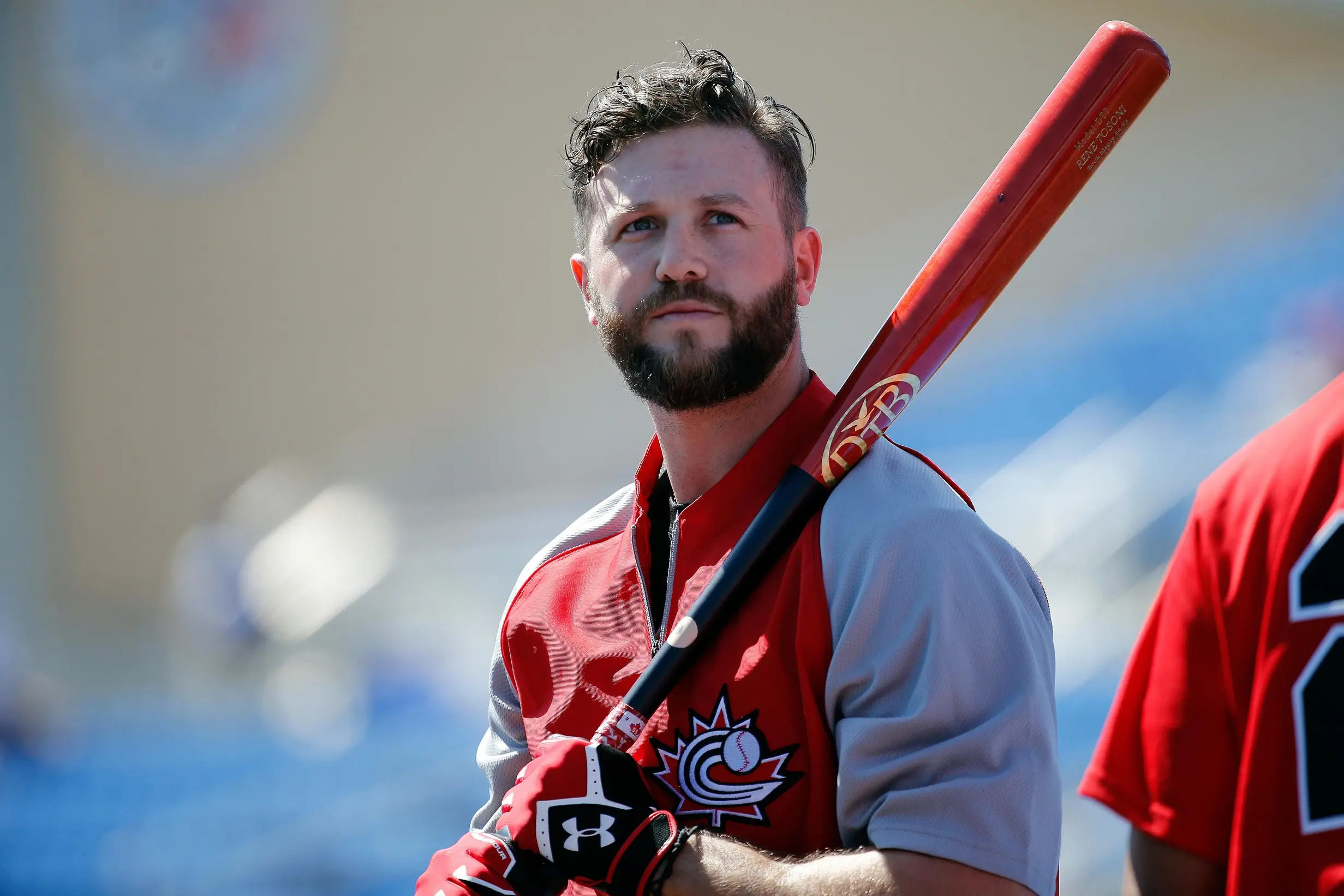
Photo credit: © Kim Klement-Imagn Images

Jul 7, 2026, 19:00 EDTUpdated: Jul 7, 2026, 13:22 EDT
The phone rang in the middle of dinner.
In April 2011, Rene Tosoni was having a night out before another long minor-league summer rolled into the next one when his Triple-A manager called with news that would change everything. By the time he hung up, he wasn’t finishing that meal. He was rushing home to pack a bag because the next morning at 5 a.m., he needed to be on a flight to Minnesota, on his way to Target Field.
These days, Tosoni’s life looks less like a highlight reel and more like a logistics problem he’s chosen to take on voluntarily. He’s a Toronto Blue Jays scout, a hitting coach for Canada’s Junior National Team, and a development coach with the Coquitlam Reds, all while working full-time as a firefighter. He’s a husband and a father of two kids who play three sports between them.
This is the story of how a 36th-round Minnesota Twins draft pick became the guy whose fingerprints are now all over the next generation of Canadian baseball, and what it took to get there.
The Call
April 28, 2011 – Tosoni’s major-league debut; a frigid afternoon in Minneapolis in a doubleheader against the Tampa Bay Rays.
But before he ever got that first at-bat, the game had already tested him. Playing left field in a ballpark far bigger than anything he’d seen, Tosoni misjudged a low line drive, backed up on it instinctively, and watched it bounce in front of him and carom off his shoulder for an error on his first big-league play.
“I’m not gonna lie, I was way more stressed out being in the outfield than being in that batter’s box,” said Tosoni, speaking to Blue Jays Nation. “Once I got into the batter’s box, it’s like a comfort zone for me.”
When he stepped in against Jeremy Hellickson, he wasn’t thinking about the error, the crowd or the magnitude of the day. “It was just me versus Jeremy,” he said.
Before the at-bat, former MVP, Tip O’Neil Award winner, and Canadian baseball legend Justin Morneau, who played for the Twins, had tipped off Tosoni to sit on Hellickson’s changeup. Battling to a 1-1 count, the Canadian got the pitch he was waiting for from Hellickson, and Tosoni slapped it over second base for his first major-league hit. As he ran to first, Rays catcher Kelly Shoppach, who’d recognized it was Tosoni’s debut, was trailing him down the line, cheering him on.
What gets lost in the box score of that cold April afternoon is how close that day came to not happening at all, and how little of Tosoni’s path to that batter’s box had gone according to plan.
The Come Up
Tosoni was a multisport kid growing up in Port Coquitlam, B.C, splitting his year between hockey in the winter and baseball in the spring and summer, in an era with far less infrastructure than is taken for granted today.
“It wasn’t like now, where all these travel ball teams go down south to tournament showcases,” explained Tosoni. Back then, it was much harder for a player to be seen, especially from Canada. His real break came when he made Canada’s Junior National Team in 2003, putting him in front of scouts and allowing him to play internationally.
The Minnesota Twins drafted him in the 34th round out of high school in 2004, but it was a draft-and-follow, a mechanism that let a team hold a player’s rights for up to a year while he played junior college ball, betting they could sign him cheaply before the next draft if he developed. Tosoni went to Chipola College in Florida, where he struggled to find his footing both at the plate and in the field.
“I did not expect the Twins to draft me again after that first year of college, because of how terrible I played,” he said. He turned down their low draft-and-follow offer, went back to Chipola for a second year, and rebuilt his stock enough to be drafted again, this time in the 36th round in 2005. Despite a signing bonus that wasn’t close to life-changing money, he turned pro. “I knew that with my work ethic and my mindset that I was going to be able to play for a long time,” he said, “just get into a program and outwork everybody.”
By 2009, Tosoni was in his third minor-league season at Double-A, hitting roughly .110 in April, a stretch so brutal he went 0-for-30 with 19 strikeouts at one point. But by the All-Star break, he’d turned it completely around, earning an invite to the Double-A All-Star Game and then a call-up to the MLB All-Star Futures Game in St. Louis, where he went on to win Futures Game MVP after a pinch-hit go-ahead RBI double.
That minor-league season, Tosoni finished with career numbers across the board: a .271 average, 15 home runs, 71 RBI and an .814 OPS in 122 games.
What the Body Takes
For a player drafted as low as Tosoni, injuries carry potentially career-ending weight.
“I knew that the Twins didn’t have anything invested in me,” he said. “There’s somebody below you that’s gonna get called up as soon as you get hurt. If they do well, you won’t have a spot when you get back.”
In 2008, a year before that career season, a foul ball broke his foot during an all-star-calibre season at Single-A, and what should have been a 10-week recovery stretched to 15. Then, at his first big-league Spring Training in 2010, he ran into the outfield fence chasing a fly ball and felt something in his shoulder, but stayed quiet rather than risk losing his spot. Tom Nieto, his Triple-A manager, eventually noticed something was wrong, and an MRI confirmed a torn labrum and rotator cuff. Surgery followed, and his arm never fully returned to its old strength and accuracy until 2012.
What he took from all this wasn’t bitterness. It was a mindset he still uses, more than a decade later, with the players he now coaches and scouts.
“It made me a way better person, understanding adversity, how to overcome it and not let it take over and just quit,” he said. “I talk about my injuries to players all the time, and I talk about failing, because baseball is a tough sport.”
Wearing the Maple Leaf
If you ask Tosoni what he’s most known for, it isn’t his MLB career at all. It’s a single moment from the 2013 World Baseball Classic.
Canada was up 9-3 on Mexico in a pool-play game in the top of the ninth, Canada up to bat, when Chris Robinson laid down a bunt for a base hit, which in certain corners of the baseball world is an invitation for the next hitter to wear one. Tosoni, who was in the on-deck circle, knew exactly what was coming. “If you’re bunting when you’re up by a lot, everybody knows the unwritten rules. Usually, the next batter is going to take one in the back.”
Mexican third baseman Luis Cruz motioned at pitcher Arnold Leon to hit Tosoni, and after two missed attempts, Leon hit Tosoni squarely in the upper back, and that’s when it all unravelled. Tosoni never threw a punch, but he got lost in the sea of green and red.
“I just remember getting hit and then at the end just being standing on the mound somehow,” he said. “It was an experience, and it’ll never be forgotten.”
But what stays with him most is the totality of nearly two decades wearing the maple leaf, from his first international trip to Curaçao in 2003 through his last at the 2019 Pan Am Games in Peru. “It gives me goosebumps thinking about it,” he said. “It doesn’t matter if you’re 4-for-4 or 0-for-4, you’re trying every at-bat to do something to help the team.”

The Crossroads
For all the drama that comes on the field, the hardest decision of Tosoni’s life happened nowhere near a ballpark.
By 2018, he and his wife were living in Arizona, where he’d been coaching in the Atlanta Braves’ minor-league system after retiring from playing in 2016. They had two young kids, with their oldest about to start kindergarten, and with only Tosoni working, there were two paths: stay in the U.S., continue coaching and see where it goes, or go home, with no clear plan beyond wanting to be closer to family and the place that raised him.
“If I stuck with it, I probably could be in the big leagues by now as a hitting coach,” he said. But that path mirrored the grind he’d seen as a player: constant travel, hotels, time away from his wife and kids at exactly the stage of life when it mattered most.
So he started building an exit plan, enrolling in online firefighting courses even as he questioned whether it was the right move.
“My biggest concern was the medical,” he said. “I honestly still wasn’t 100 percent sure if it was for me, but I needed to do something. I needed to get a real job and support my family.”
It took four years of applications before he was hired. Along the way, he discovered he actually loved the medical training he’d been most afraid of. “It was just something that kind of drew to me,” he said. “Getting into the fire service has been a blessing.”
Moving back home and getting back on the field with the Coquitlam Reds was an easy step for the veteran pro, although he was juggling construction work, the head coaching job, Junior National Team coaching commitments, and two young kids. It was a lot to handle for one man, and it nearly burned him out before he stepped back into a development role with the Reds. It’s also what put him back in proximity to the next generation of players coming up through Coquitlam.
The Future
Sean Duncan, a left-hander out of Terry Fox Secondary, Tosoni’s former high school, has emerged as the top-ranked Canadian prospect for the 2026 MLB Draft, currently ranked 66th overall in MLB Pipeline’s Top 100 list. Reports track the 18-year-old’s fastball at 91-94 mph and a sharp, high-spin slider in the low 80s. He’s a Vanderbilt commit who’s been one of the most attention-grabbing arms in the country.
The left-hander is currently on the sidelines with a UCL injury he suffered during the JNT’s trip to the Dominican earlier this year, but the B.C. product is still one of the top Canucks heading into the draft this year.

LHP Sean Duncan 2026, @Langleyblaze @VandyBoys recruit 𝟱 𝗻𝗼-𝗵𝗶𝘁 𝗶𝗻𝗻𝗶𝗻𝗴𝘀 𝗳𝗿𝗼𝗺 𝗗𝘂𝗻𝗰𝗮𝗻‼️⚡️ Duncan continues to elevate his game at the right time, mowing down hitters with the fastball over 5 no-hit innings. Really settled in after his first inning for Show more
Tosoni’s scouting circuit for the Blue Jays runs through Baseball Canada’s spring trip with the country’s top 40 prospects, the Blue Jays’ own Canadian Futures Showcase, and whatever he sees simply by being embedded in B.C.’s Premier League through the Reds. However, he didn’t have to look far to see Duncan.
Tosoni has had a connection to Duncan and his family for years. “His mother is a dance instructor for both my daughters,” he said. “I did a hitting lesson with Sean when he was 11 years old. He’s a very smart kid, well educated.” The intangibles in a player matter as much to Tosoni as the tangibles. “He’s the first kid off the bench to pick up his teammates when the other team scores a run … he’s not conceited or cocky. He carries himself very well.”
None of this fits neatly into a normal week for Tosoni. “If you look at our calendar, there are red dots all over the place; there’s never a blank spot,” he said. “It’s a lot, but I enjoy doing it. Life is busy, and I don’t like slowing down.”
It would be easy to read Tosoni’s career as a story about overcoming long odds to reach the big leagues and leave it there. But the more interesting version is what happened after the playing days ended, when a guy decided the most useful thing he could do with everything he’d learned was hand it forward, to a high school program, a national team, or a kid down the street who plays the game he loves, like fellow Coquitlam product Tim Piasentin, whom the Blue Jays drafted in the fifth round in 2025.
“I can be someone the players can lean on, I want to help them navigate through their baseball careers, but also be someone they can come to when they’re facing challenges,” he said. “This game will help you develop into a mature person through failures and adversity. It’s hard not to share everything that I’ve learned from it.”
PRESENTED BY THE BLUEJAYSNATION NEWSLETTER

Stay ahead of the first pitch! From breaking news, unexpected trades and must-read analysis, BlueJaysNation delivers the insight serious Jays fans rely on—straight to your inbox. Sign up for the Bluejaysnation newsletter here!
Breaking News
- Trade Tree Thursday: Examining how the Blue Jays got MVP-winning Josh Donaldson
- Despite early injury, Alejandro Kirk remained a focal point of the Blue Jays’ success in 2026
- Blue Jays free agent target: Gleyber Torres
- Blue Jays’ Dylan Cease nominated for MLBPA’s outstanding pitcher award
- 5 Blue Jays named 2026 American League Gold Glove finalists