
Blue Jays: Breaking down the remarkable success story of Rule 5 selection Spencer Miles
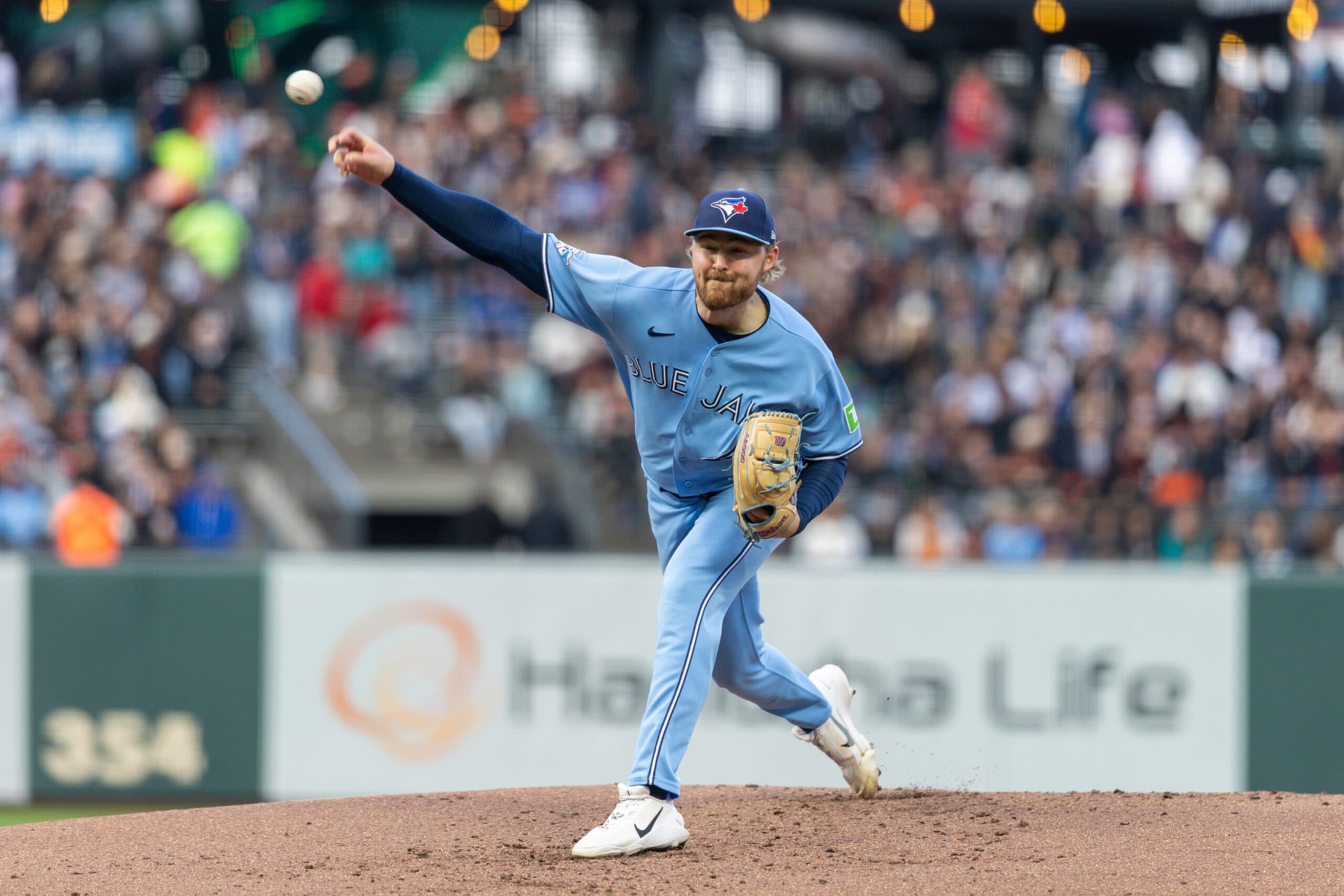
Photo credit: © Bob Kupbens-Imagn Images

Jul 17, 2026, 08:00 EDTUpdated: Jul 17, 2026, 07:03 EDT
Selecting players in the Rule 5 draft is akin to a novice dart thrower stepping up to the board and trying for the bullseye. A brief scroll through the annual selections of past seasons is all it takes to see that success stories are rare.
Teams do their due diligence, and many stellar ballplayers get picked, but the process isn’t far from a crapshoot. It’s hard to find talent when the pool available is made up of players who’ve been left exposed by their own organizations, who theoretically should know them better than anyone else. For example, only two of the 13 players chosen in the 2025 Rule 5 draft have provided positive value to the team that selected them.
Its unpredictability is quite different from the reliable repertoire of up-and-coming Toronto Blue Jays pitcher Spencer Miles, who’s one of those two. Unlike your average bar-going dart-chucker, Miles’ sinker rarely misses. It’s lived in the strike zone 60.7% of the time, well above the league average of 55.8%, and considering the hard-running 96 mph offering has produced a .189 batting average and .249 wOBA from opposing hitters, there’s little reason for him to deviate from his approach.
At the unofficial “halfway” point of the season, not only has the Blue Jays’ 2025 Rule 5 pick remained in the organization, but he’s pitched to a 2.85 ERA with 57 strikeouts and 19 walks over 60 innings. His ERA ranks third among rookies who’ve pitched at least 50 innings, and all the peripherals back it up. He’s striking out batters at an above-average clip, walking less than league average, limiting hard contact and generating loads of ground balls.
By now, we’re likely all familiar with Miles’ lore. After being selected in the fourth round of the 2022 draft, he pitched only 14.2 professional innings in the San Francisco Giants’ minor league system over the next three years. His 2023 season was lost to back surgery — he reportedly had to have a bone growth shaved down that developed because of a previous procedure in high school. Then he missed almost all of 2024 and all of 2025 due to Tommy John.
It was likely only because of this extensive injury history that Miles was left exposed to the Rule 5 draft in the first place. He was excellent in the Arizona Fall League last year after getting healthy, striking out 12 batters and walking only one over 8.2 innings, and that small sample was all the Blue Jays scouting department needed to make the call.
Fast forward a few months, and the Blue Jays, fresh off a World Series appearance and aiming to contend again, made the bold move to use a roster spot on Miles coming out of spring training. It was the right decision.
Any analysis of Miles’ success this season must start with his sinker. It’s the third-best sinker in baseball by Statcast’s run value (after Nolan McLean and teammate Tyler Rogers). Its plus-11 mark is also tied for the 18th-best pitch in baseball alongside Chase Burns’ slider, Shohei Ohtani’s four-seam, and Paul Skenes’ four-seam. Good company.
More, it’s the best pitch on the Blue Jays on a per-pitch basis. Better than Dylan Cease’s fastball or slider; Kevin Gausman and Trey Yesavage’s splitters. It’s understandable, then, that Miles uses it more than any other pitch — it has a 41% usage rate — to fill up the strike zone.
First we have a bunch of sinkers in the zone for easy outs, then, against his old club, the Giants, Miles uses the sinker to get out of a no-outs bases-loaded jam with only three pitches. The offering has induced loads of soft contact.
Miles is in the top 10% of players at limiting barrels, the most dangerous type of contact there is (they have an optimal combination of exit velocity and launch angle and produce a minimum .500 batting average and 1.500 slugging percentage). Add that he’s also in the top 10% of pitchers at generating ground balls, and the result is a recipe for success.
But Miles doesn’t exclusively use the sinker to jam players and get efficient outs. It’s a versatile pitch that he can also dot on the corners to freeze hitters for strike three, either backdoor to righties or front-hip to lefties. (Another thing to watch for in all these clips is how well Miles locates; Almost everything is on the edges.)
And when hitters aren’t weakly rolling it into the ground or watching it catch the zone before walking back to the dugout, the pitch is being fouled off or taken for a called strike as Miles works into an advantageous count. From there, it only gets easier for him to get outs, like these three-pitch strikeouts of Jazz Chisholm and Anthony Volpe with Miles’ second-most-used offering, his curveball. He throws it 26% of the time, and it has the highest whiff rate and put-away percentage of any of his pitches.
But, again, the curve isn’t a one-trick pony. Miles throws it in a variety of situations, from stealing first-pitch strikes, even counts, of course for swing-and-miss with two strikes, and even when he’s behind.
You might be noticing the theme here is — outside of the effectiveness of Miles’ pitches — the versatility of his repertoire. And a versatile pitch mix that can adapt to various types of hitters and lineups is the kind of makeup teams look for in a starter.
Consider that Miles has a distinct approach to both righties and lefties, primarily using his sinker (46% of the time) and slider (24% of the time) to both sides of the plate against same-handed batters, while throwing his curve and four-seam fastball less (17.8% and 11.7%, respectively). Then, when facing lefties, his curveball becomes his most-used pitch at 35.1%, and his four-seam usage jumps to 20.3%, while the sinker (34.5%) and slider (9.6%) are thrown significantly less.
Miles has been far more effective against righties — almost all right-handers are — allowing only a .451 OPS. But he’s also fared very well against the strong side of the platoon, with a .655 OPS allowed against lefties. It’s this kind of versatility that allows Miles to go once or twice through an opposing order. Here’s Miles using all four of his pitches on one at-bat to keep Aaron Judge off balance:
While Miles’ stuff has played as both a traditional, one-inning reliever and as a bulk guy, it’s the latter role where he’s been used more often. After the Blue Jays rotation was beset by injury and a need for innings emerged, Miles rose to the task. The first four bulk outings he threw were all scoreless.
That total amount, 14.2 shutout innings, funny enough, is the same as his entire previous professional total. He allowed only seven hits and four walks while striking out 15 over that span.
And as the need for starters remained and Miles kept producing results, he’s now been thrust from pitching bulk innings behind an opener to straight-up starting games, albeit in a truncated fashion. He threw four innings in his most recent start against the Giants and has maxed out at 4.1 innings and 73 pitches this year. Given the somewhat unprecedented nature of Miles’ leap from next to no minor-league experience to 60 quality big-league innings before the All-Star break, it wouldn’t be surprising if he stayed within those limits.
The Blue Jays have a need in the rotation, but that need will only grow with Kevin Gausman and Shane Bieber set for free agency in the offseason. Barring a big run by a Toronto team that’s often looked listless, and bearing in mind Miles’ profile, it makes sense to play it safe with the 25-year-old and see what they have in him as a bona fide starter in 2027. Getting a young, controllable starting pitcher in the Rule 5 draft? That’s a bullseye.
Breaking News
- Yohendrick Piñango’s bat flashed early-season success in rookie campaign with Blue Jays
- Blue Jays free agent target: Tyler Mahle
- Shane Bieber had his moments but 2026 was largely derailed by injuries
- Blue Jays free agent target: Michael Conforto
- Assessing Andrés Giménez’ chances of winning his fourth Gold Glove